Katie Britt Leads Alabama Delegation Urging Trump to Approve Isaias Disaster Declaration
Alabama’s full congressional delegation, led by Sen. Katie Britt, asked President Trump to quickly approve Gov. Kay Ivey’s request for a major disaster declaration covering 23 counties hit by Hurricane Isaias.
WASHINGTON — Every member of Alabama’s congressional delegation has signed on to a letter asking President Donald Trump to approve Gov. Kay Ivey’s request for an Isaias disaster declaration, telling the White House that the hurricane’s damage has grown beyond what state and local governments can manage on their own.
The letter, led by U.S. Sen. Katie Britt, R-Ala., was sent late last week, shortly after Ivey formally asked the president on Friday for a federal major disaster declaration covering 23 Alabama counties. Seven of those counties — Baldwin, Choctaw, Clarke, Conecuh, Escambia, Monroe and Washington — are in southwest Alabama.
“We write in strong support of Governor Kay Ivey’s request for a major disaster declaration for the State of Alabama following Hurricane Isaias, and we respectfully urge you to approve it without delay,” the nine lawmakers wrote.
As of Monday night, Trump had not responded to the delegation’s request.
A storm that cut across southern Alabama
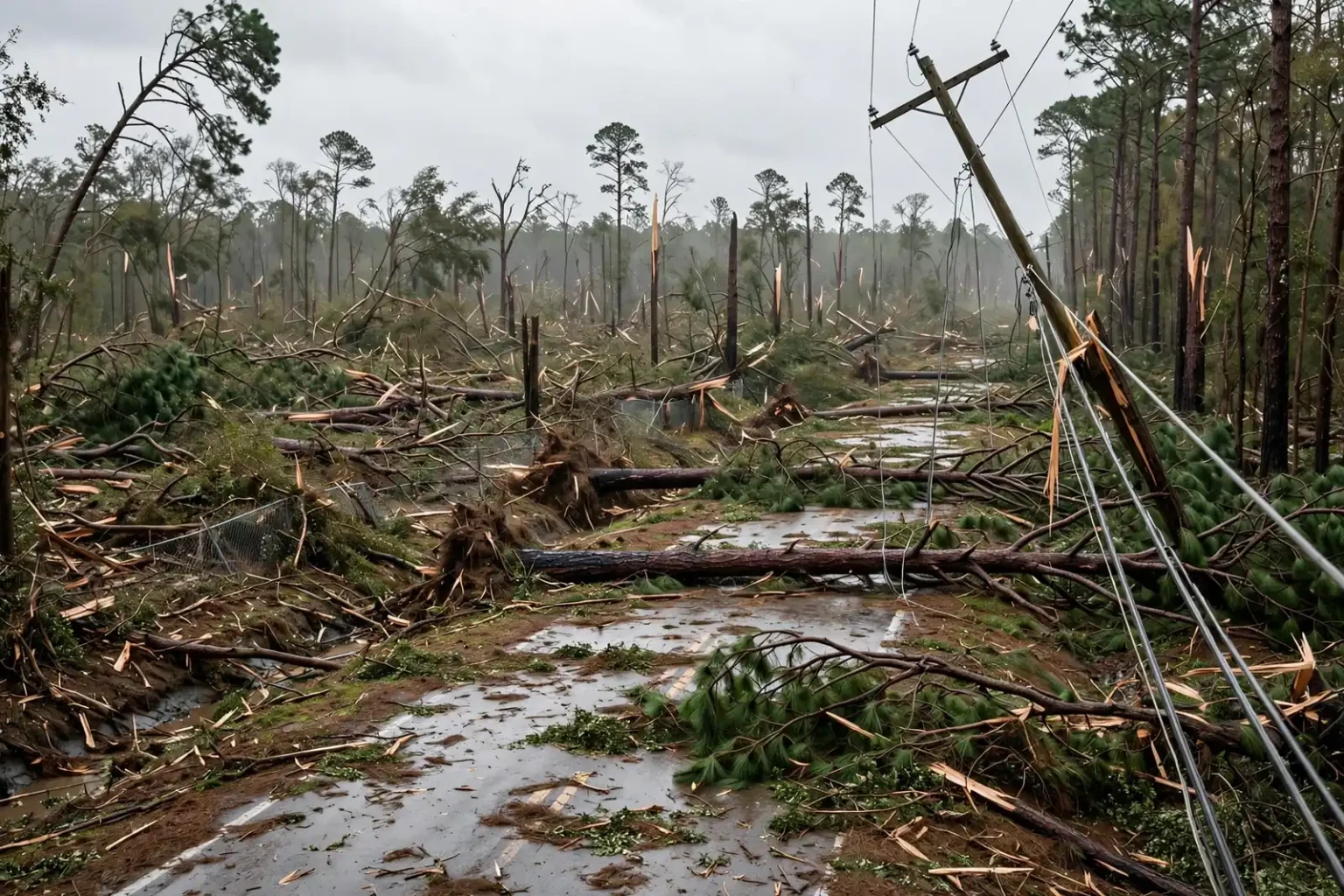
Isaias made landfall on the Gulf Coast on Oct. 9 as a Category 2 hurricane with sustained winds of 105 mph. It then tracked across the southern half of Alabama, damaging homes and businesses along the way. Two Alabamians were killed, and nearly 300,000 customers lost electricity.
Forests took a heavy hit as well. The Alabama Forestry Commission estimated $33.5 million in timber damage in Conecuh, Escambia and Monroe counties alone, a significant loss for rural counties where forestry and timber have long been mainstays of the local economy.
The 23 counties named in Ivey’s request are Baldwin, Barbour, Butler, Choctaw, Clarke, Coffee, Conecuh, Covington, Crenshaw, Dale, Dallas, Escambia, Geneva, Henry, Houston, Lowndes, Marengo, Monroe, Perry, Pike, Sumter, Washington and Wilcox. Mobile County does not appear on that initial list.
The list may not be final. Damage assessments are still underway, and the state may add counties to the request as that work continues, according to the governor’s request.
What the delegation told the president
The letter opens by thanking Trump for approving an emergency declaration for Alabama before Isaias came ashore, a step that allowed federal help to begin flowing as the storm approached.
“Thank you for your swift approval of an emergency declaration for Alabama as the storm approached,” the lawmakers wrote. “That early action made a real difference for our people, and your continued partnership with the Federal Emergency Management Agency remains critical as our communities begin to rebuild.”
The delegation went on to credit the people who have been doing the work of recovery on the ground since the storm passed.
“Alabamians have met this storm the way they always do, by showing up for one another. We are deeply grateful to our first responders, law enforcement officers, linemen, emergency management officials, volunteers, and churches who have worked around the clock to support our communities.”
But the lawmakers argued that local effort alone will not be enough to cover the cost of the cleanup and rebuilding.
“Even so, the Governor and local officials have determined that the scale of this damage exceeds what state and local governments can address on their own,” the letter reads. “A swift evaluation and approval of Governor Ivey’s request for a federal major disaster declaration is essential to helping these families and communities get back on their feet.”
The letter carries the signatures of both of Alabama’s U.S. senators and all seven of its U.S. House members, making it a joint appeal from Republicans and Democrats alike.
Separate appeals from Figures and Sewell
Two Democratic members of the delegation added their own voices beyond the joint letter.
U.S. Rep. Shomari Figures, D-Mobile, sent a separate letter to Trump urging him to approve the request quickly. Figures, who serves on the House Transportation and Infrastructure Committee and the House Agriculture Committee, pointed to the recovery work still ahead.
“While the effects of Hurricane Isaias may continue to impact the state for quite some time, promptly approving this major disaster declaration request will help ensure that the people of Alabama are prepared for the recovery phase ahead,” Figures wrote.
In his letter, Figures singled out two counties in his part of the state. He noted that Conecuh County residents dealt with widespread power outages after the storm and that Monroe County suffered significant damage to power lines and other infrastructure.
U.S. Rep. Terri Sewell, D-Ala., issued a statement Monday saying a declaration could ease the burden on local emergency workers and volunteers who have carried much of the recovery load so far.
“For the past two weeks, Alabamians have joined together to assist their neighbors with supplies and donations,” Sewell said. “Our emergency managers, first responders, and volunteers are doing all they can with the resources available, but the widespread damage created by Hurricane Isaias cannot be reasonably managed without additional federal support.”
Sewell said she shares Ivey’s view that federal help is needed for the hardest-hit areas.
“I agree with Governor Ivey that a Major Disaster Declaration is essential to provide the federal assistance necessary to support our hardest hit communities,” she said. “I am calling on the president to approve this request as soon as possible. The people of Alabama are resilient, and together we will rebuild our communities stronger than ever.”
What a major disaster declaration would do
A major disaster declaration is authorized under the Robert T. Stafford Disaster Relief and Emergency Assistance Act, the federal law that governs how the national government responds to natural disasters. It would allow FEMA and other federal agencies to provide broader aid to areas affected by Isaias than the emergency declaration issued before landfall.
Emergency declarations are generally narrower in scope. They are designed to support urgent, short-term work such as protecting lives and property and preparing for a storm’s arrival. A major disaster declaration opens the door to longer-term recovery programs.
Ivey’s request asks FEMA for two main types of help, according to the state:
- Public Assistance, which would help local governments and eligible nonprofit organizations pay for storm-related costs. Under federal rules, this program commonly covers expenses such as debris removal, emergency response work and the repair of damaged public facilities like roads, bridges and buildings, with the federal government paying at least 75% of eligible costs.
- Individual Assistance, which would provide help directly to affected households. Depending on what is approved, this program can include grants for temporary housing and home repairs and help with other serious disaster-related needs not covered by insurance.
Approval of a request does not automatically mean every program is available in every county. When a declaration is granted, FEMA specifies which counties are designated and which types of assistance each one is eligible to receive. Additional counties and programs can be added later as assessments are completed.
How the process works
Under the Stafford Act, only a state’s governor can request a major disaster declaration, and only the president can grant one. Before a request is submitted, state, local and federal teams typically survey the damage together in what are known as preliminary damage assessments. Those surveys estimate the cost of the damage and the effect on residents, and they form the backbone of the governor’s request.
Once submitted, the request is reviewed by FEMA, which weighs factors such as the estimated cost of the damage relative to the state’s population, the amount of insurance coverage in place and the overall impact on the affected communities. FEMA then sends a recommendation to the president, who makes the final decision. There is no fixed deadline for the White House to act.
That is why the delegation’s letter emphasizes speed. Local governments in the affected counties have been paying for debris pickup, overtime and emergency repairs since the storm, and many households are still dealing with damage to homes and property. Until a declaration is approved, the federal recovery programs described in Ivey’s request are not available.
What residents can do now
While the request is pending, emergency management officials generally advise storm-affected residents to take steps that will make any future assistance claims easier:
- Photograph and document all damage to homes, vehicles and other property before making permanent repairs.
- Keep receipts for cleanup supplies, temporary repairs, tree removal, lodging and other storm-related expenses.
- File claims with homeowners, renters or flood insurance companies as soon as possible, since federal aid generally does not duplicate insurance payments.
- Watch for announcements from county emergency management agencies and the state about whether a declaration has been approved and which counties are included.
If Individual Assistance is approved for a county, residents there would typically apply through FEMA at DisasterAssistance.gov, through the FEMA mobile app or by calling the FEMA helpline at 1-800-621-3362.
For now, Alabama officials from both parties are making the same case to the White House: that the communities hit hardest by Isaias, from Baldwin County to the Wiregrass, need federal help to finish the job of recovering.