Brewton Alabama Power Linemen Dug Out of Their Own Storm Damage to Restore Power After Isaias
Alabama Power linemen Kaleb Fain and J.D. Sutton had to chainsaw their way out of their own Brewton-area properties after Hurricane Isaias before spending long days restoring power to neighbors.
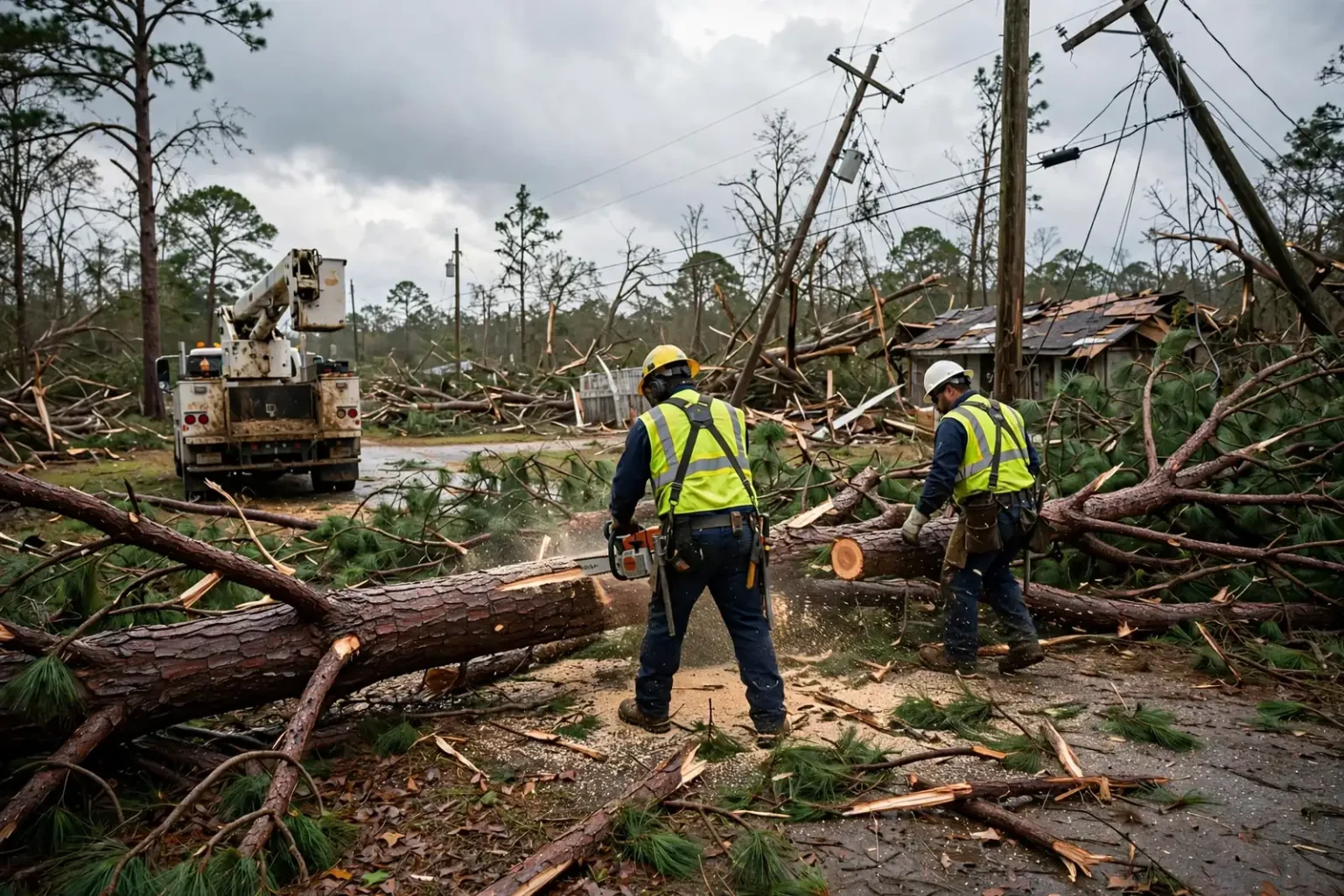
BREWTON, Ala. — When Hurricane Isaias tore through Escambia County this month, two Brewton Alabama Power linemen faced the same impossible choice as many of the customers they serve: stay home and dig out, or go to work restoring power for everyone else. Kaleb Fain and J.D. Sutton did both, cutting their way out of driveways blocked by fallen pines before spending long days and nights rebuilding the local electric system, even as their own homes and property sat damaged.
Both men are local operations linemen with Alabama Power, and both have worked storms across Alabama and in other states. They say Isaias, which struck closer to home than either expected, has given them a new understanding of what the people they help are going through.
A breezy evening turns frightening
Fain began the night of Friday, Oct. 9, watching the outer bands of Isaias reach his home near Brewton. He and his daughter and son were actually enjoying the breeze, a welcome relief from heat that had lingered into October.
He was also relieved. The storm’s expected landfall had shifted east, which would put Brewton on the west side of the hurricane’s eye. Alabama meteorologist James Spann often sums up hurricane risk with the phrase “west is best, east is the beast,” though he is quick to add that there is no truly safe side of a hurricane.
Fain found that out as he watched the top of a tree snap off and whip around in the wind. He hurried his family inside, and they braced for the worst. Through the night he could hear trees cracking and crashing down outside, flinching at each sound and half expecting one to come through the house.
A long night on the farm
About 2.5 miles to the north as the crow flies, Sutton was making last-minute preparations at his home and farm. He checked on his wife and son and on his cows, goats and chickens.
Sutton had spent that day on the job, repairing early outages in the Brewton area caused by the storm’s outer bands until conditions became too dangerous to keep working. On the way home, he had to cut and drag two trees out of the road.
Like Fain, he went to bed hoping the worst of the storm would pass well away from Brewton. Both men expected to report at 6 a.m. Saturday to help restore service.
It was not a restful night. Three separate times, the Suttons retreated to their storm shelter, afraid the roof was about to be torn from the house.
At 11 p.m., Sutton took his side-by-side out to check on his animals. Roughly half of the trees on the 30 acres that make up most of his farm were down. Fences were broken, and he had to herd his 18 head of cattle and 10 goats into a smaller space.
“I could already tell it was bad, even in the dark,” he said.
For a while he could account for only 17 cattle. Eventually a calf emerged from the wood line, visibly shaken.
Sutton then drove to a campground on his property, where several people from Pensacola had come to ride out the hurricane, not expecting Brewton to take such a blow. Everyone there was safe, though the wind had flipped an empty camper onto its side. Sutton spent the rest of the dark hours searching for any clear path to the road. He found none.
Cutting their way out
Daylight showed that neither man could get out to the road.
At Fain’s home, trees had fallen on his shop and wind had stripped shingles from his roof. He had no power and no water. The biggest problem was a tangle of large pines blocking his driveway.
“It was overwhelming,” he said. “You almost didn’t know where to start.”
He grabbed his chainsaw and went to work. A neighbor arrived with a tractor, and after a few hours Fain was able to get out.
Sutton was boxed in even more tightly. He began cutting, but the job seemed endless.
“The more you cut, the more you feel like you ain’t getting nowhere,” he said.
All the while his phone kept ringing with calls from Brewton officials asking whether he would be able to help assess the damage. Road crews finally reached his farm, and shortly after noon Sutton was on the job for Alabama Power.
Help from an unexpected place
Fain and Sutton worked alongside Alabama Power crews from other parts of the state, and eventually from other states, as word spread about how badly Brewton and the surrounding area had been hit.
For Fain, the hardest part was not knowing what was happening at home. His wife was out of the country visiting their oldest daughter, which left their 15-year-old daughter and their son, home from Auburn for fall break, alone at the damaged property. Rain kept falling, and he worried about the roof and the trees resting on his shop.
He remembered hearing at a recent safety renewal meeting about an employee assistance hotline that Alabama Power provides. Asking for help did not come naturally.
“I’ll always help anybody, but I’m the last person to ask for help,” Fain said.
He called anyway and explained his situation. He was told not to worry and that something would be done.
“When I pulled back home that night, the trees were off my shop and tarps were covering all of the damage on the roofs,” Fain said. “I couldn’t believe it.”
Days of rebuilding the system
What followed for both linemen were long days stretching deep into the night. Trees had to be cleared, broken poles replaced and downed lines restrung before power could flow again, and the extensive work took days.
Isaias affected service for more than 400,000 Alabama Power customers. According to the company, 95% of them had power restored within 48 hours of landfall. The last 5%, including customers in the hardest-hit areas around Brewton, were restored by Oct. 14. Cleanup and restoration continued through that week as more extensive repairs were made to some homes so they could safely be reconnected.
The storm damaged both transmission and distribution equipment in and around Brewton. In Brewton, East Brewton, Castleberry, Pollard and parts of Conecuh County, more than 4,400 customers lost power.
Restoring an electric system after a major storm generally follows a set order. Crews first repair the high-voltage transmission lines and substations that feed whole communities, then the main distribution lines that serve the largest numbers of customers, and finally the smaller lines and individual service connections that reach single homes. Homes with damage to their own electrical equipment, such as a broken weatherhead or meter base, often must be repaired by an electrician before the utility can safely reconnect them.
That last category is where Sutton is still working. More than two weeks after the storm, he continues to troubleshoot problems around Brewton and to identify homes that until now could not safely receive power because of the damage they sustained.
Neighbors helping neighbors
Both men say they have been repeatedly impressed by the way neighbors have stepped up to help them and others, even as the cleanup in Brewton is expected to take much longer.
Fain said he was blown away by the sight of neighbor helping neighbor across the community. For both linemen, living through the storm as homeowners has changed how they see the work they have done for years.
“Of all of the storms I’ve worked, I now have an even better understanding of what people are going through,” Fain said.
Sutton said he hears the same thing from residents nearly everywhere he goes, and he has a ready answer.
“Everybody tells me, ‘Thank you for getting the lights on,’” Sutton said. “I tell them, ‘Thank you for being patient.’”
Staying safe during storm cleanup
As Brewton-area residents continue to clear debris, utility safety guidance remains important:
- Treat every downed power line as energized and dangerous. Stay far away and report it to the utility.
- Do not cut or move trees that are touching or tangled in power lines.
- Never run a portable generator indoors or in a garage, and do not connect one directly to household wiring without a properly installed transfer switch, which can send electricity back into utility lines and endanger line workers.
- If a home’s electrical equipment was damaged, have it inspected and repaired by a licensed electrician before service is restored.