Hour-Long Waits and Longer Walks: Penn Seeks Answers on Second Line Transit Delays
Councilman Cory Penn has requested information on Mobile's new Second Line Transit system after riders reported buses running up to 90 minutes late, missed work and longer walks to stops.
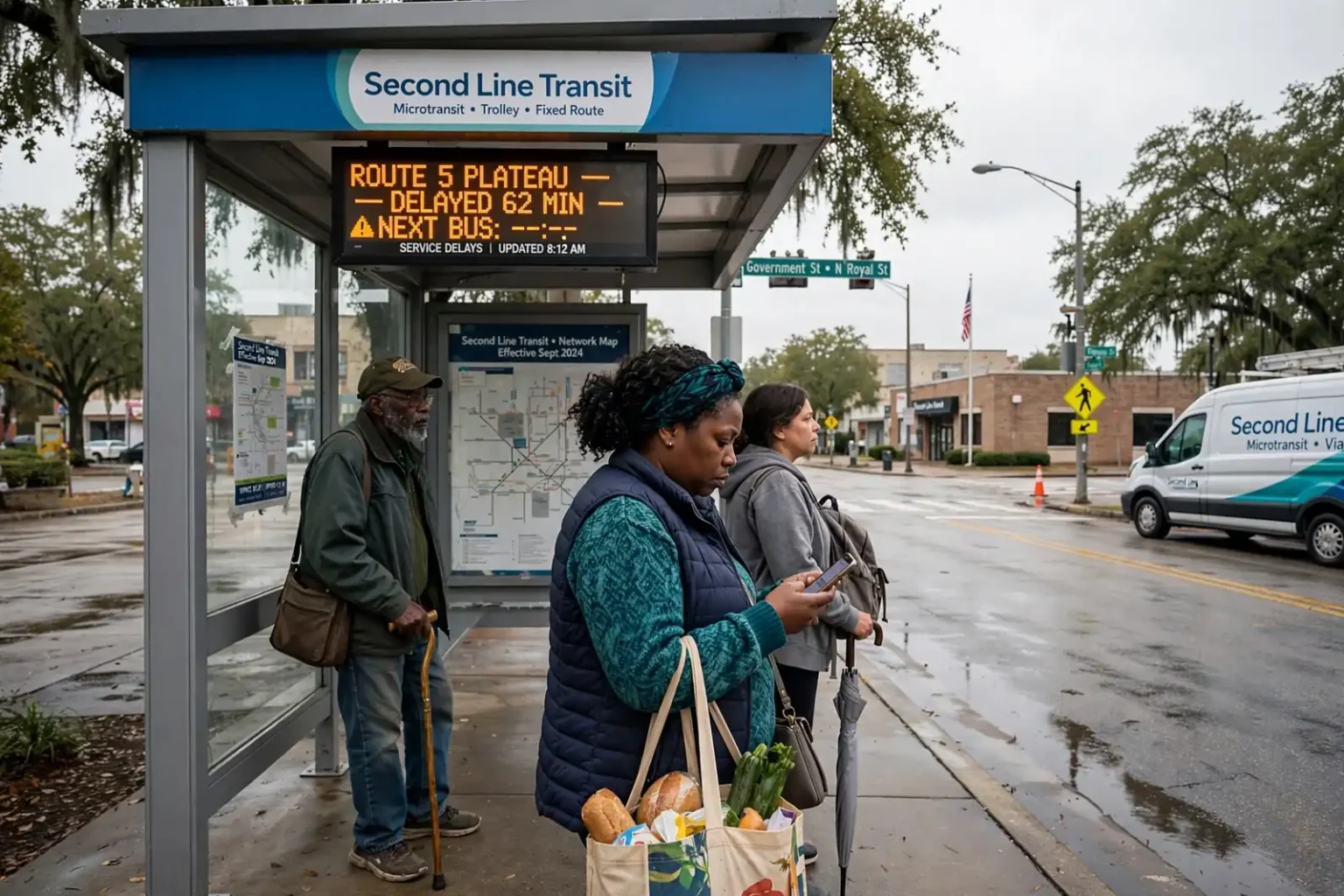
MOBILE, Ala. — Two weeks after Mobile’s redesigned bus network rolled out, District 2 Councilman Cory Penn is asking the city for answers about Second Line Transit delays, after riders told him about buses running far behind schedule, missed shifts at work and longer walks to reach their stops.
Penn raised the issue at the City Council’s pre-council meeting on Wednesday, Oct. 14, saying he had received emails and seen videos from frustrated riders. He said he has formally requested information about the system so the council can respond to the concerns.
Riders describe late buses and missed work
Mobile resident Valenia Green said she has heard from people who were late to work or missed work entirely because of the delays.
“People saying that they were late to work and missed work, and then I had a lady that’s sitting in an audience that talked about her mother going to see her mother at the hospital, and the bus was an hour and 30 minutes late,” Green said.
Residents have also raised questions about whether the system has enough vehicles in service to keep buses running on time.
‘I have to walk almost a mile’
For some daily riders, the problem is not only late buses but where the new routes drop them off. Leroy Williams said the redesign has made his commute harder.
“I was catching the Plateau bus, and it put me closer to my job. But now I have to walk almost a mile to get to work. It’s inconvenient for me at my age, you know,” Williams said. “I think the old system was better than this. It’s just worse for me, you have a long way to walk, they put you out further.”
Route changes that lengthen the walk to a stop can be a significant burden for older riders, people with disabilities and anyone carrying groceries or traveling with children, especially in Mobile’s heat and frequent rain.
Penn asks for data
Penn said residents have been contacting him directly, and he wants the administration to provide information that addresses the issues they have raised.
“I have requested the Second Line Transit information in pre-council to get all the information that you asked about, you talked about. I requested that, and so hopefully we’ll have some feedback so we can solve some of those issues you spoke about,” Penn said.
Pre-council sessions are the council’s morning work meetings, where members discuss agenda items and ask questions of the mayor’s administration before the regular meeting. Requests made there often lead to presentations or written responses from city departments at later meetings.
What changed with Second Line Transit
Second Line Transit replaced the city’s former bus service when it launched in late September. The rebranded system combines consolidated fixed bus routes, a trolley-style bus and app-based microtransit vans that pick riders up on request within defined zones. New York-based Via Transportation manages the system under a contract the council approved last year.
The redesign also folded in MoGo Rideshare, an on-demand service the Mobile Area Chamber Foundation launched in 2024 to help residents reach jobs and training. MoGo became Second Line Microtransit in September.
Before the launch, the city reported 561,000 riders from October through August and said Via had improved on-time performance by 60 percent. The city noted those gains came before new vehicles entered service and before the expansion of microtransit took effect.
Concerns raised before the launch
The shift has drawn questions from the start. When the first trolley went into service at the beginning of October, Mobile County NAACP President Robert Clopton, who served on the steering committee for the transit changes, said his organization was taking a “wait-and-see” approach. He voiced concern for riders in and around Prichard and on the outskirts of the city, where some areas rely on microtransit rather than fixed bus or trolley service, and said seniors and others would need training to use the new system.
Mayor Spiro Cheriogotis acknowledged at the time that the change would be difficult for some riders. He has made trolley-style buses a centerpiece of his transit plans and has said he hopes the city will have 10 to 12 trolleys by the end of the current fiscal year. In September, the council approved an application for up to $1.36 million in Federal Transit Administration money for five more trolleys after District 4 Councilman Ben Reynolds urged the administration to “put the brakes on” and measure results first. That grant has not yet been awarded.
What riders can do now
Riders who are having trouble with the new system have several options while the council waits for answers:
- Contact your council member: Penn and other members said they are collecting complaints. Specific details such as route, stop, date and time help officials track problems.
- Check routes in advance: Second Line Transit offers an app that shows routes and stops and can be used to book microtransit rides.
- Attend council meetings: The Mobile City Council meets weekly at Government Plaza, and residents can address the council during public comment.
What happens next
Penn’s request puts the system’s early performance on the council’s radar just weeks into its rollout. It is not yet clear when the administration or Via will respond, or whether the city will release updated ridership and on-time figures for the new network. Riders like Green and Williams say they hope the answers come quickly, because for them the stakes are as basic as getting to work on time.