

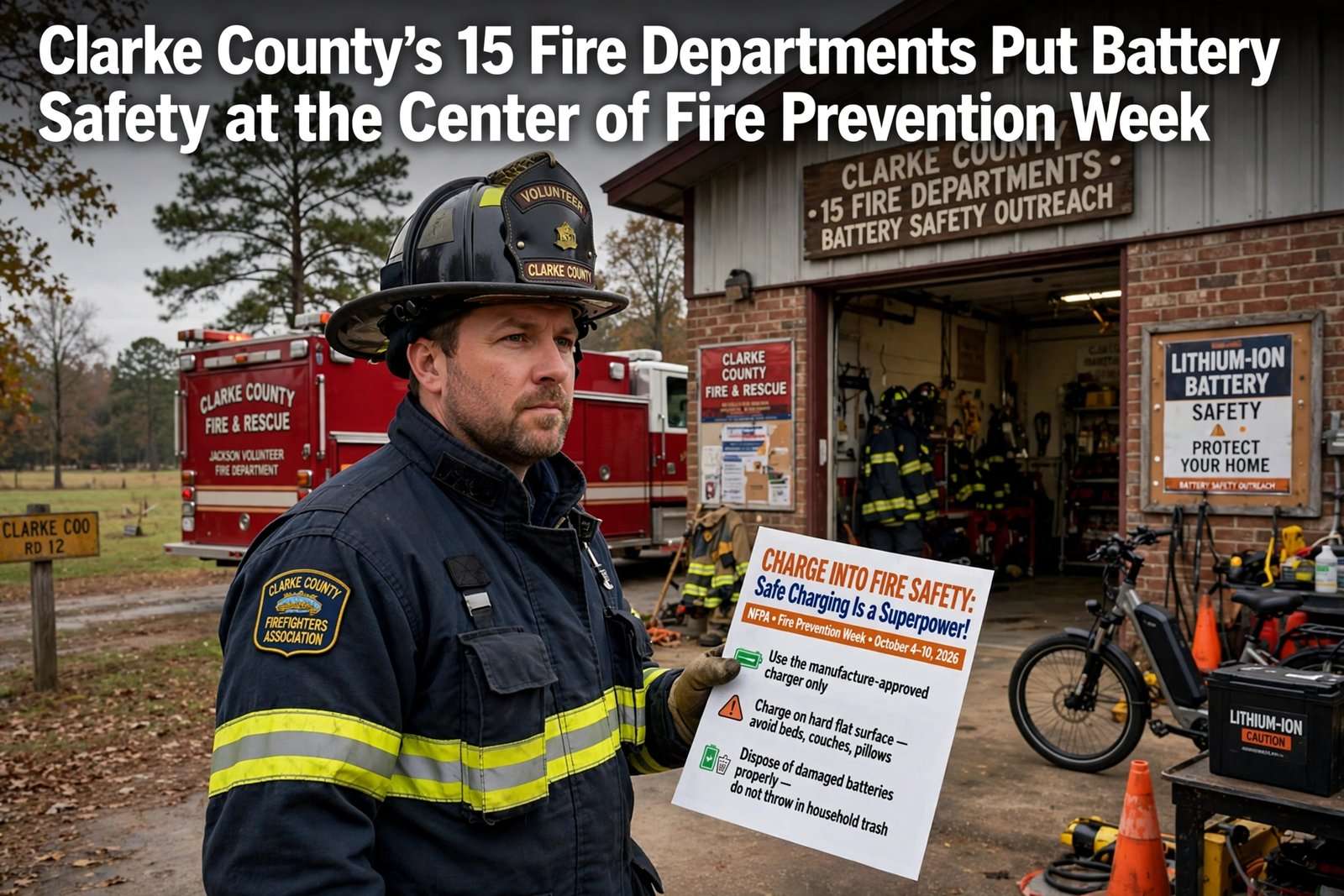
Fire departments across Clarke County will spend the first full week of October talking about something most households now plug in every night: lithium-ion batteries.
Fire Prevention Week runs Oct. 4-10, and this year’s national campaign centers on the growing fire risks tied to the rechargeable batteries that power phones, laptops, power tools, toys, e-bikes and scooters. The National Fire Protection Association, which sponsors the annual observance, has branded the 2026 campaign “Charge into Fire Safety: Safe Charging Is a Superpower!”
In Clarke County, the message will be carried by a network of 15 fire departments, most of them staffed largely by volunteers who answer fires, medical emergencies and other calls for help across one of southwest Alabama’s most rural counties.
A week of education, not just alarms
During Fire Prevention Week, firefighters and fire departments throughout the country run educational programs aimed at both children and adults. The goal is twofold: teach people how to keep fires from starting in the first place, and make sure they know what to do if one breaks out anyway.
Those programs take many forms. Some departments visit classrooms and let students tour fire trucks. Others hold open houses, demonstrate equipment or hand out safety materials at community gatherings. In Jackson, for example, the volunteer fire department will mark the week with church inspections and its annual Fire Prevention Parade on Oct. 7.
For rural departments, that outreach carries special weight. When a fire station is miles away and the crew responding is made up of volunteers leaving their homes and jobs, the minutes it takes to arrive can matter. Fires that are prevented, or caught early by a working smoke alarm, are the ones that never become tragedies.
Why lithium-ion batteries are the focus
Lithium-ion batteries have become one of the defining technologies of modern life. They store a large amount of energy in a small, light package, which is why they are found in nearly every portable device a household owns.
That same energy density is what makes them a hazard when something goes wrong. A battery that is damaged, poorly made, overcharged or charged with the wrong equipment can overheat. In the worst cases, the battery can enter what engineers call thermal runaway, a chain reaction in which heat builds faster than it can escape. The result can be a fire or even an explosion, and battery fires can be difficult to put out and can reignite.
The NFPA has noted that because lithium-ion batteries are a relatively new technology, many people are unaware of the dangers they can pose, particularly when it comes to charging. “Because lithium-ion batteries are a newer technology, not everyone is aware of the potential dangers they present, particularly when it comes to charging them safely,” Lorraine Carli, the NFPA’s vice president of outreach and advocacy, said in announcing this year’s theme.
Fire departments and news organizations nationwide have reported a growing number of fires linked to the batteries, particularly in e-bikes and e-scooters, whose large battery packs hold far more energy than a phone.
Safe charging habits
The 2026 campaign emphasizes simple steps people can take every time they plug in. Among the NFPA’s recommendations:
- Use the charging cord and charger that came with the device, or a replacement approved by the manufacturer.
- Charge devices on a hard, flat surface such as a table or desk. Avoid charging on beds, couches or under pillows, where heat can build up.
- Stop using a device that feels hot, starts to swell, smokes or gives off an unusual smell.
- Unplug devices once they are fully charged.
- Charge larger items, such as e-bikes, scooters and power tools, outdoors and away from exits.
- When charging on an airplane, keep the device where it can be seen.
Firefighters also urge residents to dispose of old or damaged batteries properly rather than tossing them in household trash, where they can be crushed and ignite in garbage trucks or landfills.
Clarke County’s 15 fire departments
Clarke County’s fire protection comes from a patchwork of departments spread across its towns and rural communities. Local fire departments coordinate with the Clarke County Emergency Management Agency and the county’s E-911 system to provide emergency response in both incorporated towns and unincorporated rural areas.
The county’s volunteer fire departments and firefighter organizations include:
- Antioch Volunteer Fire Department, Grove Hill
- Grove Hill Volunteer Fire Department
- Helwestern Volunteer Fire Department, Grove Hill
- Clarke County Firefighters Association, Grove Hill
- Coffeeville Volunteer Fire Department
- West Bend-Bethel Volunteer Fire Department, Coffeeville
- Fulton Volunteer Fire Department
- Jackson Volunteer Fire Department
- Alma Volunteer Fire Department, Jackson
- Salitpa Volunteer Fire Department, Jackson
- Winn Volunteer Fire Department, Jackson
- Thomasville Volunteer Fire Department
- Opine-Tallahatta Springs Volunteer Fire Department, Thomasville
- Scyrene-Chance Volunteer Fire Department, Dickinson
- Tri-County Volunteer Fire Department, Whatley
The list reflects the geography of the county. Clarke County stretches across a wide swath of southwest Alabama between the Tombigbee and Alabama rivers, with much of its land in timber and farms. Its population is concentrated in a handful of towns, including Jackson, Thomasville and the county seat of Grove Hill, while many residents live along county roads miles from the nearest town.
The volunteer model
Most of the nation’s fire departments are staffed entirely or mostly by volunteers, and that is especially true in rural areas. Volunteer firefighters train for structure fires, vehicle crashes, brush fires and medical calls, often while holding full-time jobs. Many departments rely on fundraisers, donations and grants to buy and maintain equipment, from turnout gear to fire engines.
That arrangement makes community support a practical matter. Residents who attend a fish fry, buy a raffle ticket or answer a fundraising letter are helping keep trucks on the road and gear in good condition. And residents who follow safety advice, such as testing smoke alarms and charging batteries carefully, reduce the number of calls volunteers must answer in the middle of the night.
A tradition more than a century old
Fire Prevention Week is the longest-running public health observance in the United States. It traces its roots to the Great Chicago Fire, which began on Oct. 8, 1871, and burned for more than a day, killing hundreds of people and leaving tens of thousands homeless. The NFPA began sponsoring a fire prevention observance in the early 20th century, and since 1925 every U.S. president has signed a proclamation declaring a national Fire Prevention Week. The observance is always held during the week that includes Oct. 9.
Each year’s campaign spotlights a different risk. Past themes have covered cooking safety, smoke alarms and home escape planning. This year’s focus on batteries reflects how quickly household hazards change as technology does.
What residents can do this week
Beyond safe charging, firefighters typically use Fire Prevention Week to remind households of a few basic steps:
- Make sure smoke alarms are installed on every level of the home, inside and outside sleeping areas, and test them monthly.
- Plan and practice a home escape route with two ways out of every room, and choose a meeting place outside.
- Keep anything that can burn away from space heaters and stoves.
- Know how to call 911 and be able to give a clear address, which matters in rural areas where homes can be hard to find.
Residents with questions about fire safety, or who want to support or volunteer with a local department, can contact the fire department serving their community or the Clarke County Emergency Management Agency.