Prichard Opens Its Battle Against Blight With Demolition on West Main Street
Prichard Mayor Troy Ephriam launched the city's Battle Against Blight in July 2014, watching crews tear down a fire-damaged house on West Main Street, the second of seven buildings targeted for demolition.
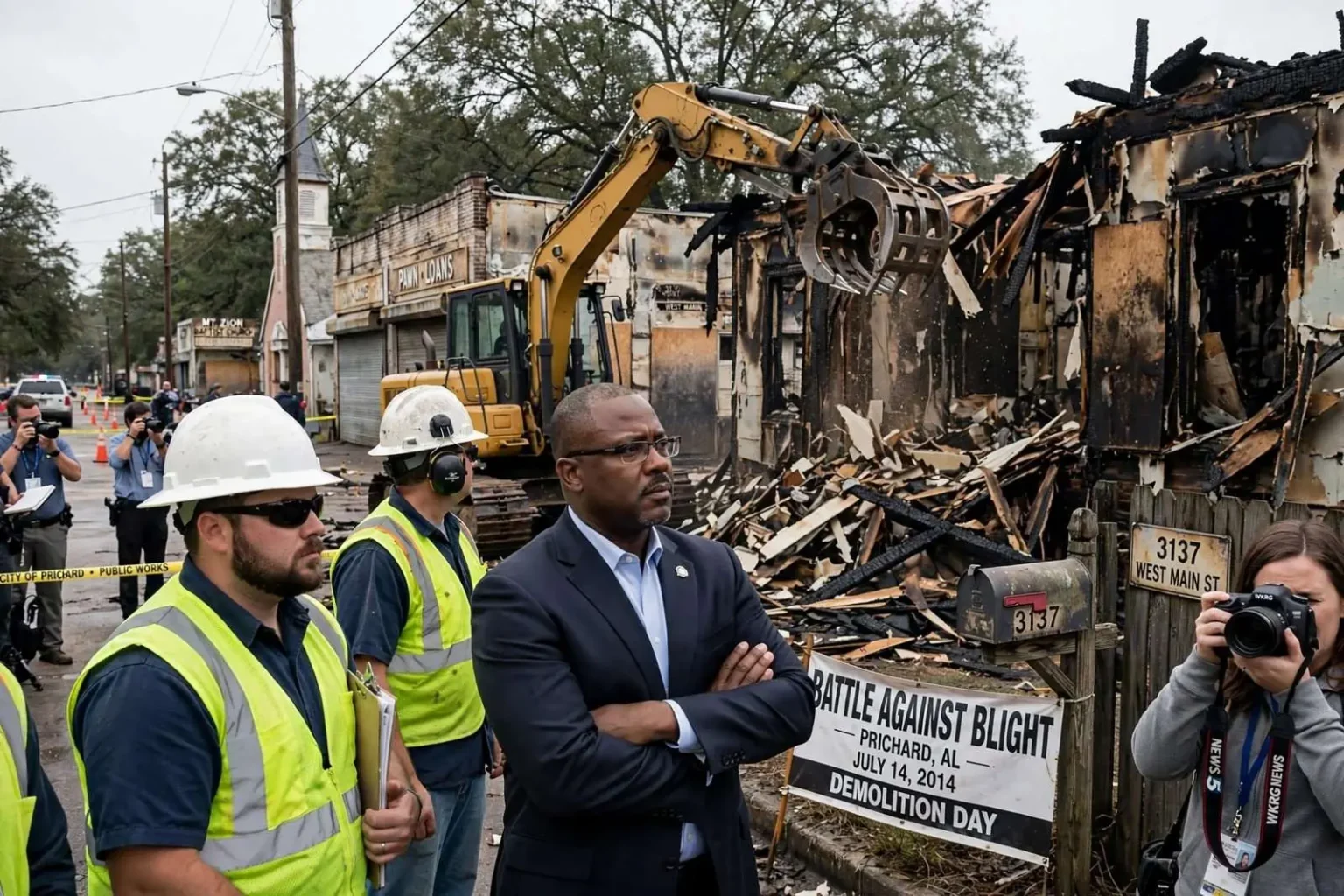
Prichard Mayor Troy Ephriam stood alongside city workers on Monday, July 14, 2014, watching as a crawler loader tore into an abandoned house at 3137 West Main St. The fire-damaged structure, empty for several years, was the second of seven buildings marked for demolition under the city’s new campaign, the Battle Against Blight.
West Main Street is one of Prichard’s oldest corridors, a road lined with the churches, storefronts and frame houses that housed the city’s growth decades ago, and the fire-damaged house at its 3100 block had stood as the kind of landmark no community wants — a structure that had been scorch-marked and vacant so long it had become part of the streetscape’s furniture.
A public start to a long-term plan
Several media outlets lined Main Street to record the demolition, but the mayor said his hope was that the work would eventually become routine enough to draw little notice. “I want this to be the norm,” Ephriam said. “This is the beginning of a consistent comprehensive plan. This time next year, we’re going to have these properties ready for re-use.”
The remark inverted the usual logic of a ribbon-cutting. Most city halls stage a demolition precisely once, for the cameras, and the program behind it fades into the budget process. Ephriam was arguing for the opposite: that the first teardown should be unremarkable, the second more so, and that by the following summer the sight of a city loader on an empty lot ought to signal ordinary government maintenance rather than a special initiative.
For a city that had wrestled with abandoned and deteriorating buildings for years, the campaign represented an effort to move from talking about blight to visibly removing it, one lot at a time.
Prichard’s struggle with abandonment is the product of a long arc. The city just north of Mobile grew rapidly in the middle decades of the twentieth century as workers settled near the shipyards and industrial jobs along the Mobile River, then lost population and investment over the decades that followed as the economy shifted and residents moved outward. Buildings that emptied were not always replaced; some were left to weather, and weathering became deterioration, and deterioration became the fire-damaged hulks that the city now began removing.
Every city that has faced the same arc has learned the same lessons: an abandoned structure is rarely a static problem. It attracts vandalism and arson, depresses the values of the houses around it, and eventually becomes expensive either to tear down or to keep. The cost of inaction accrues silently, block by block, until a city decides to pay down the debt all at once.
Turning empty lots into something useful
City officials said the goal was not simply to knock down structures but to prepare the cleared land for new life. Ephriam said the plan was to steer the properties toward residential and commercial development, depending on where each parcel sat and how it was zoned.
“Based on the areas and where they’re located, if they’re in areas where it’s commercial or light industrial, we’d like to, hopefully, recruit and market some productive re-use for those particular locations under the current zoning areas,” the mayor said. “But if they’re residential areas, hopefully we can get the citizens to come together, help us keep the property cleared off, and maybe turn it into a community garden or just a nice sitting park — whatever we can do to try to bring something positive after we eliminate the negative.”
The two-track strategy reflected the practical geography of a shrinking industrial city. Commercial and light-industrial parcels along the main corridors are the easiest to market — a cleared, titled lot on a main road is a product a broker can show — while residential lots in older neighborhoods rarely attract builders in the current market, and leaving them empty invites the return of the very problem the city is solving.
The community-garden vision answered that second problem. A mowed, tended lot with raised beds or benches requires no developer, no mortgage and no market; it requires only neighbors willing to keep the grass down and claim the space as theirs. Cities across the country have used the model to hold residential neighborhoods together while the stronger market recovers, and the mayor’s phrasing — “bring something positive after we eliminate the negative” — placed Prichard in that tradition.
That vision asked residents to become partners in the effort, tending cleared lots and helping neighborhoods reclaim spaces that had long been sources of frustration and safety concerns. The success of the program, in other words, would be measured not at the moment the loader finished its work but in the seasons after, when the city would learn whether the lots it cleared stayed cleared.
Partnership of that kind also serves a legal and civic purpose. Demolition without a plan for the ground beneath is how cities end up re-clearing the same lots a few years later; a lot adopted by neighbors is a lot with eyes on it, and a nuisance structure that is replaced by a garden is a nuisance that does not return.
A schedule of demolitions
The demolition on West Main Street was only the beginning. City officials said the work would continue through mid-August, with additional structures coming down on a set schedule. The next demolition was planned for July 21 at 4008 West Main Street.
Seven buildings in a single summer is a modest number measured against the scale of abandonment in an older city, and Prichard’s officials did not pretend otherwise. What the schedule represented was process rather than volume — a calendar, announced in advance, with addresses named — so that residents, reporters and the property owners themselves could see the order in which the city intended to work.
The announcement of the next address a week ahead was itself a small departure. Published schedules put property owners on notice that their buildings were on a list, and they give city workers a rhythm: survey, clear utilities, post the structure, demolish, haul, grade. Demolition, done lawfully and safely, is mostly paperwork and preparation with a few loud hours in the middle.
By laying out a calendar rather than acting on a single property, Prichard signaled that the Battle Against Blight was meant to be a sustained program. The mayor framed it as the opening phase of a broader strategy to reshape the look and the future of the community.
A named campaign does work that a line item in a budget cannot. “Battle Against Blight” gave the city’s effort a handle — something for residents to join, for churches to organize around, for the code enforcement office to identify its work by — and it set a public expectation that the city’s own leaders had staked their credibility on keeping.
Why blight mattered in Prichard
Abandoned and fire-damaged buildings had long been a challenge for Prichard, weighing on property values, discouraging investment and raising concerns about safety in neighborhoods where empty houses sat for years. Clearing them, city leaders argued, was a necessary first step before the land could attract new homes, businesses or public green space.
The economics of blight are unforgiving in a small city. A vacant, deteriorating house does not pay taxes commensurate with what it costs the city in fire runs, police calls and grass-cutting contracts, and it drags down the assessments of every well-kept house on its street. Prospective homeowners comparison-shopping in the Mobile area drive past the sagging porch and cross the neighborhood off the list. The blighted structure is, in effect, a tax levied on everyone who kept up their property.
Safety is the other half of the ledger. Unsecured structures draw trespassers, and fires in vacant buildings are among the most dangerous calls a fire department answers — crews arriving at a building with no occupant to save, no owner to answer questions and a structure already weakened by decay. A fire-damaged house that has already burned once, like the one at 3137 West Main St., is a known hazard by definition.
Ephriam’s emphasis on making demolition routine underscored the scale of the task. Seven buildings marked for removal in a single summer represented a start, and the mayor made clear he intended the pace to continue well beyond the initial round.
As the crawler loader worked through the structure on West Main Street that Monday, the message from City Hall was that Prichard intended to keep at the effort, treating each cleared lot as an opportunity rather than simply an absence. The measure of success, Ephriam suggested, would come the following year, when he hoped to point to properties ready for re-use rather than ruins waiting to come down.
That twelve-month deadline gave the campaign its yardstick. Demolition alone is easy to count — structures removed, lots cleared, dollars spent — but the mayor’s standard asked a harder question: what had the city done with the ground? A lot marketed to a light-industrial tenant, a garden tended by a church, a sitting park with benches under the oaks — any of those would count as “ready for re-use.” A lot that grew back up in weeds would not.
The Battle Against Blight, as it was framed on that July morning, was Prichard’s attempt to answer a question every small city with an industrial past eventually faces: whether the buildings the economy left behind can be turned back into assets, and whether a city government with limited means can lead that work. The crawler loader on West Main Street was, in the end, a small machine doing a small piece of that answer — one address on a list, on a schedule the city had published for everyone to see, with six more to follow before the middle of August and, the mayor intended, a great many more after that.