Fire Tears Through Balcony at Maison DeVille Apartments in Mobile
Mobile Fire-Rescue responded to a balcony fire at Maison DeVille Apartments that spread through a second-floor unit, forcing an evacuation.
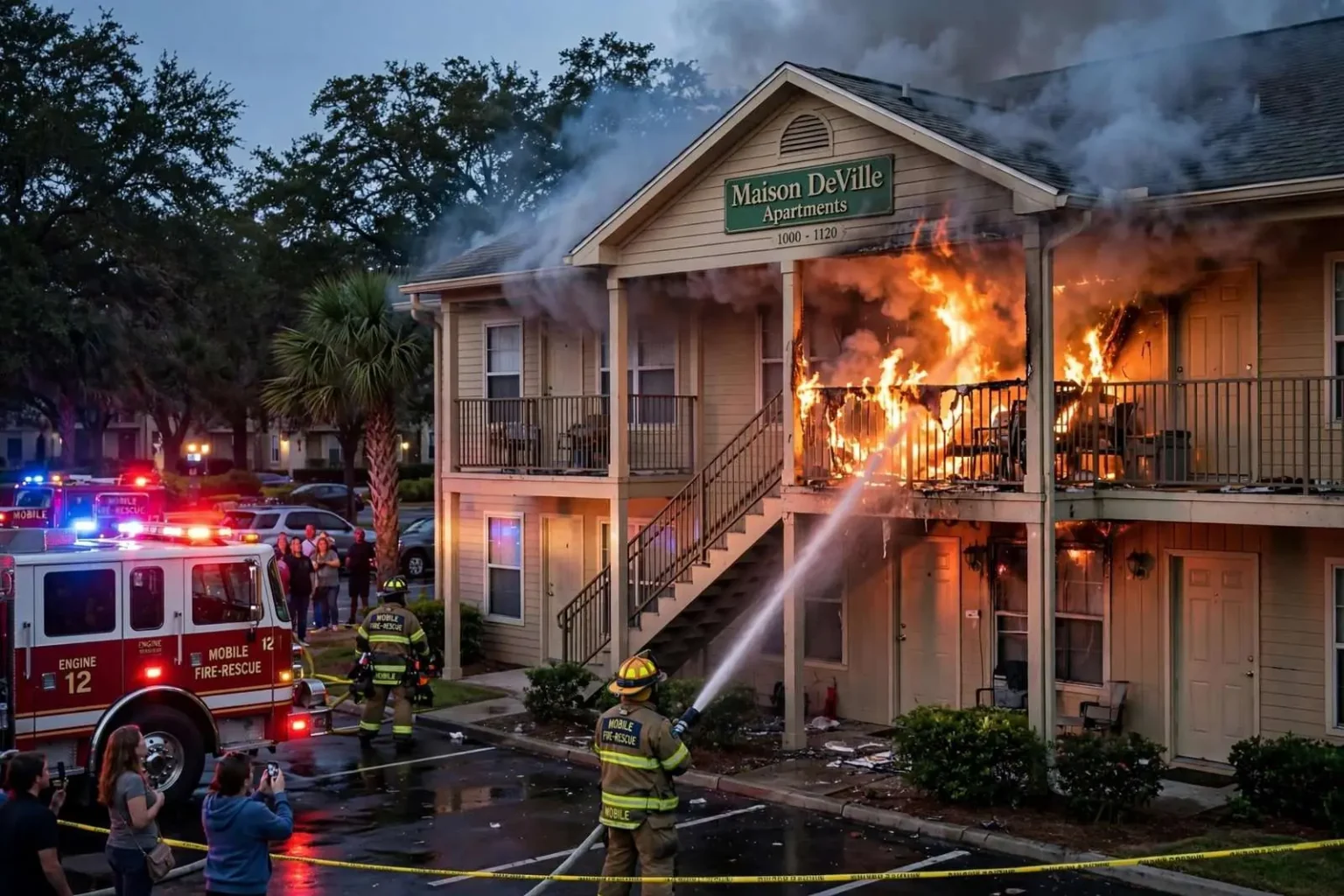
MOBILE, Alabama — Mobile Fire-Rescue crews responded Sunday evening to a fire at the Maison DeVille Apartments that began on a balcony and quickly consumed a second-floor unit. The fire sent smoke across the complex and left residents watching as flames spread along the roofline of the building before crews brought the blaze under control.
According to Fire-Rescue Public Information Officer Steve Huffman, the initial 911 call came in around 6:44 p.m. and was reported simply as a grill fire. When crews arrived, Huffman said flames were coming from a balcony area of the complex. Firefighters evacuated the building as they worked to contain the blaze.
No residents were injured, though one firefighter was taken to the hospital after being overcome by heat during the response. Heat exhaustion is a persistent hazard for firefighters working in Alabama’s summer conditions, when heavy protective gear combined with high temperatures and humidity can push body temperatures to dangerous levels within minutes of vigorous work.
By the time crews got the fire under control, the second-floor apartment where it originated had been effectively destroyed. Balcony fires are a recurring danger in apartment buildings across the Gulf Coast, where grills, stored furniture and dry materials can give a small flame a foothold before it climbs into the eaves and spreads through the attic space of a wood-framed building.
Residents Describe a Chaotic Scene
Residents in nearby units described a chaotic scene as smoke and flames spread along the building. Lyndsey Bickens, who lives directly below the unit where the fire broke out, said she has lived at the complex for about a year and a half and has now witnessed three separate fires there during that time. She said this latest blaze appeared to move down the length of the building as firefighters worked to douse the flames.
Next door, resident Dominique Jackson returned home in the middle of the incident. She said she had just pulled up to put away groceries when she saw the fire and, for a moment, thought it was her own apartment burning. Jackson, who has lived at the complex since April 2013, said she’s aware of at least two prior fires at the property, including one she said was started by candles.
The accounts from residents paint a picture of a property where fire has become an unsettlingly familiar part of life. Multiple fires in the same complex over a short period raise obvious questions for tenants, from the condition of the buildings to how fires start and how quickly they spread, and residents said Sunday’s blaze renewed those concerns.
For the family in the destroyed unit, the fire meant the loss of their home and belongings in a matter of minutes. Neighbors described watching from the parking lot as firefighters worked, unsure whether the flames would reach their own units before the crews stopped them.
Investigation Continues
Fire officials did not immediately release a cause for Sunday’s fire, and Mobile Fire-Rescue said the incident remains under review. Investigators will examine the balcony area where the fire started, interview residents and review any available surveillance footage before determining an official cause, a process that can take days or longer in cases involving structural damage.
The initial report of a grill fire is a detail investigators will weigh carefully. Grills on apartment balconies are a common hazard, and many leases and municipal fire codes restrict or prohibit open-flame cooking on multi-family balconies precisely because of how quickly such fires can extend into the building. Whether Sunday’s blaze was connected to cooking, discarded smoking materials, an electrical fault or something else remains an open question for now.
The apartment complex has not publicly addressed the pattern of repeated fires described by residents, and it was not immediately clear whether any additional safety measures would be implemented in response. Tenants at apartment communities typically look to management for answers after a fire — working smoke detectors, clear evacuation routes and, where warranted, changes to policies on grills, candles and balcony storage.
Fire safety officials note that working smoke alarms and prompt 911 calls are the two factors that most often determine whether an apartment fire stays a single-unit loss or becomes a building-wide disaster. Sunday’s outcome — no resident injuries and damage confined largely to the unit of origin — suggests those basics worked in this case, even as the building absorbed significant damage.
Maison DeVille and the West Mobile Rental Market
The Maison DeVille complex is part of the large stock of garden-style apartment communities that house much of Mobile’s rental population, a market that has grown as the city’s population has shifted toward rental housing and as new arrivals — many drawn by the city’s growing aerospace, shipbuilding and healthcare employers — seek housing across west Mobile.
Apartment fires of this kind carry costs well beyond the burned unit. Residents of adjacent apartments often face smoke and water damage even when flames never reach them, displacement can last for weeks while repairs are made, and insurers for both the complex and individual tenants become central figures in the recovery.
For now, residents whose units were affected are left assessing the damage, while neighbors who watched the fire spread said they will be watching more closely than ever how the complex handles safety in the months ahead. The Fire-Rescue review continues, and any official findings on the cause will be released once investigators complete their work.
When Fire Strikes the Same Complex Twice — or Three Times
Multiple fires at a single apartment community in a short span is a pattern fire officials take seriously. Repeat fires can point to a range of causes: resident behavior such as unattended cooking or candles, building features such as aging wiring or inadequate exterior lighting, or simply chance. Determining whether there is a common thread requires the kind of detailed investigation now underway into Sunday’s blaze.
Statistics on apartment fires consistently show cooking as the leading cause nationwide, followed by heating equipment, electrical distribution problems and intentional fires, with smoking materials among the deadliest. Balcony fires occupy their own category in coastal markets, where outdoor living is a year-round habit and grills, furniture and storage boxes accumulate on second-story decks above wood-frame structures.
For residents, the practical guidance is familiar but worth repeating. Smoke detectors should be tested monthly, and every household should know two ways out of its unit and where to meet after evacuating. Balconies should be kept clear of combustibles, candles should never be left burning unattended, and grills should be used well away from the building in line with lease terms and fire code.
Mobile Fire-Rescue, the city’s fire department, operates fire stations across the city and responds to tens of thousands of incidents a year, from structure fires to medical calls. Departments across the Gulf South run especially busy summers, when heat, fireworks, outdoor cooking and severe weather combine to raise the call volume, and Sunday’s response came during exactly that stretch.
What Comes Next for Displaced Residents
Residents displaced by apartment fires in Alabama have a handful of typical routes to recovery. Renters insurance, when tenants carry it, covers belongings and additional living expenses, though many renters go without coverage. Property owners are generally responsible for repairs to the structure itself, and lease terms govern what happens to rent obligations when a unit becomes uninhabitable.
Disaster relief organizations and local churches often step in with immediate help — clothing, toiletries and temporary lodging — while families sort out longer-term arrangements. The full picture of damage at Maison DeVille, and how many units beyond the destroyed apartment were affected by smoke and water, will become clearer as the complex completes its assessments.
The department’s review of Sunday’s fire remains open, and residents said they hope it produces answers — both about what started this blaze and about why fire keeps finding their community. Until then, the neighbors who traded stories in the parking lot Sunday night are left to do what residents of fire-struck complexes always do: replace what was lost, check the smoke alarms and keep an eye on the balcony above.
Fire investigators typically sort causes into a handful of buckets — accidental, natural, incendiary and undetermined — and will not speculate publicly until the physical evidence is examined. In balcony fires, the point of origin usually holds the answer: remains of a grill, an electrical cord, a cigarette butt or an accelerant pattern each tell a different story, and the balcony’s position at the building’s edge means fire spread from there is heavily influenced by wind and the building’s exterior materials.
The apartment residents described watching flames travel what sounded like an exterior or attic path down the building, a spread pattern that is consistent with fires that escape a unit of origin and move through connected construction. Wood-framed garden apartments built in earlier eras can lack modern fire stops between units and attic spaces, which is one reason a balcony fire can threaten an entire building rather than a single home.
City records show Mobile’s apartment stock includes thousands of units in communities of the Maison DeVille type, and fire officials have long pressed property owners on inspection and maintenance basics: clear exits, working alarms, extinguishers in common areas and prompt repairs to electrical systems. After a fire like Sunday’s, the department’s findings often determine whether any code issues surface — and whether the property’s owners face questions beyond the damage itself.
For the moment, the investigation file remains open, the firefighter who was overcome by heat has the department’s attention, and two households are beginning the work of replacing what the fire took. The rest of the complex, and the city, will be waiting to hear what investigators find.