Pedestrian Killed by Pickup Truck on Old Pascagoula Road South of Mobile
A man was struck and killed by a pickup truck on Old Pascagoula Road south of Mobile Sunday night, according to state troopers.
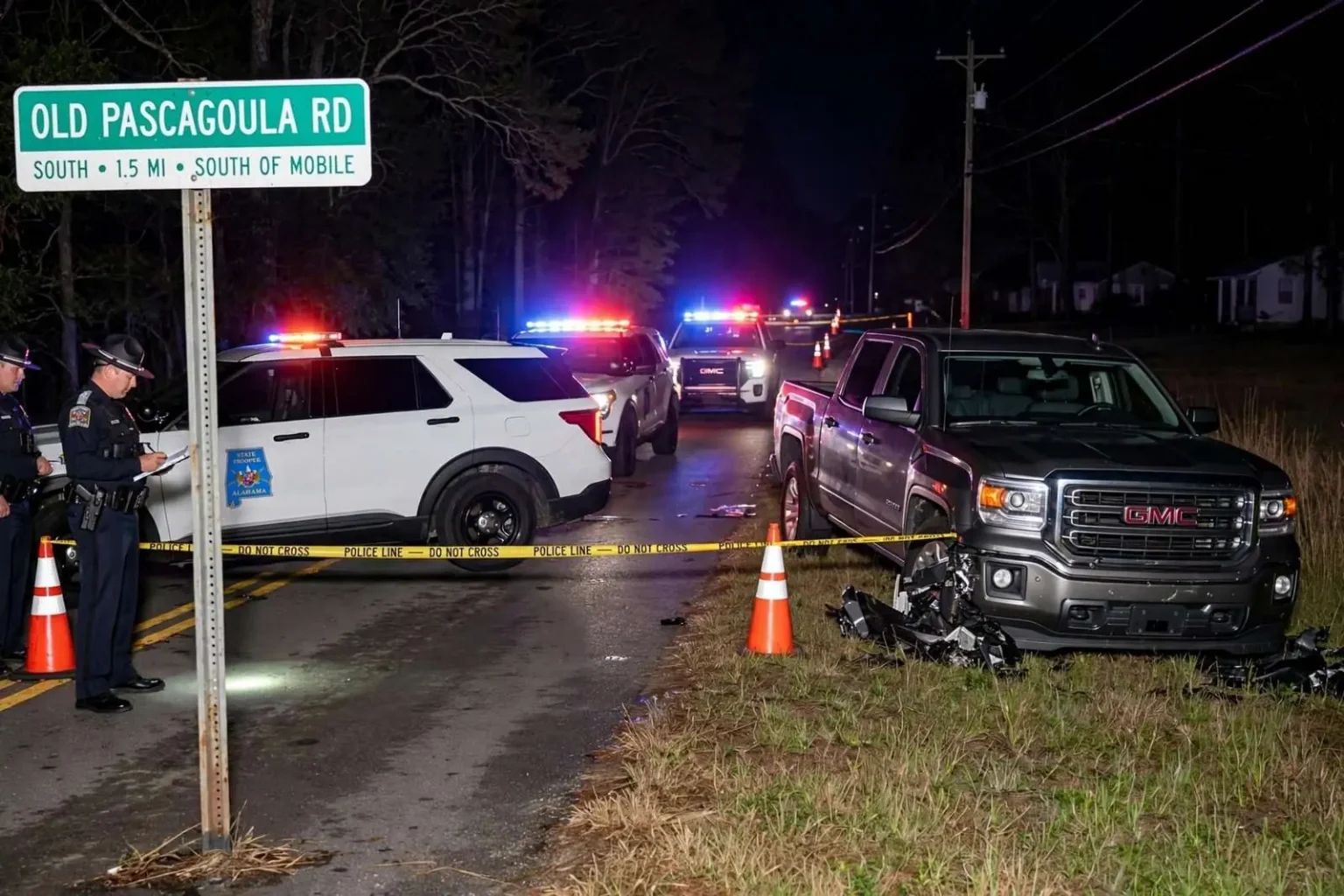
A pedestrian was struck and killed by a pickup truck Sunday night on Old Pascagoula Road south of Mobile, according to Alabama State Troopers. The crash occurred around 8:45 p.m., roughly a mile and a half from the city limits, in an area where the roadway narrows and lighting is limited after dark. The collision prompted a response from state highway patrol units, who closed the immediate area to traffic while they documented the scene.
Troopers said a 2011 GMC pickup struck 33-year-old Pedro Montes Oterro, a Theodore resident, who was pronounced dead at the scene. Emergency personnel who arrived alongside troopers were unable to revive him, and county authorities were notified of the fatality shortly after responders secured the location.
As of the initial report, no arrests had been made, and authorities had not confirmed whether the driver remained on scene when troopers responded. Investigators have released few details about the moments immediately before the impact, and it remained unclear whether any charges would ultimately be filed.
State Trooper Kevin Cook, who provided details of the crash, said the investigation into the exact circumstances leading up to the collision was continuing into the following day. Cook said troopers would be reviewing the conditions along the roadway and speaking with anyone who may have witnessed the collision before reaching conclusions about how the crash unfolded.
A busy connector south of the city
Old Pascagoula Road serves as a connector for residents traveling between Mobile and communities to the south, carrying a mix of local and through traffic. The route runs southwest out of the city through some of the oldest settled portions of Mobile County, threading past residences, small businesses, churches and schools before continuing toward communities closer to the Mississippi state line.
Generations of Mobile-area families have used the road as a practical alternative to busier federal highways, and its daily traffic includes commuters, delivery vehicles, farm equipment and pedestrians walking to nearby homes and bus stops. That mixture of users is common on older county roads, where development arrived gradually over decades rather than following a modern, planned layout.
Like many rural stretches around Mobile County, portions of the road lack continuous sidewalks or dedicated pedestrian space, which safety advocates have long identified as a risk factor for people walking along or crossing such roadways, particularly at night. Where no sidewalk exists, pedestrians are left to share narrow pavement or grass shoulders with vehicles traveling at highway speeds.
Fatal pedestrian crashes on roads without sidewalks tend to share common contributing factors, according to traffic safety researchers: reduced visibility after sunset, higher posted speeds compared with urban streets, and limited shoulder space for pedestrians to move out of a vehicle’s path. Researchers note that darkness compounds every other risk, because drivers have less time to see and react to someone in or near the roadway.
How investigators build the case
Investigators in cases like this typically examine vehicle speed, lighting conditions, and whether the pedestrian was in a marked or unmarked area of roadway before determining whether charges are warranted. Those questions shape the legal analysis, because Alabama law treats collisions involving pedestrians differently depending on where the person was located and what the driver could reasonably have seen.
Troopers investigating a nighttime fatal crash generally work through a standard sequence: photographing and measuring the scene, documenting skid marks or debris patterns, examining the vehicles involved, and canvassing nearby homes and businesses for witnesses or security camera footage. Weather and ambient lighting are recorded as well, since both can affect what a driver would have been able to observe.
Traffic fatalities involving pedestrians are typically reviewed by state investigators to determine whether any charges are appropriate once all evidence, including witness statements and vehicle data, has been collected. Depending on what that review shows, a case may be closed without charges, referred to the district attorney, or presented to a grand jury if prosecutors believe a crime occurred.
A countywide pattern
Mobile County has seen periodic traffic fatalities involving pedestrians on its outlying roads, prompting occasional calls from residents and local advocacy groups for expanded lighting and walking infrastructure in unincorporated areas outside the city core. Those calls tend to intensify after high-profile deaths, when neighbors point to specific stretches where people regularly walk along roads built without them in mind.
Addressing those concerns is complicated by the way unincorporated Mobile County is developed. Sidewalks, streetlights and marked crosswalks are standard features inside municipal boundaries but are far less consistent along older county roads, where responsibility for improvements can fall on state, county or private interests depending on who maintains the segment.
Safety organizations across Alabama have encouraged communities to treat pedestrian safety as a planning issue rather than a purely individual one, arguing that road design, posted speed limits and lighting decisions made decades ago still shape crash risk today. Advocates say even modest investments, such as improved lighting at known crossing points or paved shoulders on key routes, can meaningfully reduce nighttime fatalities.
No such improvements were announced in connection with this crash, and the investigation into what led up to the collision remained open as troopers continued gathering information. Any infrastructure questions raised by residents in the crash area would be considered separately from the law enforcement review of the collision itself.
What happens next
Anyone with information about the crash was asked to contact Alabama State Troopers as the investigation continued. Witnesses who come forward after the initial response can still provide information that proves decisive, particularly about the speed and position of vehicles in the moments before impact.
Safety officials also remind pedestrians traveling along rural roadways after dark to walk facing oncoming traffic, stay as far from the travel lane as conditions allow, and carry a flashlight or wear reflective clothing to make themselves visible sooner to approaching drivers. Drivers, meanwhile, are urged to slow down on unlit stretches, giving themselves more time to react to someone near the road.
For the family and neighbors of Pedro Montes Oterro, the immediate questions are more personal than procedural, as investigators work to establish exactly how a routine Sunday night on a familiar stretch of road ended in a fatal collision. The answers will determine what, if any, legal consequences follow, and may add another voice to the ongoing conversation about how Mobile County’s older roads can be made safer for the people who walk along them.
The community along the corridor
Theodore, where Pedro Montes Oterro lived, is an unincorporated community in southern Mobile County with deep roots in the area’s maritime and agricultural history. Residents there rely on corridors like Old Pascagoula Road for daily trips to work, school and shopping, and many households along the route have used it for generations. Because Theodore sits outside the Mobile city limits, county and state agencies, rather than city departments, handle most roadway and public safety matters in the area.
Alabama State Troopers, part of the Alabama Law Enforcement Agency, are routinely called to investigate crashes on roads outside municipal police jurisdiction, and they handle fatality investigations statewide. Their findings become the basis for any referral to local prosecutors, which is why the early stages of such investigations are often deliberate and measured.
Alabama law and pedestrian crashes
Under Alabama law, drivers are required to exercise due care to avoid colliding with any pedestrian on or near the roadway, to sound a horn when necessary to give warning, and to exercise proper precaution when observing a child or anyone who appears confused or incapacitated. When a pedestrian is struck outside a marked crosswalk, investigators still weigh whether the driver had a reasonable opportunity to see the person and stop.
That balancing of responsibilities is why these investigations take time. A determination that a pedestrian was walking in the roadway does not automatically end the inquiry, and a driver’s inability to avoid someone visible ahead can still support citations or criminal charges. Prosecutors typically wait for the full trooper report, including any reconstruction analysis, before making charging decisions.
Nationally, pedestrian deaths represent a stubborn share of roadway fatalities, and safety researchers have documented that nighttime crashes account for a disproportionately large portion of them. Rural and suburban roads without sidewalks, like many in south Mobile County, are consistently identified in that research as environments where a single moment of inattention can be fatal for someone on foot.
Pressure for safer design
Advocates in Alabama have pointed to a range of measures that can lower pedestrian risk on older corridors: reduced speed limits through developed stretches, paved shoulders, improved lighting at intersections, and crosswalks near bus stops, schools and churches. Federal transportation programs periodically make funding available for such projects, though applying for and scheduling the work can take years, and unincorporated communities often have fewer staff resources to pursue it.
In the meantime, law enforcement agencies across the region continue to urge both drivers and pedestrians to adjust their behavior on dark two-lane roads. For drivers, that means slower speeds, undivided attention and extra caution at night. For pedestrians, it means maximizing visibility and staying clear of the travel lane whenever possible.
Troopers have not announced a timeline for completing the investigation into the crash that killed Pedro Montes Oterro. When the review is finished, its findings will be shared with prosecutors if warranted, and the results will become part of the public record — small comfort, but a measure of answers, for a Theodore family now grieving a loss on a road they had surely traveled many times.