Mobile Police Investigate Reported Attempted Assault Near Moffett Road
Mobile police are investigating a reported attempted assault near Moffett and Howells Ferry roads after a passing car interrupted the incident.
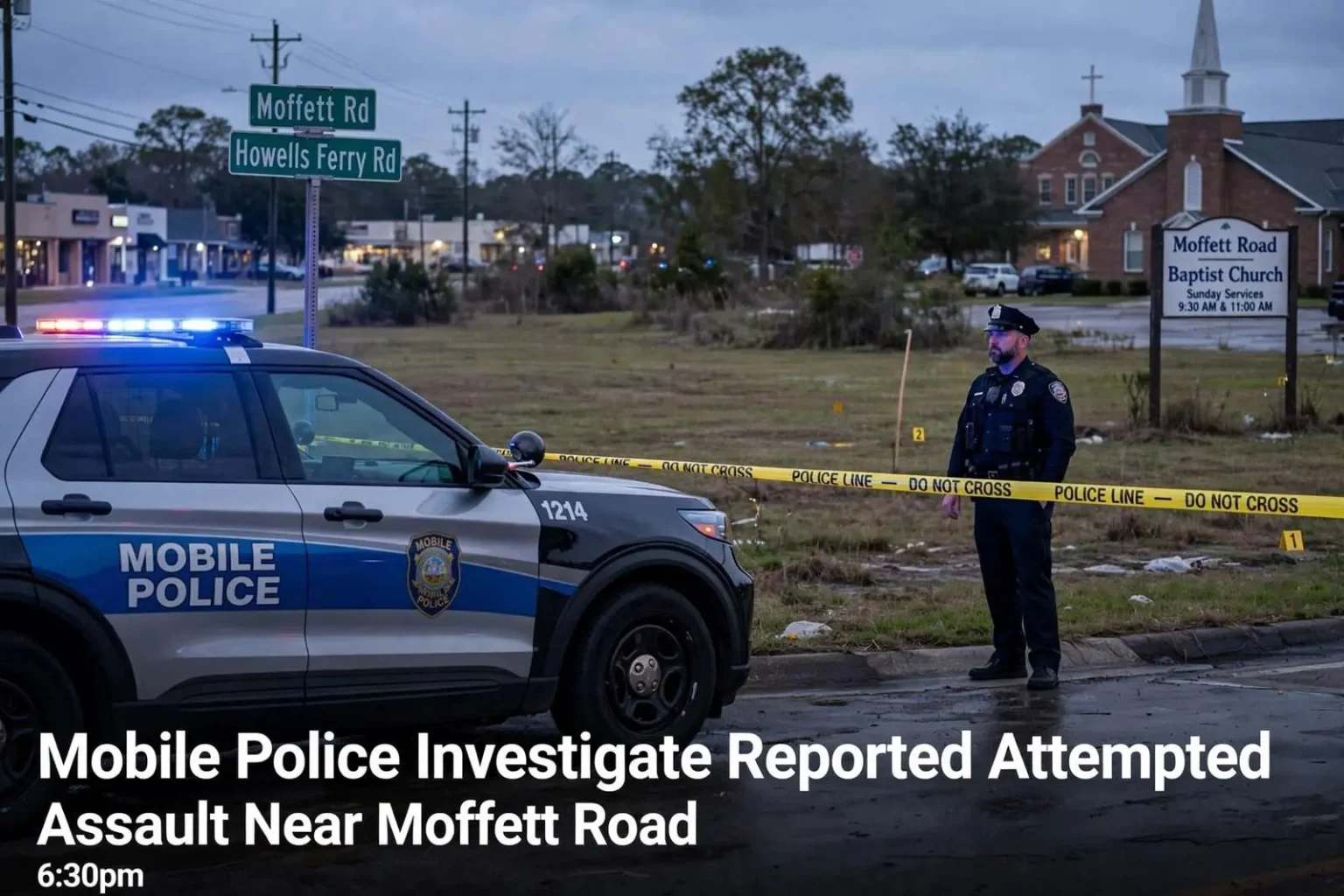
Mobile police are investigating a reported attempted sexual assault that a woman says occurred Saturday evening in an open field near Moffett Road Baptist Church, an incident she told officers was interrupted when a passing vehicle approached the area. The report has drawn attention in the surrounding neighborhood, where residents have been asked to stay alert while detectives work the case.
According to the woman’s account to investigators, she was confronted by a group that included both people she knew and strangers. She told police two women held her down while two men touched her inappropriately and another man attempted to sexually assault her before stopping once he noticed an approaching car. The intervention of the passing vehicle, she said, was what ended the assault before it progressed further.
Officers responded to the area near the intersection of Moffett Road and Howells Ferry Road around 6:30 p.m. Saturday, according to Mobile Police Department spokesman Officer Terence Perkins. The woman told responding officers the attack took place in an open field near that intersection, a stretch of the corridor that mixes commercial strips, churches and older residential streets west of downtown.
No suspects identified yet
As of the initial police report, investigators had not identified any suspects in connection with the case. However, the woman told officers she recognized at least four of the individuals involved in the incident, information that could aid detectives as the investigation continues. Cases in which a victim knows some of the people involved often move differently than stranger-assault investigations, since detectives can work names and prior contacts even before formal identification.
The Mobile Police Department is asking anyone with information related to the incident to come forward. Tips can be submitted by calling MPD at 251-208-7211. Investigators stressed that even partial details — descriptions, vehicle information, or knowledge of gatherings in the area that evening — can help establish a timeline and identify additional individuals.
As is standard practice, the Mobile Police Department has not released the identity of the woman who reported the incident, and no arrests had been announced at the time of the report. Officials cautioned that the account remains under investigation and that charges, if any, would follow the completion of detective work and consultation with prosecutors.
An ongoing investigation
Cases involving reported sexual assaults where a victim knows some but not all of the people allegedly involved can present particular challenges for investigators, who must corroborate accounts and identify additional individuals before charges can be pursued. Detectives typically begin with a recorded interview, a medical examination when applicable, and canvas of the area for witnesses or surveillance video from nearby businesses and homes.
The geography of the reported incident is also part of that work. The Moffett Road and Howells Ferry Road intersection sits along a busy route lined with businesses and congregation parking lots, and investigators will be looking at any camera footage that covers the evening hours in question. Open fields and undeveloped parcels along the corridor, like the one described in the report, are common in that stretch of the city.
Residents in the Moffett Road and Howells Ferry Road area are encouraged to remain vigilant and to report any suspicious activity to police. Neighborhood watch contacts and civic associations along the corridor often serve as the first channel for passing along information, and officers have repeatedly said that community tips are among the most productive sources in cases like this one.
Resources for victims
Beyond the criminal investigation, advocates note that sexual assault is one of the most underreported crimes in the country, and that reporting — whether immediately or long after the fact — connects victims with medical care, counseling and legal support. The National Sexual Assault Telephone Hotline, reachable at 800-656-4673, routes callers to crisis centers in their area, and Mobile has long-standing victim service organizations that work with law enforcement on cases of this kind.
Victim advocates emphasize that a victim’s account to responding officers is only the first step in a process that can take weeks or months. Forensic interviews, evidence collection and review by prosecutors all follow, and the pace is deliberately careful: an arrest made before the evidence supports it can collapse a case later. That is part of why no arrests had been announced even with identifiable individuals mentioned in the report.
For the neighborhood around Moffett Road Baptist Church, the report is a reminder of how quickly an evening can turn, and of the role ordinary passersby can play. In this case, the woman said, it was the approach of a single vehicle that stopped the assault. Police frequently cite similar examples when urging drivers and residents not to assume someone else has already reported what they saw.
What happens next
The case now sits with MPD detectives, who will continue interviewing the woman and any witnesses who come forward. If investigators identify the individuals described in the report, warrants would be sought through the district attorney’s office, and any charges would be announced once filed. Until then, police have asked that speculation about the identities of those involved be avoided, noting that premature naming can complicate prosecution and harm uninvolved people.
The department has also used cases like this to remind the public of basic reporting practices: if you see something that appears to be an assault in progress, call 911 immediately; if you have information after the fact, use the department’s tip line. Dispatchers ask callers to note descriptions of people and vehicles, direction of travel and landmarks — details that helped in this case only because someone drove near the field at the right moment.
For now, the investigation remains open. The woman’s report — that she recognized at least four of the individuals involved, that the assault was interrupted by an approaching car, and that it happened in the early evening near a busy west Mobile intersection — gives detectives a foundation to work from. Anyone with information is asked to call the Mobile Police Department at 251-208-7211.
Sexual assault investigations in Alabama follow a defined path once a report is made. Responding officers secure the scene and arrange for the victim’s medical needs first; detectives take over for follow-up interviews; and evidence from any forensic exam is submitted for analysis. Prosecutors become involved early in serious cases, reviewing the file as it develops so that charging decisions can be made on a complete record. Each stage takes time, and department policy generally limits what can be released publicly while the case is active.
The distinction between an attempted offense and a completed one also shapes how the case proceeds. Attempted sexual assault is a serious felony under Alabama law, but prosecutors must prove the specific intent and actions alleged, which places added weight on the victim’s account, any physical evidence, and witness or video corroboration. The interruption described in the report — an approaching vehicle that caused the assault to stop — is a detail investigators will want to pin down precisely, because it may have been visible to others on nearby roads.
That possibility of additional witnesses is why police canvasses matter. Detectives will typically revisit the area on multiple evenings at the same time of day, when residents are home and traffic patterns match those of the incident. They will ask businesses along Moffett Road and Howells Ferry Road to preserve security footage from the relevant date, since many systems overwrite recordings within days.
Community reaction to reports like this one often includes questions about area safety measures — lighting along the corridor, visibility of open parcels, and the frequency of police patrols. Those questions are typically routed through neighborhood associations and the department’s precinct commanders, who can walk the area with residents and identify spots where overgrown lots or burned-out streetlights create risk. Residents who notice such conditions can report them through the city’s non-emergency services.
For victims of similar crimes who have not reported, advocates offer a consistent message: medical care and counseling are available regardless of whether a police report is filed, and evidence collection can be done while options are still open. Reporting can happen when a victim is ready, and in many jurisdictions evidence collected earlier can be held while that decision is made. The choice belongs to the survivor, and crisis counselors are trained to explain the options without pressure.
The Mobile Police Department’s request in this case is the same one it makes in every unsolved case: that anyone who knows something come forward, even anonymously through third parties, rather than assume investigators already have the information. The woman in this report provided a detailed account and names she recognized; what detectives need now is the corroboration that turns a report into a case, and that usually comes from one caller at a time.