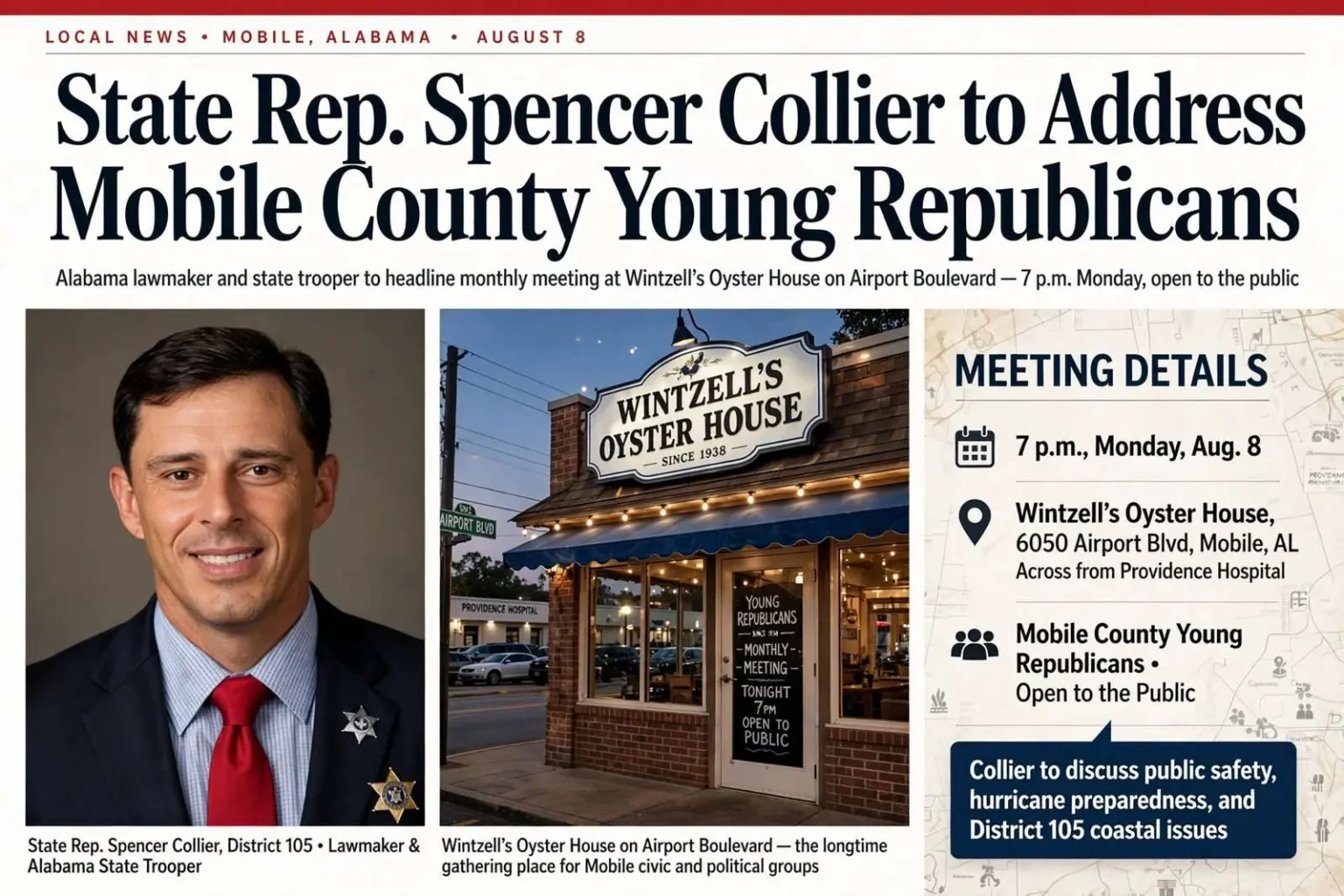
The Mobile County Young Republicans lined up a state lawmaker with a badge for their monthly meeting, announcing that State Rep. Spencer Collier would headline the group’s gathering at Wintzell’s Oyster House on Airport Boulevard. The meeting was set for 7 p.m. Monday, Aug. 8, at the restaurant across from Providence Hospital. The public was invited to attend.
The choice of venue was as Mobile as the choice of speaker. Wintzell’s, an oyster bar and restaurant that has served the city for generations, has long doubled as an unofficial civic hall for west Mobile — the kind of place where political clubs, business groups and campaign committees gather over platters of oysters and the restaurant’s famously irreverent wall signage. Its Airport Boulevard location, across from the Providence Hospital campus, puts it at one of the busiest crossroads in the city.
A Trooper in the Legislature
Collier represented District 105, covering south Mobile County, in the Alabama House of Representatives. He was also a state trooper, serving as a public information officer — a dual role that gave him an unusual profile in Montgomery.
Lawmakers who also carry a law enforcement commission bring firsthand experience to debates over public safety funding, highway patrol staffing and criminal statutes, and that experience tends to make them sought-after speakers for local party organizations. Collier’s seat on both sides of the line — writing the laws one session, enforcing them on the highways the rest of the week — made him a natural draw for an audience of politically active young professionals with questions about how state government actually works.
His background as a public information officer also gave him a command of the roadside-safety briefings troopers deliver each year, from hurricane evacuation traffic plans to holiday enforcement details, subjects of immediate interest to a Gulf Coast audience.
District 105 covered a stretch of Mobile County that runs south from the city toward the bays and bayous — a mix of suburban subdivisions, working waterfronts and small communities that includes some of the most hurricane-exposed real estate in Alabama. Representing it means dealing with drainage, insurance, coastal development and the fishing economy alongside the ordinary business of state government.
The district’s geography shapes its politics. Its voters include suburban families in the expanding corridors south of the city, watermen and seafood workers in the bayou communities, and retirees along the western shore of the bay — constituencies that agree on few issues but share a direct stake in flood control, insurance rates and the health of Mobile Bay. A representative from that district arrives in Montgomery with a file of constituent concerns that runs from stormwater ditches to shrimp import policy.
Who the Young Republicans Were
Young Republican chapters have long served as the training ground for local party activists. They meet monthly, host elected officials, register voters and provide volunteers for campaigns. Many of Alabama’s officeholders have spent time in a YR chapter early on, and the groups function as a proving ground where organizational talent gets noticed.
The monthly speaker’s meeting is the chapter’s core ritual. Members get face time with lawmakers and judges in a room small enough for real questions, and the officials get a captive audience of the volunteers and donors of the next generation. For the speakers, the invitation is both a favor and an investment: today’s Young Republican asking about highway funding is tomorrow’s county commissioner, legislative aide or campaign manager.
Mobile County’s chapter has been part of that tradition for decades, drawing its membership from young professionals in law, business, medicine and the military — a substantial constituency in a city shaped by its port, its hospitals and its defense installations.
The Mobile County chapter’s vice chairman, Alex Mathis, handled arrangements for the meeting. The group listed his contact information — 251-716-7524 and an email address — for anyone wanting to attend or learn more.
Opening the meeting to the public was standard practice for the chapter and part of its recruiting strategy. A guest who comes for a single interesting speaker sometimes stays for the committee work, the campaign assignments and, eventually, the candidacy. The groups’ leadership understands that its long-term product is not any one meeting but the pipeline of activists it feeds into county and state politics.
Meeting Details
Speaker: State Rep. Spencer Collier, District 105. When: 7 p.m., Monday, Aug. 8. Where: Wintzell’s Oyster House, Airport Boulevard, across from Providence Hospital. Admission: open to the public.
For members and guests, the evening’s format offered the usual mix — a short business session, the speaker’s remarks, and the extended question period where the real education happens. Collier’s double life as lawmaker and trooper promised questions ranging from the Legislature’s budget fights to the practical realities of highway patrol work, with the state’s hurricane preparedness plans a likely subject given the season.
The August timing placed the meeting in the lull between the summer’s municipal races and the fall’s campaign season, when political organizations across south Alabama reload their calendars and line up speakers for the year ahead. For the Young Republicans, a well-attended August meeting with a compelling speaker set the tone for the months of door-knocking and fundraising that follow.
Wintzell’s role in the evening deserved its own note. The restaurant, founded in 1938 by J. Oliver Wintzell as a six-stool oyster bar, grew into one of Mobile’s most beloved institutions, famous as much for its walls — papered with decades of hand-lettered aphorisms and one-liners — as for its seafood. Politicians of both parties have held court there for generations, and a speaker who can’t hold a room at Wintzell’s probably can’t hold one anywhere.
Its Airport Boulevard location, in west Mobile’s commercial spine, made it a practical choice for a group drawing members from across the county. The corridor’s restaurants and hotels serve the city’s growing western suburbs, and Providence Hospital across the boulevard — one of Mobile’s major medical centers — anchors the district’s daytime traffic. For an after-work meeting, few locations in the city are easier to reach.
The meeting itself faded into the chapter’s long history of such evenings, but its ingredients were the classic ones of Mobile civic life: a working lawmaker with an unusual resume, a restaurant that has hosted the city’s politics since before most of the members were born, and an open invitation to anyone curious enough to show up. The Young Republicans’ formula — feed them, bring them a speaker, ask the questions — has been producing Alabama’s next generation of officeholders for decades, one oyster platter at a time.
The dual career Collier carried — legislator and trooper — is rare enough in Alabama politics to be worth understanding. State legislators in Alabama are part-time by design; most hold day jobs as lawyers, business owners, farmers or, in Collier’s case, sworn officers. The part-time structure means a representative’s constituents interact with him not only in district offices and campaign events but, in Collier’s case, on the shoulder of Interstate 10 during a traffic stop.
That visibility works both ways. A trooper-legislator hears about road conditions, speeding problems and emergency response times from drivers at the window, and brings those observations straight into budget hearings where the Highway Patrol’s staffing and equipment are decided. Colleagues in the House tend to defer to such members on public safety bills, and committee chairmen who need a practical read on a bill’s effect on law enforcement know whose office to visit.
For the Young Republicans’ audience, the speaker offered something a politician’s usual resume does not: a look at how a bill becomes policy in practice rather than in theory. The difference between a statute’s text and its enforcement — who stops whom, what the trooper’s shift looks like, how a new law changes the highway — is exactly the kind of knowledge party activists collect to inform their own advocacy later.
The district’s coastal concerns promised their own thread in the evening’s discussion. South Mobile County’s communities live with hurricane seasons, flood insurance maps and the slow economics of the seafood industry, and a representative from the bayou country is expected to speak to all of it. Collier’s service in a law enforcement role added emergency management to the list — the evacuation routes, the contraflow plans and the communications failures that every Gulf Coast official is asked about after each storm.
Chapters like Mobile County’s operate on a calendar that mirrors the state’s political rhythm. Spring brings municipal qualifying and county party reorganization; summer fills with speaker meetings and socials that keep members engaged through the heat; fall belongs to campaign season, when the chapter’s volunteers scatter to the districts where their labor is needed most. The August meeting with Collier sat at the hinge of that cycle — the last easy evening before the fall’s work began.
For anyone weighing whether to attend, the calculus the chapter offered was simple: an open door, a well-known speaker, the city’s most storied restaurant and a room full of people who would, within a few election cycles, be running for office themselves. In Mobile’s political ecosystem, few evenings offered a better return on two hours’ time.