Albritton, D’Olive Spar Over Taxes and Economy Ahead of Senate Runoff
Ahead of their Senate District 22 runoff, Greg Albritton and Harry D'Olive clashed over taxes, spending and economic development.
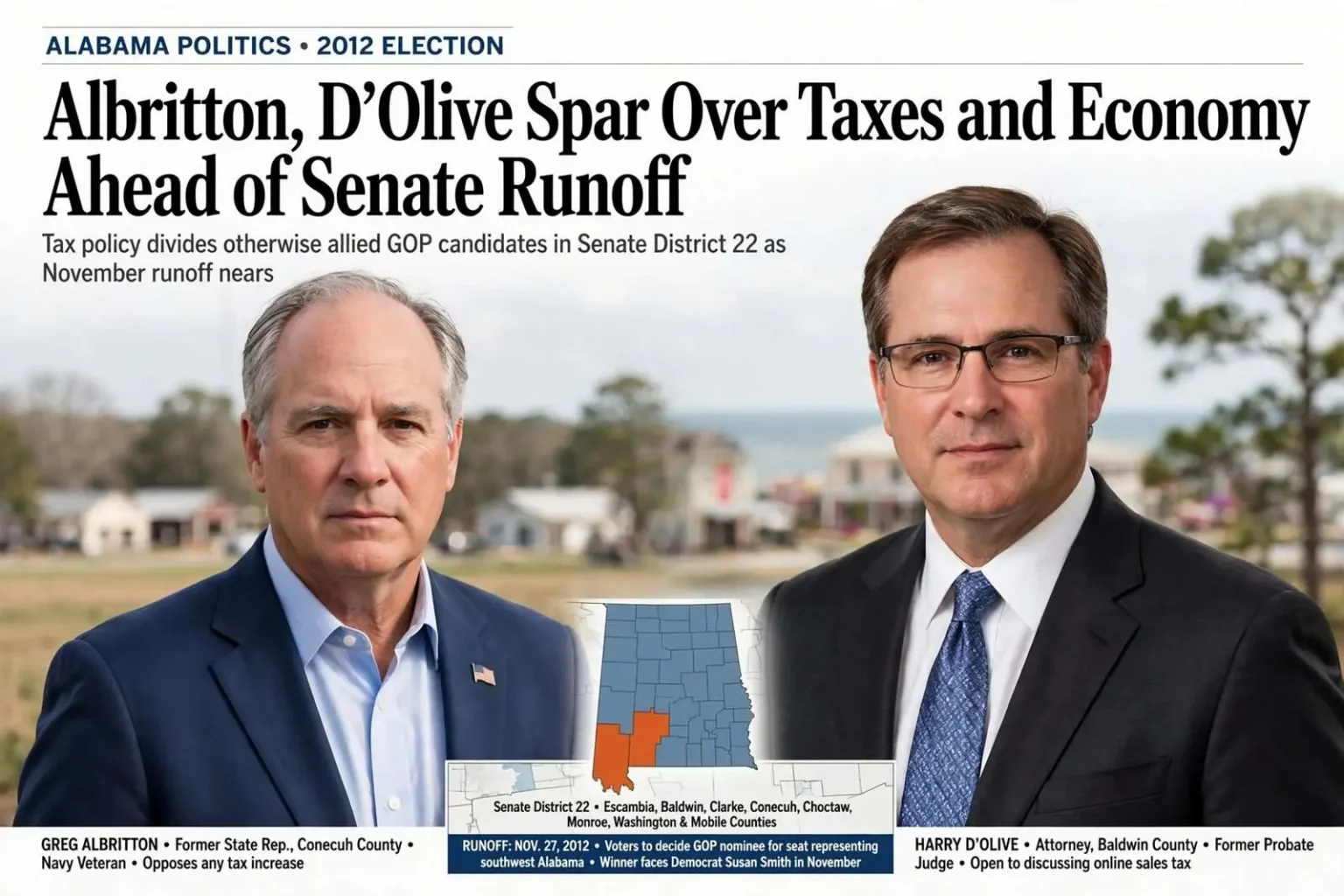
With days to go before their runoff election, the two Republican candidates vying for the Alabama Senate District 22 seat found themselves largely in agreement on policy, save for one sharp point of disagreement: taxes.
A Runoff Shaped by One Big Difference
Former state Representative Greg Albritton edged Bay Minette lawyer Harry D’Olive in a five-candidate primary field back in June, but neither man cleared the 50 percent threshold needed to avoid a runoff. The winner will face Democrat Susan Smith in November for a seat representing Escambia County and portions of Clarke, Conecuh, Choctaw, Monroe, Washington, Mobile and Baldwin counties.
The district is one of the largest geographically in the Alabama Senate, sweeping across the rural Black Belt counties of southwest Alabama and up into the fast-growing southern end of Baldwin County. That mix — struggling rural economies and booming suburban growth — shapes every campaign for the seat, forcing candidates to speak to farmers and small-town mayors in Conecuh and Monroe counties in the same breath as commuters and retirees in the subdivisions outside Spanish Fort and Daphne. With longtime incumbency patterns in flux, the 2012 cycle has drawn unusually crowded fields on the Republican side, reflecting the district’s shift toward the GOP in recent elections.
Albritton, who runs a solo law practice in Conecuh County, said flatly that he opposes any tax increase on the public given the fragile state of the economy. D’Olive, for his part, said he personally opposes an Internet sales tax but acknowledged in an earlier interview that it was an idea worth discussing given the potential revenue it could generate for the state, even while conceding many people are strongly opposed to it.
The exchange mattered because the question of taxing online purchases was emerging as a live issue for state budgets across the country. Alabama’s reliance on sales taxes — among the highest combined state and local rates in the nation — has long made the untaxed growth of Internet commerce a slow leak in the general fund, and legislators have debated for years how to capture revenue from out-of-state online sellers without running afoul of federal rules. D’Olive’s willingness to discuss the idea, however hedged, gave Albritton his clearest point of contrast in an otherwise ideologically similar race.
Common Ground on Medicaid and Education
Beyond the tax question, the two candidates found considerable common ground. Both oppose expanding Alabama’s Medicaid program, and both oppose the Common Core State Standards Initiative aimed at standardizing curriculum nationwide. Their positions mirror the conservative consensus of the state’s Republican primary electorate, where opposition to the federal health care law’s Medicaid expansion and to national curriculum standards had become standard tests for candidates seeking GOP nominations.
Their biographies also run in parallel. D’Olive, from one of Baldwin County’s oldest families, spent 15 years as a Baldwin County sheriff’s deputy before winning appointment as probate judge to complete his ailing father’s term, then lost his bid for a full term the following year and lost again in a 2012 probate judge race. He also won a term as mayor of Silverhill but resigned after about a year to attend law school.
Albritton, a U.S. Navy veteran, won a state House seat in 2002 but lost his re-election bid four years later after redistricting reshaped his district. He has emphasized that he has lived in five of Senate District 22’s eight counties over his lifetime.
Both men have built their campaigns on deep local roots rather than statewide connections, a reflection of how personal politics remains in Alabama’s rural districts. In a Senate district where a candidate can drive the full length of it in two hours but cannot cover its towns and crossroads communities in a week, name recognition built over decades of civic life — courthouse work, city councils, school boards, volunteer fire departments — is often the decisive currency.
Diverging Paths to Economic Growth
Both candidates agree that improving the economy of the largely rural district is the top priority, but they differ on strategy. Albritton has pointed to excessive regulation as the chief obstacle to job creation at both the state and federal level, criticizing what he described as an overabundance of licensing boards and commissions that make it needlessly hard for people to enter certain professions. He has pointed to a study from Troy University’s free-market-oriented Manuel H. Johnson Center for Political Economy and praised efforts by Governor Robert Bentley and the Legislature to consolidate state agencies, including a push to bring various law enforcement functions under a single public safety director.
D’Olive has instead stressed industrial recruitment, pointing to a government-owned “mega site” north of Bay Minette in Baldwin County as a prime opportunity to lure manufacturers. He supports targeted tax incentives to attract industry, while also arguing the state senator’s personal involvement in recruitment matters just as much as any incentive package.
The mega site at issue — a large industrial park assembled north of Bay Minette with state and local support — has been the centerpiece of Baldwin County’s economic development ambitions, marketed as one of the few sites in the region capable of hosting a major manufacturer with rail, port and interstate access. Whoever holds the Senate seat will have a voice in the state incentives and infrastructure spending that determine whether such a project ever lands, which is why recruitment strategy has figured so prominently in the runoff debate.
On the state budget, D’Olive said he would look to cut wasteful spending, though he offered few specifics, and he cast himself as a fresh face compared with Albritton, noting that voters had already declined to send Albritton back to the Legislature in 2006.
A Costly Campaign
Campaign finance reports show Albritton had raised more money heading into the runoff, $89,901 to D’Olive’s $70,650, including in-kind contributions, with much of his support tied to political action committees connected to the Poarch Band of Creek Indians and Alfa Mutual Insurance Group. D’Olive has suggested that Alfa-linked support could complicate Albritton’s ability to weigh in on homeowners insurance policy, an accusation Albritton denies.
The insurance issue carries particular weight in south Alabama, where coastal homeowners have watched premiums climb for years as insurers pull back from wind-exposed areas near Mobile Bay and the Gulf. State coverage of the insurance question — from the creation of the Alabama Insurance Underwriting Association, the state’s insurer of last resort, to rebate and strengthening programs intended to harden homes against storms — has been a persistent concern for south Alabama legislators, and D’Olive argued a senator whose campaign was underwritten by one of the state’s largest insurers would enter those debates with a conflict. Albritton rejected the suggestion, saying his record and his district’s interests would guide his votes.
The Poarch Band’s political committees have become significant players in Alabama legislative races, and their interest in District 22 is not incidental: the tribe’s economic enterprises sit in Escambia County, at the heart of the district, and tribal governance issues — including long-running questions about gaming and the tribe’s relationship with the state — have repeatedly come before the Legislature. Contributions flowing from tribal-connected PACs are a familiar feature of Alabama campaign finance, watched closely by both supporters and opponents of expanded gaming.
Despite raising less overall, D’Olive actually outspent Albritton late in the race, $53,532 to $47,173, thanks to a late fundraising push. The late spending surge reflected how tight the contest had become, with both campaigns pouring their remaining resources into radio, yard signs and the get-out-the-vote effort that decides low-turnout runoffs.
With the district redrawn to lean more Republican after the 2010 census, whoever wins the runoff will enter the general election as the clear favorite. The redrawn lines folded more of Baldwin County’s growing Republican precincts into the district, shifting its political center of gravity away from the historically Democratic Black Belt counties and making the GOP primary — not the November general — the true contest for the seat. For Albritton and D’Olive, that meant one last week of convincing the party’s most reliable voters that they, not the other, should carry the district’s flag into Montgomery.
What the Runoff Means for the District
Whichever man prevails, the runoff’s outcome will hand Senate District 22 a senator with deep familiarity in courthouse politics across eight counties, and the range of the district ensures the job will demand it. A single district that stretches from the beaches of Baldwin County through Monroeville’s courthouse square and into the timberlands of Choctaw and Washington counties cannot be represented from any one place, and senators from rural southwest Alabama have historically leaned on their county-level networks — probate judges, sheriffs, county commissioners and volunteer organizations — to stay in touch with constituent needs between sessions.
The issues awaiting the next senator are familiar ones for the region: rural hospitals operating on thin margins, the slow erosion of manufacturing jobs in the small towns, the rising cost of homeowners insurance near the coast, and the perennial fight over how the state’s education and general fund budgets divide scarce dollars between growing suburbs and shrinking rural systems. The district’s split personality — a quarter of it booming, three-quarters of it fighting decline — makes those budget votes particularly consequential, since the needs of a Baldwin County school system adding hundreds of students a year collide with rural systems losing them.
For the two candidates, the final days of the runoff came down to turnout arithmetic rather than persuasion. Runoffs in Alabama are decided by a fraction of the primary electorate, typically older, more reliable voters who follow county-level politics closely, and both camps spent the closing stretch working their lists of supporters, arranging rides and staffing the poll-watcher tables that keep a friend-of-the-campaign operation honest. The policy differences between the men were real but narrow; the choice before Republican voters was as much about temperament, biography and geography as it was about issues.
However it ends, the 2012 contest marks another step in the political realignment of southwest Alabama, a region where Democratic dominance once seemed permanent and where Republican primaries now draw five-candidate fields and six-figure campaigns. Senate District 22’s seat in Montgomery will be filled by a Republican — the only question left was which one.