Ann Bedsole Honored With Lifetime Achievement Award for Historic Preservation
Mobile trailblazer Ann Smith Bedsole, the first woman elected to the Alabama Senate, was named to receive a lifetime achievement award for decades of work saving the state's and the city's historic places.
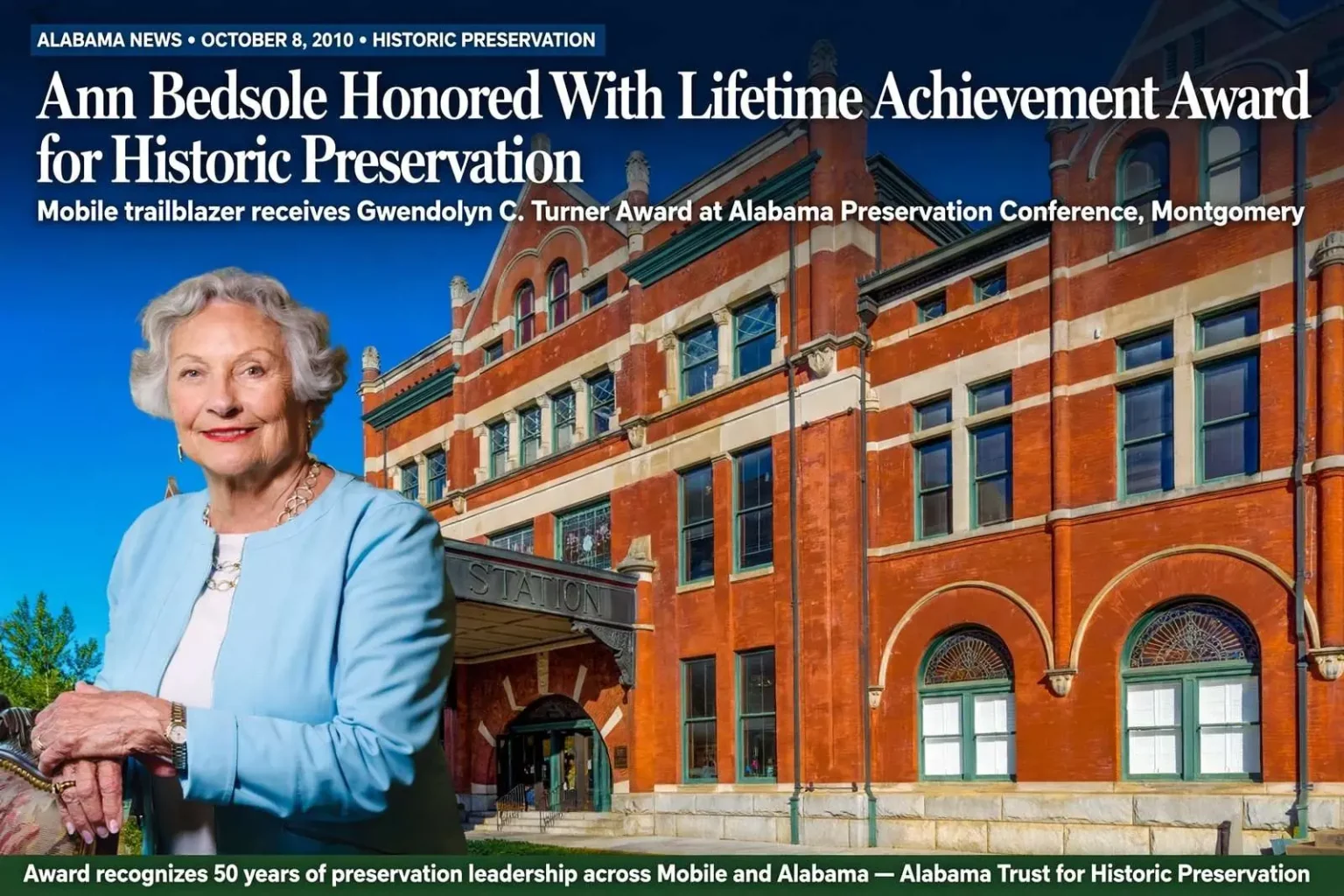
Ann Smith Bedsole, a Mobile trailblazer whose fingerprints mark many of the city’s most cherished landmarks, was set to be recognized by the Alabama Trust for Historic Preservation with a Gwendolyn C. Turner Lifetime Achievement Award.
An award decades in the making
The honor was to be presented at the Alabama Preservation Conference, held Oct. 7-9 in Montgomery, during a “Salute to the 2010 Preservation Awards Honorees” on the afternoon of Friday, Oct. 8, at the historic Union Station in Montgomery. The Trust annually recognizes individuals and projects that have had a notable impact on efforts to save Alabama’s historic places.
This year’s conference, themed “Embracing Historic Places, Making Life Better,” spotlighted preservation as an economic development tool, with Donovan Rypkema, principal of PlaceEconomics and a noted authority on the economics of preservation, delivering the keynote. The theme was a fitting frame for Bedsole’s career, which has long treated old buildings not as relics but as working assets — economic anchors, tourist draws and the physical memory of a city.
Union Station itself is a case study in what the conference was celebrating. The grand 1898 rail terminal had sat neglected before its restoration returned it to active civic use, and hosting the state’s preservation community inside a rescued landmark underscored the argument Rypkema and others have made for decades: historic buildings, properly restored, pay their way.
“Ann Smith Bedsole has been a vibrant force for historic preservation in Mobile and throughout the state,” said David B. Schneider, executive director of the Alabama Trust. “Her incredibly long list of accomplishments has helped to make Mobile a better place, and her efforts have been instrumental in the preservation of many of the city’s architectural landmarks, great and small.”
The Turner award, named for a preservationist whose own career set the standard for lifelong advocacy, is reserved for exactly that kind of sustained record — not one successful campaign, but a career of them. Bedsole’s list of campaigns spans a half-century of Mobile civic life, and by the time the award was announced she was still adding to it.
A record of firsts
A native of Selma, Bedsole became the first Republican woman ever elected to the Alabama House of Representatives and, later, the first woman elected to the Alabama State Senate, where she served until 1994. The award program summed up her reputation simply, noting that mentioning her name brings to mind the words “trailblazer,” “leader” and “model volunteer.”
Her legislative career gave her a statewide platform unusual for a preservation volunteer. As a senator representing Mobile, she carried the city’s historic districts and institutions into rooms where budgets and policy were decided, and she left office as one of the most senior women in Alabama legislative history. The path itself was historic: a Republican woman winning House and Senate seats in an era when both milestones were firsts required the kind of persistence her supporters would come to recognize from her civic work.
Her commitment to preservation ranged across Mobile’s historic downtown and neighborhoods and reached well beyond the city. She served as founding president of the Mobile Historic Home Tours, and her push to get people to care about downtown could be seen in restoration projects such as the 1927 European-style Saenger Theatre, the renovations of the Franklin Firehouse and two other historic buildings in Mobile, as well as the Murphy House and an 1800s farmhouse in Monroe County.
Each of those projects tells the same story from a different angle. The Saenger’s restoration returned a grand movie palace to live use downtown, anchoring the theater district that helps drive evening foot traffic. The Franklin Firehouse and its neighboring buildings kept 19th-century streetscapes intact. The Murphy House and the Monroe County farmhouse extended her reach into residential and rural preservation — a reminder that Alabama’s endangered places are not only downtown storefronts but ordinary homes and farmsteads with no corporate savior in sight.
The home tours she founded flipped the model from defense to invitation: instead of fighting to save buildings one protest at a time, the tours put visitors inside restored historic houses each year, converting curiosity into advocacy and, ultimately, into buyers for historic properties that might otherwise have emptied out.
Still on the front lines
At the time of the award, Bedsole remained active on multiple fronts. She served on the Mobile Historic Development Commission and the Mobile Bay Lighthouse Committee, sat as a commissioner for the Alabama Historical Commission, and was one of two Alabama advisors to the National Trust for Historic Preservation.
That portfolio spans every level of American preservation work — municipal review in Mobile, statewide policy through the Alabama Historical Commission, and national strategy through her advisory role to the National Trust. Few volunteers anywhere in the country hold seats at all three levels at once, and the combination has made her a conduit through which national preservation expertise reaches Mobile’s neighborhood battles.
She continued to champion the preservation of historic Barton Academy, the first public school in Alabama, and Perdue Hill’s Masonic Lodge. The two projects could hardly be more different — a landmark Greek Revival school building on Government Street in the heart of Mobile, and a rural lodge building maintained by a small community up the Alabama River — but both illustrate her instinct for buildings whose stories matter as much as their architecture.
Barton Academy, with its columned façade long a symbol of the city, had spent years vacant while officials debated its future; advocates like Bedsole argued that the birthplace of Alabama’s public education deserved better than demolition by neglect. The Perdue Hill lodge, meanwhile, represents the kind of modest rural landmark that survives only when someone local — or someone influential and willing to listen — refuses to let it go.
She also led opposition to a proposed interstate bridge over the Mobile River, which some feared would affect historically significant sites along the waterfront. That fight placed her preservation instincts directly against the region’s transportation planning — an argument that has resurfaced in various forms as officials have repeatedly revisited the idea of a new crossing over the river near downtown.
Politics and preservation, together
Taken together, her career bridged politics and preservation, using the visibility of elected office and the patience of volunteer stewardship to protect buildings and places that might otherwise have been lost. That combination is rarer than it might seem. Politicians move on term to term; preservation campaigns run on decade-long clocks. Bedsole’s career worked because she operated on both clocks at once — winning elections in two-year and four-year cycles while sustaining volunteer commitments that spanned generations.
Her post-legislative work demonstrated the point. Rather than stepping back after 1994, she poured her political capital into the causes she had championed in office, lending her name, her network and her formidable fundraising ability to buildings and committees that needed exactly what a former state senator could provide: access, credibility and persistence.
The lifetime achievement award recognized not a single project but a sustained body of work, one that helped shape how Mobile and Alabama came to view their historic fabric as an asset worth defending. In a city whose economy increasingly leans on visitors drawn to its historic districts — Oakleigh, the Church Street East neighborhood, Dauphin Street’s storefronts — that shift in attitude is arguably her most durable legacy.
It is also a legacy with successors. The commissions, tours and restoration projects she built or led have trained a generation of Mobile preservationists, and the annual conference where she received the award exists precisely to spread that model across the state. The economics-focused keynote that framed the 2010 conference would have sounded, to anyone who knew her record, like an extended footnote to Bedsole’s career: the argument that saving old buildings is not sentimentality, but investment — made in Mobile, by a Mobile volunteer, over a lifetime.
Colleagues from her political years have often made the same observation in different words. Bedsole, they note, treated a piece of legislation and a piece of architecture with the same method: identify what is worth saving, find the coalition that can save it, and stay with the fight longer than anyone expects. The translation of skills between the Statehouse and the historic district was seamless because, to her, both were community stewardship.
Her Selma roots and Mobile career also trace a familiar Alabama arc — a generation of women who built civic power outside the formal structures that once excluded them, then reshaped those structures as they entered. As a first in both legislative chambers, Bedsole carried the burden of proving that a woman could hold the office; she answered it by holding it with distinction and then opening the door wider from the Senate side, where her service until 1994 made her a fixture in budget and policy deliberations.
The honors that followed her from public life — and the volunteer leadership posts she has never really surrendered — suggest the Turner Lifetime Achievement Award is less a capstone than a checkpoint. At an afternoon ceremony inside a restored Montgomery train station, the state’s preservation community simply made official what Mobile has known for decades: Ann Bedsole builds coalitions the way her favored architects built buildings — to last.