University of South Alabama Mobile
USA Scholarship Matching Campaign Tops 200 Awards as Tuition Pressure Grows
A matching-gift campaign built on a $50 million donation has already produced 76 new and 137 enhanced scholarships at the University of South Alabama.
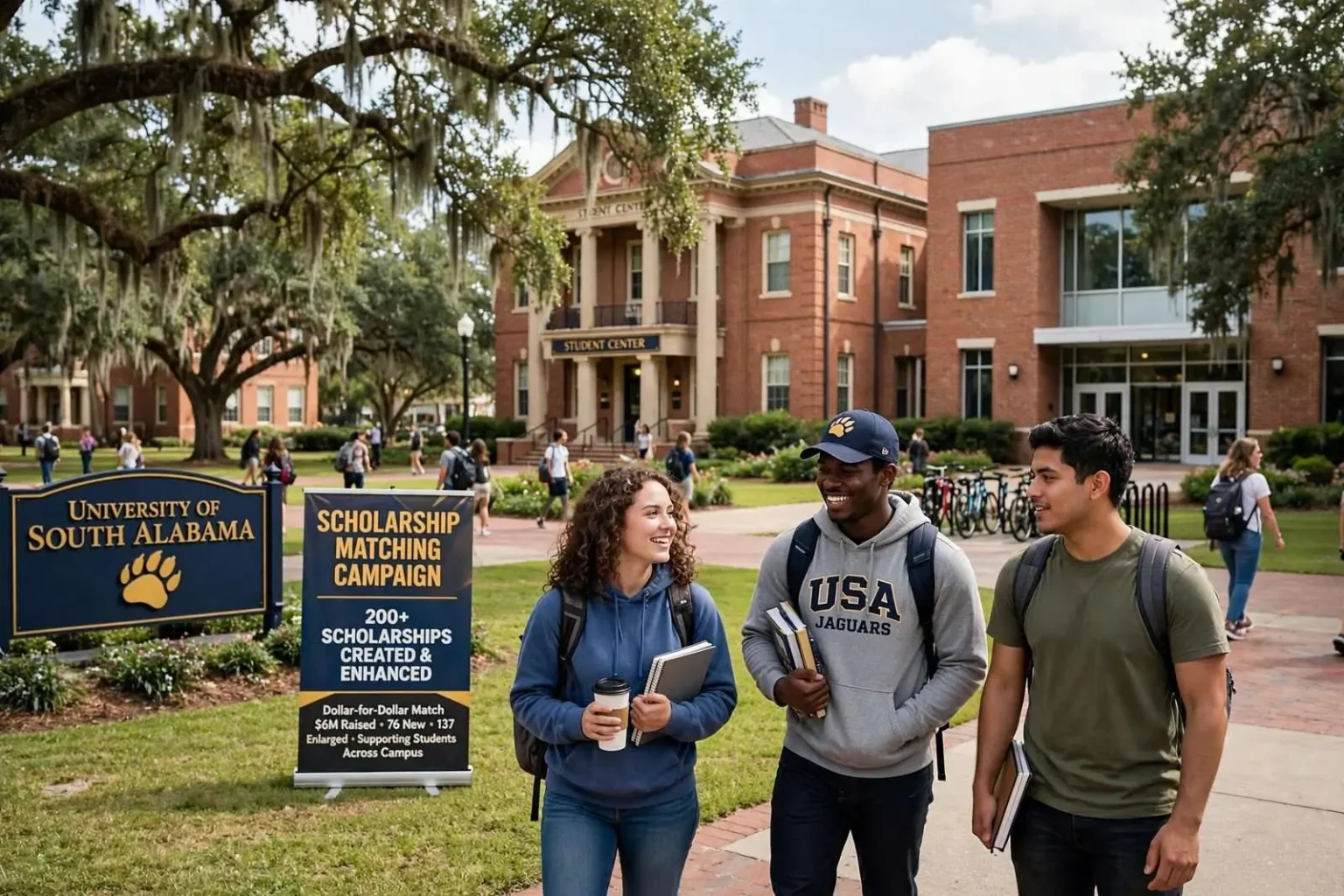
A university-wide push to grow scholarship funding at the University of South Alabama is paying off in a big way, with more than 200 new or improved scholarships created in just months, as school leaders lean on a matching-gift strategy to soften the impact of rising tuition. The effort traces back to a $50 million gift from Mobile businessman Abe Mitchell, announced during the university’s 50th anniversary celebration. Half of that donation was set aside to create a dollar-for-dollar matching program aimed at growing the university’s undergraduate scholarship endowment, an initiative now named in honor of Mitchell and the late USA president emeritus who helped shape the university for decades.
The matching program sits at the center of the university’s development strategy because it changes the arithmetic of giving for donors at nearly every level. Under a dollar-for-dollar structure, every new dollar a contributor commits to an undergraduate scholarship endowment is paired with a matching dollar from the fund, effectively doubling the impact of the gift. For donors who have hesitated in the past because the amount they could afford seemed too small to sustain a meaningful award, the match can be the difference between a modest one-time contribution and a scholarship that carries their name in perpetuity.
According to the university’s vice president for development and alumni relations, the matching structure has proven to be an unusually effective motivator for existing donors. A supporter who previously endowed a scholarship, for example, can add a modest new contribution and see it doubled by the matching funds, instantly increasing the size of the award available to a student. That dynamic has encouraged many longtime donors to expand gifts they’d already made rather than start from scratch.
Development officers say this pattern — building on existing relationships rather than cultivating entirely new ones — is one of the most efficient ways to grow a scholarship portfolio. Alumni and friends of the university who already have an emotional connection to a particular award, often established in memory of a family member or in honor of a beloved professor, need far less persuading to enlarge it than a first-time prospect would. The match simply removes the financial hesitation that might otherwise keep such a gift at its original size, and it lets the donor see a tangible, immediate result: a larger check going to a student each year.
The mechanics of an endowed scholarship also help explain why the university is focusing its fundraising energy there. An endowed award is not a one-time payout; it is a permanent fund whose investment income supports a student year after year, typically covering tuition, fees, books or housing depending on the size of the endowment. Once established, an endowment continues working indefinitely, which means every dollar matched through the campaign will keep producing aid for generations of students long after the donors themselves are gone. That permanence is what distinguishes endowment growth from annual fundraising drives, which must be repeated every year to produce the same result.
For the University of South Alabama, the campaign comes at a moment when the price of attendance weighs more heavily on families across Mobile and the surrounding region. As a public university serving a large share of first-generation college students from south Alabama and the Mississippi Gulf Coast, USA’s affordability directly shapes whether local students can pursue degrees close to home or must look elsewhere. University leaders have repeatedly emphasized that keeping a quality education within financial reach is not merely a fundraising talking point but a strategic necessity for a campus whose enrollment depends heavily on the communities within driving distance of its Mobile campus.
Since the matching campaign launched at the start of the year, it has generated roughly $6 million in gifts and formal pledges. University officials say that has translated into 76 brand-new scholarships and 137 existing scholarships that were enlarged, giving the school considerably more financial aid firepower heading into the fall term.
The pace of the campaign has surprised even some veteran fundraisers, who note that matching programs of this kind often take several years to reach the totals USA has posted in a matter of months. Part of the speed reflects the breadth of the donor base: scholarship giving touches nearly every college and department on campus, from nursing and engineering to business and the arts, so alumni with widely varying interests all have a reason to participate. Pledges, which are counted alongside cash gifts in the campaign total, also allow donors to spread larger commitments over several years while the matching benefit applies immediately.
The timing matters. USA’s Board of Trustees approved its fourth consecutive annual tuition increase this summer, and university leaders have acknowledged that scholarship growth is one of the few tools available to offset rising costs for students, since the university’s broader endowment and foundation assets are largely restricted to specific donor-designated purposes.
That restriction issue is a familiar challenge in public higher education. Much of the money held by university foundations is legally or contractually bound to the purpose the original donor intended — an endowed chair in a specific academic department, an athletic facility, a lecture series or a particular building. Those funds cannot simply be redirected to cover general expenses or financial aid, no matter how pressing the need. Growing the unrestricted portion of the scholarship endowment is therefore one of the few levers the university can pull to directly counterbalance tuition increases, and it is the reason administrators have thrown institutional weight behind the matching program rather than relying on general appeals.
Tuition pressure is hardly unique to South Alabama. Public universities across the country have faced reductions or stagnation in state appropriations over the past generation, shifting a larger share of instructional costs onto students and their families. In Alabama, where household incomes in many counties trail the national average, even modest annual increases can push a four-year degree out of reach for families without aid. Universities in the state have responded by leaning harder on philanthropy, and scholarship endowments have become the most visible battleground in that effort, because aid dollars flow directly to the students who are deciding whether college remains affordable.
For students, the difference between a small scholarship and a larger one can be decisive. Aid that covers only a fraction of tuition may still leave a gap that requires loans or part-time work, while an award that grows to cover tuition and fees can keep a student on track to graduate without debt. Financial aid administrators note that students who receive endowed scholarships also tend to persist at higher rates, since the award removes some of the financial shocks — a car repair, a family illness — that otherwise force interruptions in enrollment. In that sense, every enlarged award in the campaign represents not just money but improved odds of a degree.
University officials have framed the campaign’s early success as evidence that the Mobile community and the university’s alumni network are prepared to invest directly in students when given a mechanism that multiplies their generosity. With the matching fund still active, development staff continue to meet with donors across the region, and the expectation on campus is that the tally of new and enlarged awards will keep climbing through the academic year, adding to the more than 200 scholarships already created or expanded since the program began.
Why Endowment Growth Shapes Affordability
The scholarship push also supports the university’s longer-term financial health in ways that extend beyond individual awards. A larger undergraduate scholarship endowment gives admissions officers a stronger story to tell prospective students and their parents during campus visits and college fairs across the region. When a family compares offers from competing institutions, the size of the aid package is often the deciding factor, and a university with a deep scholarship bench can compete for talented local students who might otherwise be lured out of state by more generous award packages.
Retention matters as much as recruitment in that equation. University research across the sector consistently shows that unmet financial need is among the leading reasons students leave school before finishing a degree. By enlarging existing awards, the matching campaign helps students already on campus stay enrolled, which protects both the students’ academic progress and the university’s enrollment base. Enrollment drives state funding formulas and tuition revenue alike, so scholarship growth and institutional stability are closely intertwined, even though the connection is rarely visible to the public.
A Legacy Tied to the Match
The decision to name the matching initiative for Mitchell and the late president emeritus ties the campaign to the university’s founding generation. Mitchell’s gift, announced as USA celebrated 50 years since its establishment, ranks among the largest in the institution’s history, and its structure reflects a deliberate choice: rather than dedicating the entire sum to a single building or program, half was reserved to leverage gifts from hundreds of other donors. That design turns one act of philanthropy into a multiplier across the entire campus, seeding awards in virtually every discipline and giving contributors of all sizes a stake in the university’s future.
University leaders have described the approach as a model for future campaigns, arguing that matching structures make philanthropy accessible to donors who would never consider themselves major benefactors. A retired schoolteacher, a local small-business owner or a young alumnus paying off student loans can each see a gift of modest size doubled, and each can know the award will renew every year. The cumulative effect of many such gifts — 76 new scholarships and 137 enlarged ones so far — builds a broad base of support that is less vulnerable to the loss of any single donor.
What Comes Next
Heading into the fall term, the financial aid office will begin distributing the newly created and enlarged awards, and students will see the results in their aid packages. Meanwhile, development staff continue to work the donor pipeline, and the university’s message to alumni and friends remains straightforward: contributions to undergraduate scholarships are being matched dollar for dollar, and every match translates directly into aid. For a university community watching tuition climb for the fourth straight year, the more than 200 scholarships created in a matter of months represent the most concrete counterweight available — and, by all indications from campus, the campaign is far from finished.
The broader lesson for institutions across the Gulf Coast may be the one administrators least expected: that a well-designed match does not merely raise money, it changes how a community talks about its university. Donors who might once have viewed giving as a transaction now describe scholarship support as an investment in local students who will become local nurses, engineers, teachers and physicians. In a region where the university is among the largest employers and talent producers, that reframing may prove as valuable as the $6 million already raised — and every future dollar it continues to double.