University of South Alabama Mobile
Federal Lawsuit Over Fatal USA Campus Police Shooting Claims Student Was Seeking Help
A federal lawsuit filed over the 2012 fatal shooting of a USA freshman by a campus officer says the student was seeking help, not attacking.
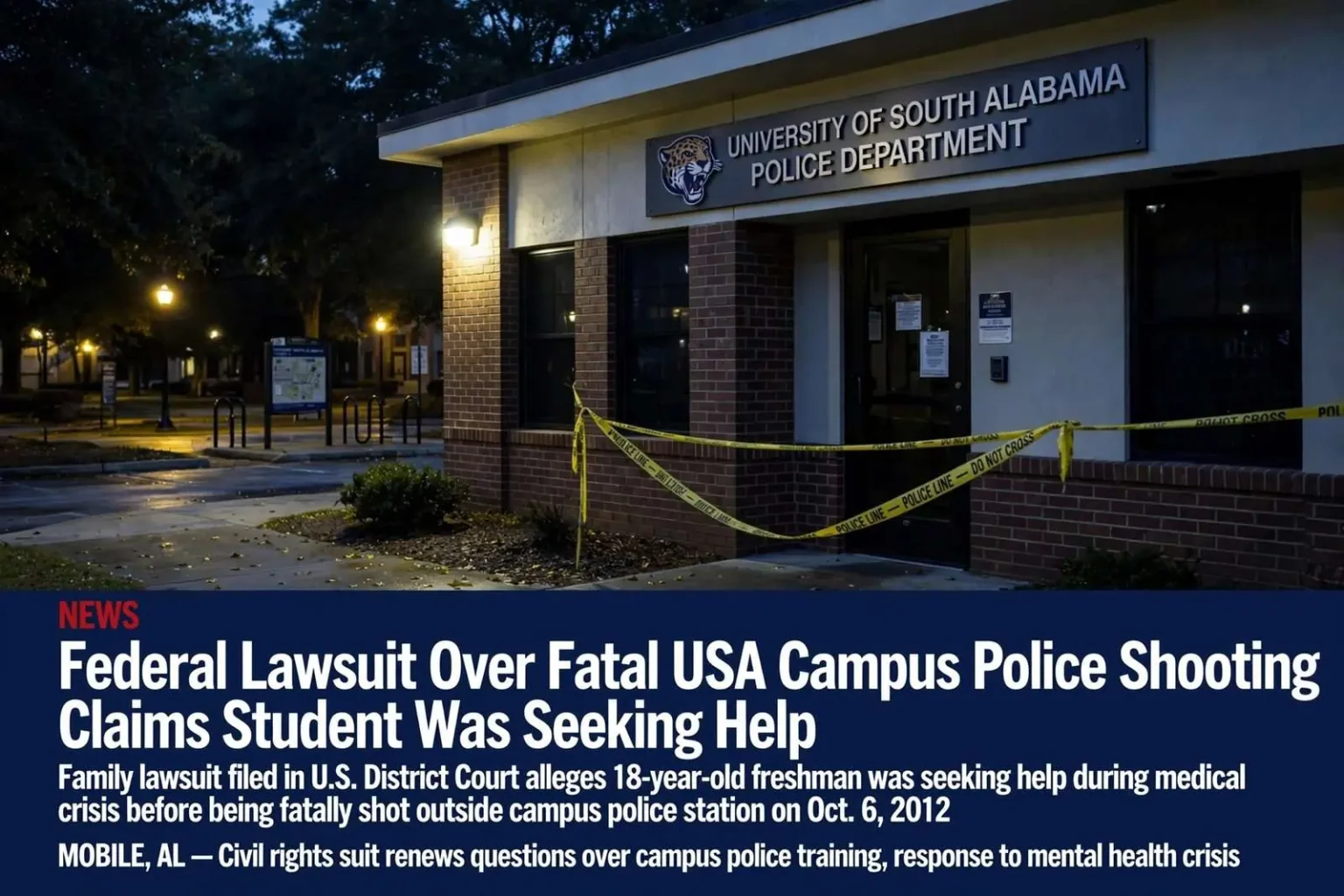
A federal civil rights lawsuit filed on behalf of the family of a University of South Alabama freshman killed by a campus police officer nearly two years earlier argues that the young man was desperately seeking assistance in his final moments, not posing a threat. The complaint, filed in U.S. District Court after attorneys for the family withdrew a related case from Mobile County Circuit Court, lays out in detail what happened in the early morning hours of October 6, 2012.
The lawsuit returns one of the most closely watched episodes in the university’s recent history to a courtroom, this time before a federal judge. It also renews questions that have lingered since the shooting about how campus police officers are trained to respond to people in medical or psychological distress, and whether less lethal options were exhausted before deadly force was used outside a police station in the middle of the night.
What the Filing Says Happened
According to the filing, the 18-year-old had ingested a synthetic drug known as 51-i-NBOMe while at a nearby music festival earlier that night. The substance reportedly left him disoriented and overheated, prompting him to remove his clothing and wander the campus in search of help. Finding no one else nearby, he eventually made his way to the university’s police station.
Synthetic drugs of that era occupied a volatile corner of the recreational drug market. Marketed under labels that suggested they were legal alternatives to controlled substances, they were sold in head shops and online with names that changed almost as quickly as regulators could restrict their chemical formulas. Users and emergency room physicians alike often had no way of knowing exactly what a given packet contained, and the compounds were associated with severe agitation, elevated body temperature, hallucination and unpredictable behavior — precisely the symptoms described in the complaint.
The lawsuit contends that even in a confused and distressed state, the student understood he needed help and believed the police station was the place to find it. Video recordings cited in earlier proceedings show him knocking on the station door, walking away, and then returning to strike a window repeatedly before an officer came outside to confront him unarmed and naked. The officer fired his service weapon during the encounter, and the student later died from the injury.
Those recordings became a centerpiece of public debate in the months after the shooting, replayed in news coverage and discussed at public meetings. To the family’s attorneys, the footage shows a deteriorating young man in the grip of a drug reaction moving toward and away from the station, behavior they characterize as erratic but not assaultive. To defenders of the officer, the pounding on the window and the sudden confrontation outside the door presented a split-second judgment call of the kind officers are forced to make.
The Earlier Criminal Proceedings
A Mobile County grand jury previously cleared the officer of criminal charges, though the county sheriff at the time publicly questioned whether the officer had adequate time to consider non-lethal options before resorting to deadly force. That public reservation distinguished the case from other officer-involved shootings in which prosecutors announced grand jury outcomes without such commentary, and it gave the family’s civil effort a talking point that has followed the litigation ever since.
Grand juries in Alabama meet behind closed doors, hear evidence presented by prosecutors, and decide only whether probable cause exists to indict. The standard is far lower than the burden a jury would apply at trial, and the decision not to indict left the civil courts as the only forum in which the family’s account of the encounter could be tested in full, with depositions, expert testimony and a public record.
Why the Case Moved to Federal Court
Attorneys representing the family say the shift to federal court was a strategic decision made after weighing the risks of the state court process. They argue the officer’s actions violated the student’s constitutional rights and also amount to wrongful death under state law. The complaint further alleges the officer failed to follow department policy that limits deadly force to situations where an officer’s life or another person’s life is in clear danger, noting the size difference between the two men and the availability of less lethal tools such as pepper spray.
The distinction matters because the two forums treat claims differently. State court wrongful death actions proceed under Alabama’s tort system, while federal civil rights claims require a plaintiff to establish that a constitutional right was violated under color of law — a framework that brings its own body of case law on the use of force, including the U.S. Supreme Court’s guidance that force must be judged from the perspective of a reasonable officer on the scene rather than with hindsight. Defendants in federal civil rights cases frequently invoke qualified immunity, a doctrine that can shield government employees from damages unless the right they allegedly violated was clearly established, and such defenses routinely shape the early stages of litigation.
The university and its police chief, who had been named as co-defendants in the original state lawsuit, were previously dismissed from that case after a legal challenge. Their removal narrowed the state proceedings to the officer alone and left open the question of whether the university itself would ever answer for its policies in court. The federal complaint gives the family a fresh procedural vehicle, and the pleading standards that govern dismissal motions in federal court differ in important ways from those that governed the state case.
Discovery Has Yet to Begin in Earnest
Attorneys for the family say they still have not had the opportunity to formally question the officer or the chief under oath, since that process was paused during the earlier state court fight. They expect the federal case to take more than a year to resolve, saying much of the evidentiary groundwork still needs to be built from scratch.
That lack of sworn testimony has defined the case as much as any filing. Without depositions, the public record consists largely of the video recordings, the grand jury’s decision and the competing public statements that followed. Depositions of the officer, the chief and other department personnel would for the first time place under oath the people who know most about the department’s training, its use-of-force policy and the decisions made in the minutes surrounding the shooting.
The Larger Questions for Campus Policing
The case remains a point of scrutiny for how campus law enforcement in Mobile handles encounters with individuals in medical or psychological distress. University police departments occupy a distinctive position in American policing: their officers are armed and empowered to make arrests, yet the populations they police are overwhelmingly young, and the calls they answer frequently involve alcohol, drugs and mental health crises rather than predatory crime.
Nationally, the years since the shooting have seen growing attention to crisis intervention training, which teaches officers to recognize the signs of medical emergencies and psychological distress and to slow encounters down where possible. Advocates for such training argue that excited delirium and drug-induced agitation present officers with symptoms that can resemble aggression, and that departments equipped with that knowledge are better positioned to resolve such encounters without deadly force. Whether the university’s department had received comparable training — and what its officers are taught about less lethal options available inside a station house — are among the questions the federal case is expected to explore.
For Mobile, the litigation also lands in a community still working through the episode’s aftermath. The university, one of the largest employers in the region, sits on a campus in the city’s western reaches, and the shooting prompted vigils, student forums and calls for a review of police practices in the months that followed. Campus leaders pledged cooperation with investigators at the time, and the university community has watched each turn in the legal process closely.
The family’s attorneys have said their goal is a full public accounting of what happened and why. Whether the federal court process delivers that accounting through a trial, a settlement or a ruling on the merits, the case is likely to shape how the university’s police department trains its officers and documents its encounters for years to come — and it stands as a reminder that the final chapter of a controversial encounter is often written not in the streets where it began, but in the slow machinery of the courts.
Legal observers note that cases of this kind often hinge on narrow factual questions: what the officer saw and heard in the seconds before the shot was fired, what training records show about responses to agitated or impaired individuals, and how the department’s written policy defined the circumstances that justify deadly force. Those are precisely the questions that depositions and expert reports are designed to answer, and both sides are expected to present testimony from use-of-force experts as the case moves forward.