University of South Alabama Mobile
University of South Alabama Approves $520,000 Study of Aging Campus Infrastructure
USA trustees approved a $520,000 study of aging pipes, cable and roofs across the Mobile campus after a series of sinkholes and pipe failures.
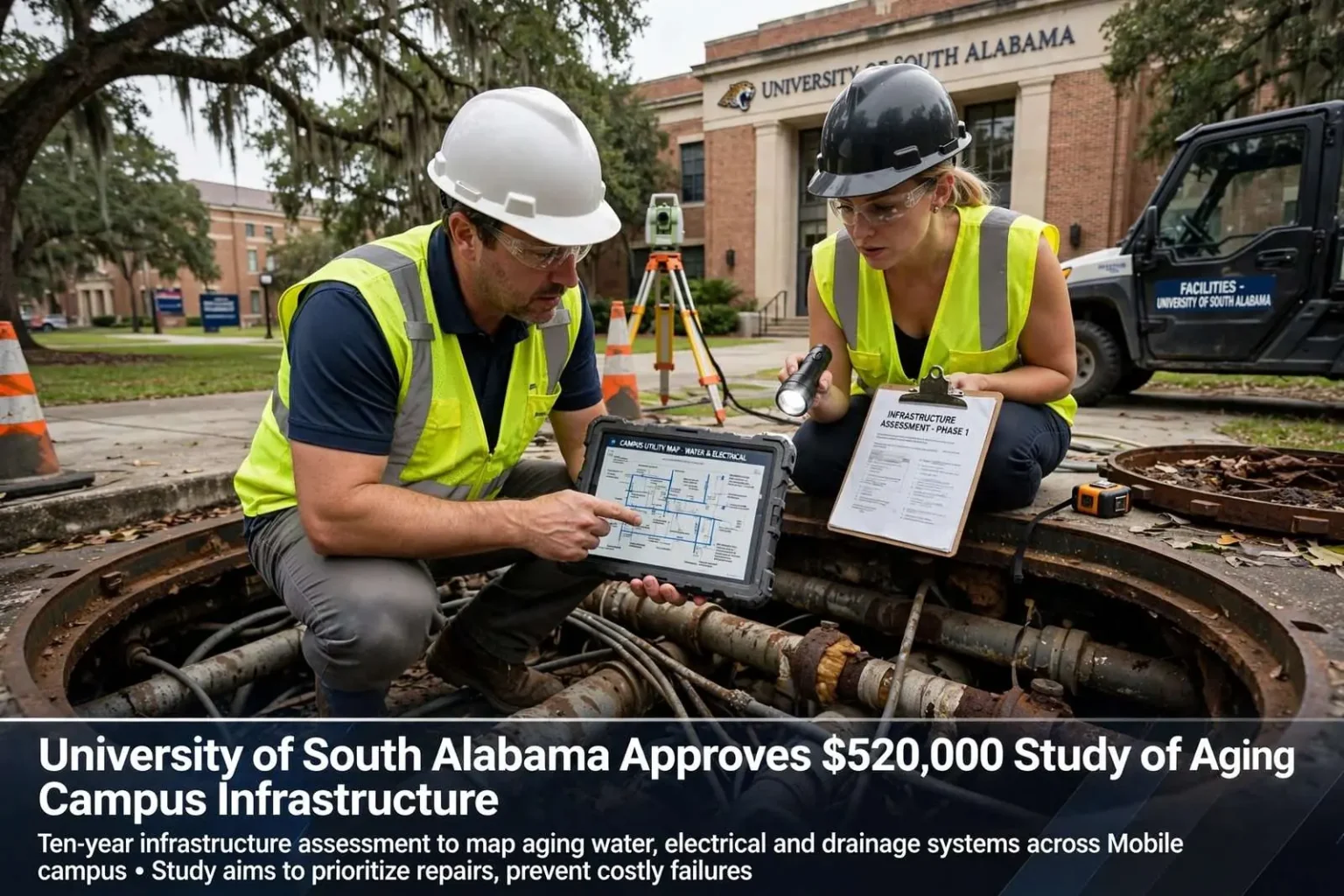
Trustees at the University of South Alabama have signed off on a $520,000 study aimed at mapping out how the Mobile campus will maintain and eventually replace its aging buildings, water pipes and electrical systems over the next decade. The vote gives administrators the authority to hire outside engineering consultants who will inventory the campus’s critical infrastructure, evaluate the condition of systems that have been buried underground or hidden above ceilings for decades, and produce a prioritized roadmap for phasing repairs and replacements across the coming ten years.
University officials plan to bring in outside engineers and infrastructure specialists to conduct the review in the coming months, according to the school’s vice president for financial affairs, who told trustees that after 50 years of operation, campus systems are increasingly starting to show their age. The assessment will look well beyond the appearance of campus buildings, focusing instead on the hidden networks — underground drainage, water lines, electrical distribution and mechanical equipment — that keep classrooms, laboratories, residence halls and offices functioning every day. Officials describe the effort as one of the most sweeping looks at the campus’s physical plant in the university’s history.
Decades of Growth Left Behind a Dated Backbone
The University of South Alabama was founded in the early 1960s and grew with remarkable speed, expanding from a handful of buildings on a tract of land in west Mobile into a comprehensive university with a medical school, a teaching hospital network and an enrollment that has made it one of the largest institutions of higher learning on the Gulf Coast. Much of that growth happened in concentrated bursts during the 1960s and 1970s, which means large portions of the campus share infrastructure of the same generation. When systems from one era wear out, they tend to wear out together — a pattern administrators say is becoming impossible to ignore.
Financial officers told the board that the study is intended to move the university away from its traditional approach of fixing what breaks, when it breaks. Consultants are expected to catalog each major utility system, estimate its remaining useful life, and rank replacement projects so trustees can budget for the most urgent work first. A decade-long horizon, officials say, will let the university spread costs across multiple budget cycles instead of confronting sudden, unbudgeted emergencies that compete directly with academic and health-related spending priorities.
The review comes at a time when universities across Alabama and the Southeast are grappling with the same problem: campuses that expanded rapidly after World War II are now caretakers of underground utilities designed for a lifespan measured in decades, not generations. Deferred maintenance has become a running theme in higher education finance, and institutions that document their needs early are generally better positioned to compete for state capital funds, bond financing and private support when those sources become available.
Sinkholes and Aging Pipes
The need for a broader study has become more apparent as problems have surfaced even in some of the campus’s newer buildings. A stormwater drain beneath the university’s activity center, which opened in 1999, collapsed roughly six months earlier after decades of gradual deterioration and had to be replaced. The failure disrupted a building that hosts some of the largest crowds on campus and offered a vivid illustration of how trouble can develop out of sight for years before announcing itself in a sudden and costly way.
At a June 5 meeting of the board’s facilities committee, administrators presented photos of sinkholes that had opened up in areas such as University Commons, caused by leaking steel pipes installed without proper insulation three to four decades ago. The corroded lines have been slowly leaking beneath walkways and green spaces, undermining the soil until the ground gives way. Crews have had to repair the voids while also tracing the leaks back to their source, work that is both disruptive and expensive when it is done reactively rather than on a planned schedule.
The campus’s electrical distribution system is facing similar issues, with roughly 60 percent of its cable now older than 30 years, well beyond the industry’s typical 25-year life expectancy. Aging electrical infrastructure raises the stakes considerably, because a cascading failure can knock out power to broad sections of campus, interrupt research, compromise building climate control during Mobile’s long, humid summers, and create safety hazards. Replacing distribution cable is also inherently slow work, since it typically involves digging trenches or boring beneath roads and utility corridors that are in constant use.
Many flat roofs on older buildings were also described as past their expected service life. Flat roofing is a persistent maintenance challenge in the Gulf Coast climate, where heavy rains, high winds and intense summer heat combine to shorten the life of membrane systems. Roofs that are allowed to fail do damage far beyond their own replacement cost, letting water into attics, ceiling cavities and electrical components. Including roofs in the decade-long plan would let the university group roof projects with other interior and exterior work on the same buildings, reducing duplication of mobilization costs.
Administrators said the inventory compiled by the consultants will help them distinguish between systems that can be nursed along with monitoring and modest repairs and those that need replacement in the near term. That kind of triage, facility officers explained, is what turns a scattered list of failures into a capital plan the board can actually fund and manage year by year.
A Central Plant Ahead of Its Time
The planned study will also examine the university’s centralized chilled-water system, which was installed in the mid-1960s under the direction of the school’s founding president. Rather than equip every building with its own heating and cooling equipment, the university built a central plant that chills water and distributes it campus-wide for air conditioning, a design officials credit with saving substantial energy and operating costs over the decades. In a climate like Mobile’s, where cooling loads drive utility bills for most of the year, the efficiency of that network has a direct effect on the university’s bottom line.
Administrators noted that the approach, unusual for its time, has since been adopted by many other universities that now build district energy systems for the same reasons. But the buried distribution network and the plant itself are decades old, and consultants will evaluate their condition alongside the rest of the utility infrastructure. Keeping the central system healthy, officials say, protects one of the university’s most valuable long-term assets, since a modernized district cooling loop can serve new construction for generations without each new building needing its own compressors, cooling towers and maintenance contracts.
What Comes Next
With the study approved, the next step is selecting the outside firms and negotiating their scope of work, with field surveys and engineering assessments expected to begin in the coming months. Findings will be reported back to the board’s facilities committee as they develop, giving trustees a running picture of where the most urgent risks lie. University leaders have indicated that the final product will be a phased, ten-year replacement plan that can be folded into future budget requests rather than a single, all-at-once construction program.
For students, employees and the broader Mobile community, the practical payoff is intended to be fewer disruptions: fewer emergency closures of buildings, fewer surprise excavations across quads and parking areas, and fewer interruptions to the classes, clinics and events the campus hosts. The university is one of the largest employers in the Mobile area, and its facilities also serve patients and families who come to campus for medical care, making reliability a community concern and not just a campus one.
The study will also give the university a documented basis for conversations with state leaders and other funding partners. Capital requests supported by independent engineering assessments carry more weight in Montgomery than general appeals for maintenance money, and a clear inventory of needs allows donors and alumni who want to help to see exactly where their support would go. University officials say the resulting plan will be revisited regularly as conditions change, ensuring the decade roadmap remains a living document rather than a report that sits on a shelf.
Trustees framed the $520,000 investment in the study as a modest price for avoiding far larger emergency costs down the road. Engineering studies of this kind routinely pay for themselves, supporters of the plan noted, by catching failures before they happen and by letting maintenance dollars follow a documented set of priorities instead of the loudest problem of the week. As campus systems cross the half-century mark, university leaders say the goal is simple: keep the institution’s physical foundation as durable as the academic and medical missions it supports.
Universities across the Gulf Coast face versions of the same reckoning as their mid-century building stock ages. Deferred maintenance accumulates quietly while budgets prioritize academic programs, and the bill arrives all at once when a major system fails. The study approved by the trustees is designed to break that cycle by giving the university a documented, prioritized map of its infrastructure before the next emergency dictates the agenda.