Political Notebook: A Former Federal Agent to Serve as Mobile’s Interim Sheriff
Under an arcane provision of Alabama law, retired federal agent David A. Evans Sr. was set to be named a special coroner so he could assume the duties of Mobile County sheriff after Jack Tillman's plea.
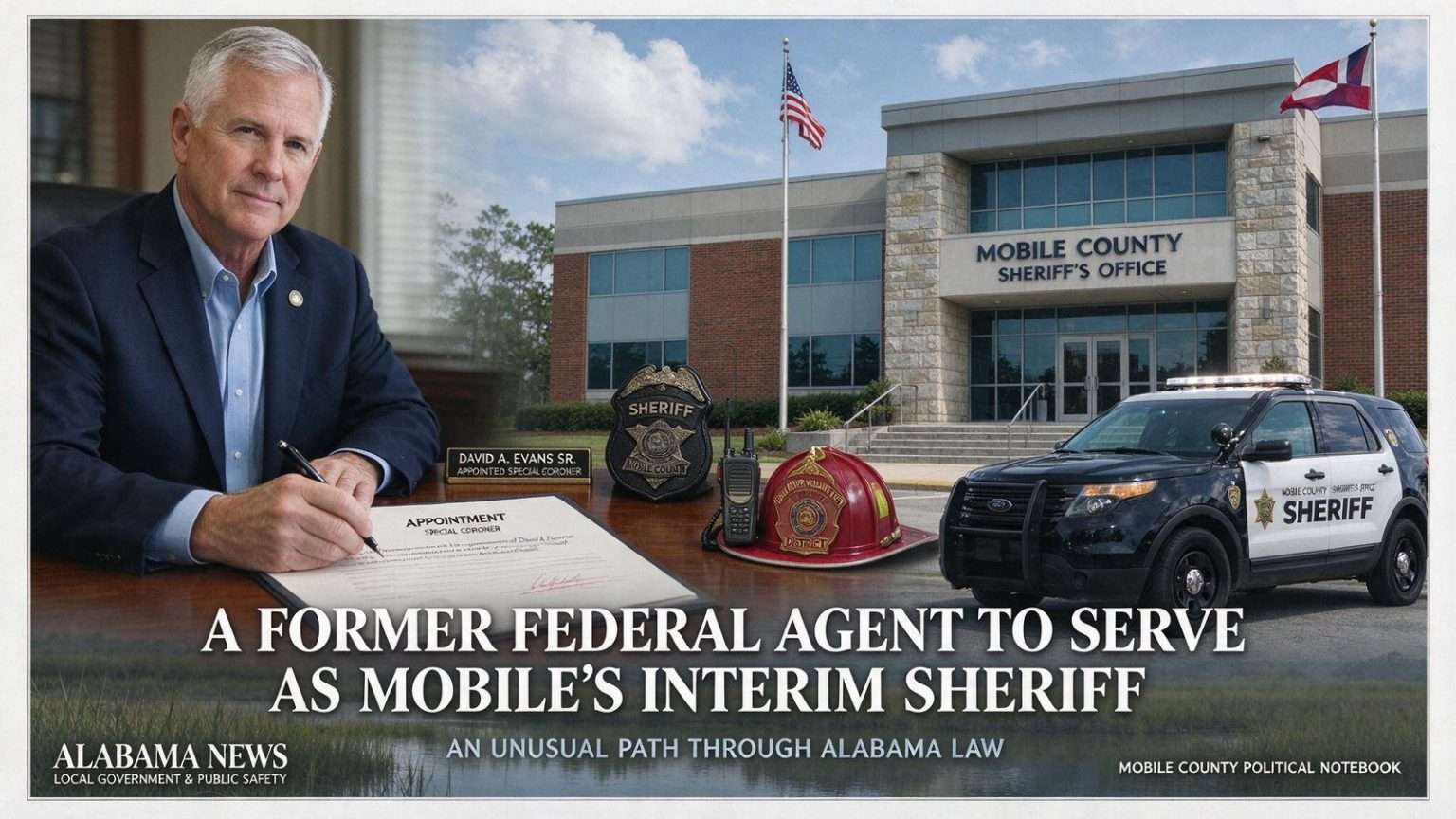
Under an arcane provision of Alabama law, former federal law-enforcement agent David A. Evans Sr. was set to be appointed a special coroner of Mobile County on Friday, April 14, enabling him to assume the duties of sheriff — a post vacated by former Sheriff Jack S. Tillman in the wake of his guilty plea to misdemeanors connected to his operation of the department, sources reported.
The arrangement sounds strange to modern ears, but it is a genuine feature of Alabama’s constitution-era legal machinery. The state’s constitution requires that a sheriff be available to keep the peace, and in counties where the office of coroner has been abolished, the law preserves a workaround: a special coroner may be appointed to perform the sheriff’s duties when the elected sheriff cannot. It is a mechanism few Alabamians have ever heard of and fewer still have seen used — and Mobile County has now needed it twice in a matter of months.
An unusual path to the office
Evans, 68, had served six and a half years with the U.S. Customs Service and 15 years with the U.S. Secret Service, switching to Customs in order to remain in Mobile after Secret Service superiors directed his transfer to Washington. The decision — a federal career reshaped around a family’s roots in the Gulf Coast — made him a familiar figure in Mobile law-enforcement circles long before his name surfaced in connection with the sheriff’s office.
Mobile County Probate Judge Don Davis was to make the appointment, much as he had earlier named Mobile attorney Chuck Miller a special coroner to serve Tillman with his indictment. The mechanism was necessary because Mobile had abolished the office of coroner nearly two decades earlier in favor of a more highly qualified medical examiner. The modernization was widely considered a public-health advance — medical death investigations belong with physicians rather than elected officials — but it left the county without the traditional officer the old law expected to step in for a disabled sheriff.
Evans was expected to serve until the Republican nominee for sheriff was determined in that year’s elections; the GOP primary was set for June 6, with five Republicans and five Democrats seeking the office. The crowded field on both sides reflected the unusual circumstances of the race: Tillman’s decision not to seek a fourth term had opened the seat, and the turmoil surrounding his final months had made the office the most talked-about job on the county ballot.
Evans said he was neutral in the contest and that any pay tied to the appointment had not been discussed. He asked that fuller comment wait until the appointment became official, though he generally confirmed the report. His brief tenure, however long it lasted, would carry the full legal authority of the sheriff’s office — jail oversight, civil process, court security and the day-to-day command of one of the largest law-enforcement operations in Alabama.
A life of service
Evans and his wife, Elizabeth, lived near Fowl River in south Mobile County and held leadership positions at Westminster Presbyterian Church. A former chairman of the Mobile County Republican Executive Committee, Evans remained active with the Fowl River Volunteer Fire District, still responding to calls — “too many brush fires recently,” he noted.
The volunteer fire work is a distinctive marker of life in south Mobile County, where rural districts outside the city limits of Mobile depend on volunteer companies for first-line fire protection. Fowl River’s district covers a spread-out peninsula community of waterfront homes, woods and marsh where brush fires are a recurring hazard in dry weather. That a 68-year-old former federal agent still answered the pager said something about how he had spent his retirement years: close to home, and useful to it.
His civic résumé was long and varied. As chairman of the county’s Republican Executive Committee, he had helped guide local party politics through a period of growth, and his federal service had given him both investigative experience and administrative background. A native of Baltimore raised in Atlanta, he had put down deep roots in Mobile, and his family’s ties to local law enforcement ran through the next generation: he had a son, David “Skip” Evans Jr., a detective sergeant with the Mobile Police Department.
Friends and associates described the appointment as fitting in one respect — the office was passing to someone with a career of public service behind him rather than to a caretaker with no background in the work. Whether the interim sheriff’s duties ran for weeks or months, the county’s top law-enforcement post would be held by a man with more than two decades of federal investigative experience.
How Tillman’s tenure ended
Tillman had stepped down earlier that week, short of completing his third term, as the result of a plea bargain. A Mobile County grand jury had indicted him the previous April on two counts of perjury, one count of using his office for personal gain and two counts of theft, following a bitter dispute with District Attorney John Tyson Jr. over the jail food fund and a law-enforcement seminar managed by his sister-in-law, Brenda Pate.
The jail food fund had become the defining controversy of Tillman’s final term. Alabama sheriffs have historically operated county jails under a state framework in which food-service appropriations and surplus funds are managed at the sheriff’s discretion — a system that has drawn scrutiny in counties across the state. The grand jury’s questions about the Mobile County operation and the separately managed seminar escalated into a public fight between the sheriff and the district attorney’s office that dominated county government for months.
A former professional boxer, Tillman had been elected sheriff in 1994 after 16 years as a school resource officer, and his decision not to seek a fourth term had drawn 10 candidates into the race. His tenure spanned a period of enormous change for the department — a growing metro jail population, post-September 11 security demands, and modernization of a force whose roots stretch back to the eighteenth century, when the office of sheriff predated Mobile’s incorporation as an American city.
That history, and the manner of its latest chapter, made the June 6 primary unusually consequential. Whoever emerged from the crowded field would inherit not only the routine duties of the office but the task of restoring public confidence after an indictment, a plea and an interim appointment arranged through a legal mechanism most residents had never heard of. The five Republicans and five Democrats campaigning for the job each promised, in their own way, a fresh start.
For Evans, the appointment represented a coda to a career rather than a new beginning. He had come to law enforcement in an era of carbon paper and two-way radios, served two federal agencies, and retired to volunteer fire calls and church work on Fowl River. Being asked to steady a county office in crisis was, as one associate might put it, simply another form of answering a call — the same instinct that kept him riding out to brush fires in south Mobile County when most men his age had long since stayed home.
The Probate Judge’s office said the paperwork would be completed ahead of the Friday appointment, and county officials indicated the transition at the sheriff’s department would be orderly. Whether the special coroner’s tenure lasted until the June primary or through a runoff into the fall depended entirely on the voters — and on a Republican field that, for once, would choose not just a nominee but the sheriff’s successor in everything but name.
Also noted
Experienced criminal defense attorney Neil Hanley joined the team defending Gordon Waller, who had resigned as executive director of the Alabama Safety Institute amid charges that he extorted sex from a young man by using his influence to keep the man out of jail. Hanley would assist attorney Claude Boone in the case.
The case against Waller had drawn attention well beyond Mobile’s legal community because of what it suggested about the intersection of private programs and the criminal justice system. The Alabama Safety Institute’s work placed it in regular contact with courts and offenders, and prosecutors alleged that Waller had converted that position of trust into leverage over a vulnerable young man. Waller’s resignation and the defense buildup around him indicated the case would be contested vigorously, with Hanley’s decades in criminal courtrooms adding weight to the defense table.
Meanwhile, the countdown to the June 6 primary continued to give the sheriff’s story its real ending. With five candidates on each side of the ballot, no one expected the June vote to settle the matter outright; Alabama law required a majority to win a nomination, and a runoff in early July remained a live possibility. That timeline meant Evans could be wearing the sheriff’s badge well into the summer, overseeing the jail, the deputies and the courthouse security the department provides across Alabama’s second-largest county until an elected successor takes over.