University of South Alabama Mobile
Beyond the Obvious: Mobile Insiders Sort the Winners and Losers of the 2006 Election
Bob Riley won, Luther Strange and John Tyson lost. But when the sun came up Wednesday, Mobile-area political hands saw a more complicated ledger of winners and losers across Alabama.
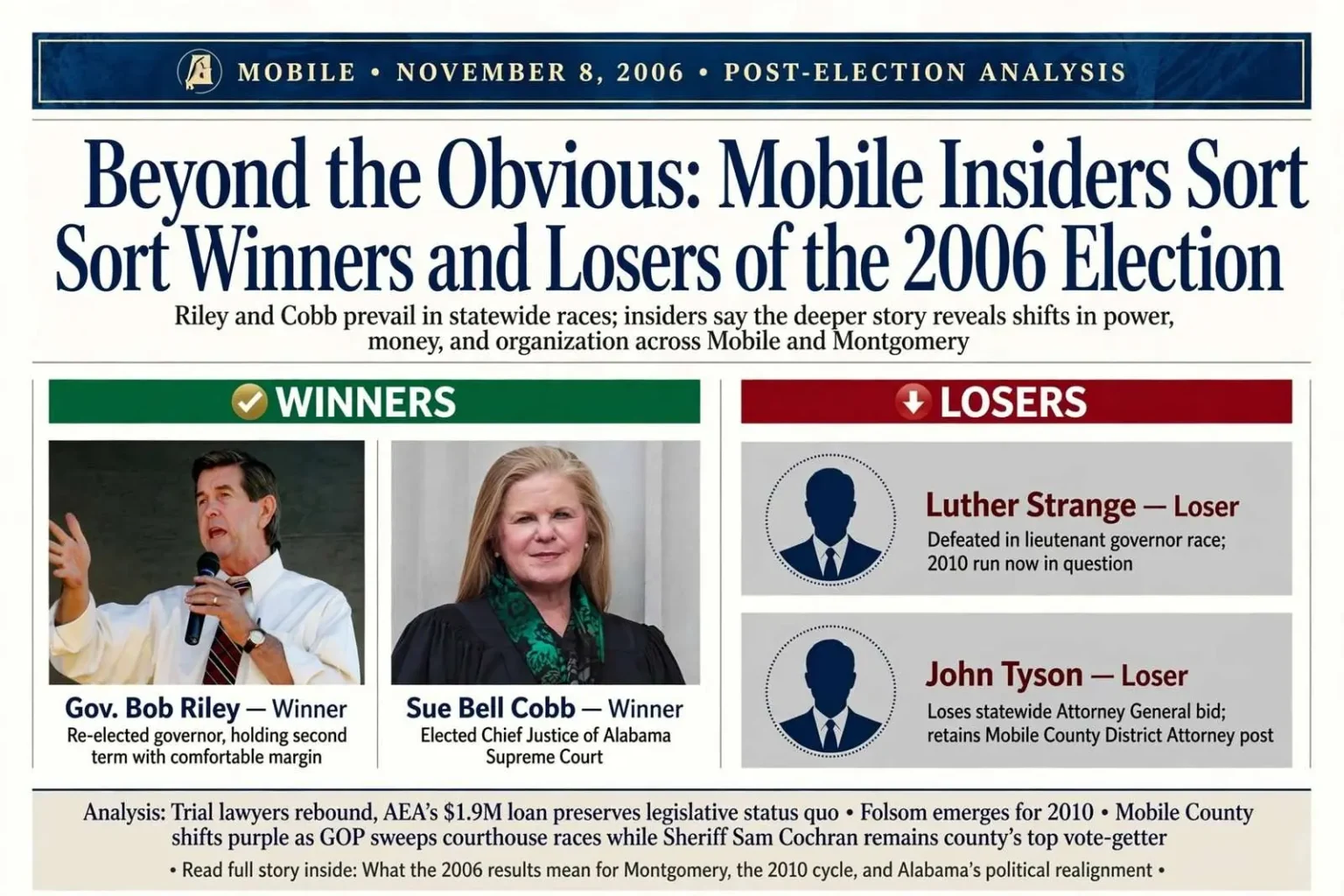
Bob Riley, winner. Luther Strange, loser. John Tyson, loser. Sue Bell Cobb, winner. Those verdicts were as plain as the results themselves. But candidates are only part of an election’s story, and when the sun came up the Wednesday after the 2006 general election, seasoned Mobile-area political hands saw a far more complicated ledger. In conversations following the vote, insiders across the ideological spectrum offered their reading of who really won and who really lost.
The obvious scoreboard told only part of it. Riley had been re-elected governor comfortably, Cobb had won the chief justice’s office, and Mobile County’s own contests had produced their share of surprises and confirmations. The deeper question — what the results meant for the balance of power in Montgomery, for the 2010 cycle already taking shape, and for the factions that run Alabama politics — was where the real analysis happened.
The Winners
Trial lawyers topped many lists. Democrats held the state Senate and, with Cobb’s victory in the chief justice race, established what one observer called a beachhead on the Alabama Supreme Court. For a legal community that had spent years on the defensive against business-backed judicial candidates and tort reform campaigns, a Democrat winning the court’s top seat statewide counted as a reversal of fortune with consequences for every civil docket in the state.
Alabama Education Association chief Paul Hubbert also drew praise from rivals: a reported $1.9 million loan had, in the words of one analyst, essentially preserved the status quo in Montgomery, leaving the House and Senate friendly to the association’s interests. The loan, made from AEA’s resources in the campaign’s closing stretch, funded the down-ballot efforts that decided legislative races few voters could name but every interest group in the State House had scored.
Several insiders pointed to the enduring power of a populist, fight-for-the-little-guy message, which they said carried both Jim Folsom in the lieutenant governor’s race and Cobb to the bench. In a state where economic anxiety runs alongside cultural conservatism, the appeal that had defined Alabama Democratic politics for generations — defense of the little guy against the powerful — demonstrated it still worked, at least in the right races with the right candidates.
Folsom emerged, by common agreement, as an early favorite for the Democratic gubernatorial nomination in 2010. His second stint as lieutenant governor began with the kind of goodwill that money cannot buy: he had beaten a well-funded challenger, run ahead of his ticket’s expectations, and emerged as the one statewide Democrat with both a fresh mandate and a plausible path to the top of the ticket.
Locally, Sheriff Sam Cochran was described as perhaps the most popular elected official in Mobile County, drawing the highest vote total of anyone on the county ballot. The sheriff’s office, with its countywide jurisdiction over law enforcement and the jail, rewards incumbency like no other local post, and Cochran’s totals confirmed a personal popularity that transcended the ordinary partisan breakdown of the county’s voters.
Councilman Ben Brooks claimed a hard-fought Senate District 35 victory over veteran Democrat Gary Tanner, a result several observers called the biggest local prize of the night. The race, among the most expensive and hard-fought legislative contests on the Gulf Coast, flipped a seat held by a senior Mobile County legislator and shifted the region’s voice in a Senate whose margins were anything but comfortable. For Mobile’s Republicans, it was the cycle’s signature win; for its Democrats, the clearest warning.
Circuit clerk-elect JoJo Schwarzauer and the Mobile County Republican Party, which swept the contested countywide races, also earned mention. The sweep confirmed the county’s drift toward the GOP in courthouse offices, the kind of down-ballot dominance that builds durable organizations: every clerk, commissioner and judge elected under the party banner becomes part of a network that recruits, funds and turns out the next cycle’s candidates.
The Losers
Luther Strange, who ran a strong race after coming from relative obscurity, absorbed the night’s most painful defeat, watching his hopes for the lieutenant governor’s office and a possible 2010 gubernatorial run evaporate. The loss carried a double cost: the office itself, and the presumption of inevitability that had surrounded his candidacy since he cleared a Wallace out of the Republican primary. Recovery was possible — Alabama politics is full of second acts — but nothing about the morning after suggested an easy one.
John Tyson, the veteran Mobile County district attorney, also finished in the losing column, falling short in his statewide bid for attorney general against Republican incumbent Troy King. The defeat was double-edged: Tyson lost the state office but retained the district attorney’s post, giving him a perch for future ambitions even as the AG’s office — a traditional launch pad — stayed in Republican hands.
The Deeper Ledger
Beyond individual fortunes, the insiders’ verdicts mapped the structural forces that would govern Alabama politics for the next cycle. A Legislature organized by Democrats and friendly to the AEA, a supreme court with one prominent Democrat at its head, and a popular Republican governor who had just won a second term — the combination guaranteed continued combat over budgets, courts and the annual question of who speaks for the state’s business establishment.
The results also clarified the 2010 chessboard years in advance. Folsom’s standing made him the Democratic frame around which a gubernatorial contest would be built; Riley’s second term would be consumed, in part, by speculation about his allies and his legacy; and the legislators who survived — on both sides — began the next round of positioning the day after the votes were counted. In Alabama, the morning after an election is never just a morning after; it is the starting gun for the following one.
For Mobile County specifically, the mixed verdicts captured a county in transition. A Republican councilman had taken a Senate seat the Democrats had held, the party had swept the courthouse races, and yet the county’s most popular official was its Democratic-leaning sheriff and the region’s Democratic machine had shown it could still raise money and fight. The county’s politics were neither blue nor red so much as purple in the middle of a long reordering — and everyone quoted in the post-election conversations knew it. Veterans of earlier realignments, the Democrats who had once dominated every courthouse office and the Republicans who had spent decades chipping away at that dominance, agreed on little else except that the trend lines pointed in one direction and the timetable was no longer anyone’s to dictate.
The winners’ column came with its own caution, several observers noted. A beachhead is not a majority, a loan is not a mandate, and a chief justice elected statewide inherits a court where every contentious ruling is measured against the campaign that produced her. What the 2006 results settled was less about the future than about the present: who would hold the levers of power for the next four years, and who would spend those four years — as defeated politicians in Alabama always do — looking for the next door to open.
What the Insiders Agreed On
For all the ideological spread among the observers, certain conclusions crossed party lines. Money had mattered — the AEA’s loan was cited by people who deplored it as much as by those who welcomed it. Message had mattered — the populist appeal that carried Folsom and Cobb was described with a respect bordering on envy by Republican analysts. And organization had mattered, from the courthouse sweep to the Senate race, wherever one side had simply worked harder at the unglamorous mechanics of turning out voters.
The 2006 election also settled a running argument about Alabama’s electorate. The same voters who re-elected a Republican governor by a wide margin split their tickets down the ballot, keeping Democrats in control of the Legislature and electing a Democrat as chief justice. Analysts who had predicted a uniform Republican tide were left explaining, once again, that Alabama voters evaluate candidates as individuals — and that statewide coattails in the state are shorter than the party professionals on both sides prefer to admit.
Mobile’s post-election conversations, conducted in law offices, committee rooms and the courthouse cafeteria, produced no consensus on what it all meant. But the exercise itself said something about the state’s political culture: elections here are followed the way other states follow professional sports, with a stat-obsessed audience that grades every performance, remembers every score and begins speculating about the next season before the confetti is swept up.
By the following week, the verdicts that mattered were already hardening into the conventional wisdom that would shape the next four years: Riley ascendant, Folsom positioned, Cobb tested, and the Legislature’s balance — the prize every interest group actually cares about — unchanged. The winners would spend the term defending their gains; the losers would spend it plotting reversals. In Alabama, that is what passes for consensus.