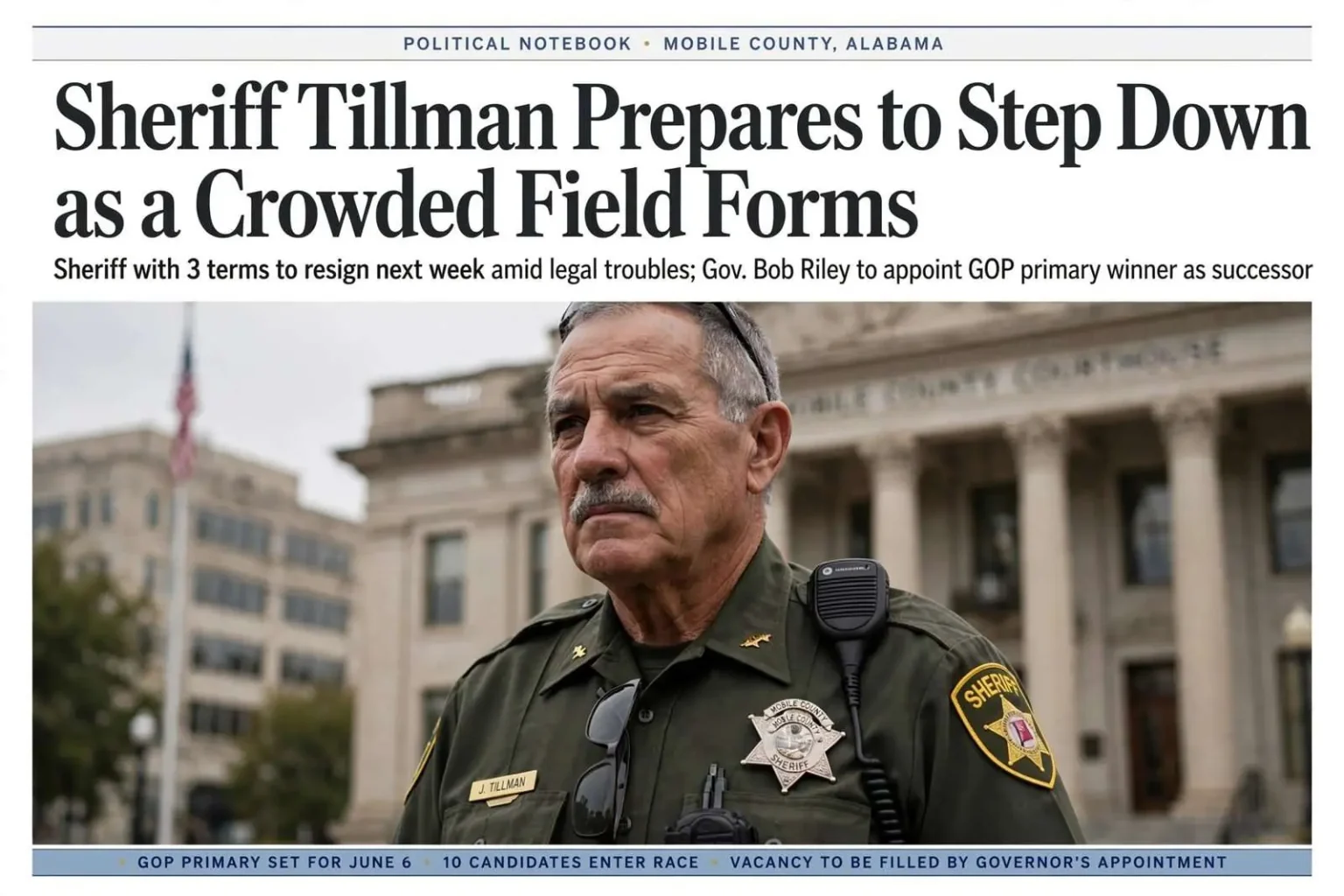
Mobile County Sheriff Jack Tillman planned to step down the following week, cutting short his third term in office, sources close to the matter reported. Gov. Bob Riley, who held the authority to fill the vacancy, was aware of Tillman’s plans and intended to name as his successor whoever won the Republican nomination for sheriff, according to sources close to the governor. The GOP primary was set for June 6, which meant the state’s top officeholder would effectively be handing the office to the winner of a contest already crowded with candidates from both parties.
The arrangement underscored how much weight the race carried. A sheriff’s departure in the middle of a term sets off a chain of events that reaches all the way to the governor’s office, and in this case Riley’s plan meant the appointee would be a caretaker whose legitimacy rested on the primary verdict. For voters, the June 6 ballot was suddenly about more than choosing a nominee — it was about choosing the next sheriff of Alabama’s most populous county.
A departure tied to legal troubles
Tillman’s retirement appeared linked to a plea arrangement in connection with charges pending against him, though efforts to confirm that were unsuccessful, and neither Tillman nor the district attorney’s office would comment. A Mobile County grand jury had indicted the sheriff the previous April on two counts of perjury, one count of using his office for personal gain and two counts of theft.
The charges grew out of a long and rancorous dispute between Tillman and the office of District Attorney John Tyson Jr. over the sheriff’s handling of the jail’s food-fund monies and a law-enforcement seminar managed by Tillman’s sister-in-law, Brenda Pate, who also worked in the department. The feud between the two offices had simmered for years, and it turned on questions of how money collected for feeding inmates was actually being spent — a subject that had drawn scrutiny from deputies, attorneys and auditors long before the grand jury took up the case.
Among the allegations was an illegal withdrawal of nearly $13,000 from the jail food fund that Tillman was said to have placed in a personal retirement account. The claim became the centerpiece of the dispute, a concrete figure in an otherwise sprawling disagreement over accounts, paperwork and authority. Jail food funds have been a recurring flashpoint in Alabama county politics, where sheriffs traditionally control the money collected for inmate meals, and disputes over how much of it can supplement a sheriff’s own income have reached the state legislature repeatedly over the years.
The indictment itself arrived the way grand jury presentations usually do in Alabama: quietly, through sworn testimony presented in secret, followed by a public hand-up of the charges. Perjury counts accuse a witness of knowingly lying under oath, while theft and using-office-for-personal-gain charges strike directly at a public official’s conduct in the job. Fighting any of the charges would have consumed months of court appearances, depositions and legal fees, which is one reason a negotiated resolution — if that is indeed what was in the works — would appeal to both sides. A plea would spare the state a trial and spare the county the spectacle of its sitting sheriff in the dock, but it also leaves open questions about accountability that only the court file can eventually answer.
For a lawman who had spent decades in uniform, the legal cloud was a stunning turn. The sheriff’s office touches nearly every corner of county government — the jail, courthouse security, rural patrol, warrants — and its head answering criminal charges while still holding the badge made for an extraordinary stretch in Mobile County government.
A lawman’s career
Tillman’s path to the sheriff’s office was an unconventional one. A former professional boxer, he had been elected sheriff in 1994 after 16 years as a resource officer in the Mobile County Public School System, where he worked campuses across the county and built the name recognition that carried him into countywide office. The boxing past gave him a colorful biography — a fighter in the literal sense — and he won re-election twice, making the departure now a cut short of a completed third term.
Sheriffs in Alabama are constitutional officers with wide discretion over their departments, and Tillman’s three terms spanned an era of enormous change: the expansion of the Metro Jail, shifts in drug enforcement, the growth of the county’s suburbs and the professionalization of a department with hundreds of sworn deputies. Whatever the final accounting of his tenure, the man leaving the office had held it through more than a decade of the county’s history, and his resignation marked the first open race for the job since 1994.
Ten seek the office
Tillman’s earlier announcement that he would not seek a fourth term had opened the floodgates. Ten candidates entered the race: among Republicans, Deputy Chief Mark Barlow, Deputy Kyle Callaghan, former Mobile Police Chief Sam Cochran, ex-deputy Rick Daves and Deputy Bobby Hartmann; among Democrats, Billy Ray Stroups, businessman Matt Tew, Prichard magistrate supervisor DaVon Grey, detective Donald E. Lunceford and bondsman Clint Ulmer.
The Republican field read like a cross-section of the county’s law-enforcement establishment. Barlow held the deputy chief’s post inside the sheriff’s own chain of command, giving him an insider’s command of the department’s operations. Callaghan and Hartmann brought the credentials of serving deputies, while Daves offered the perspective of a former member of the department. Cochran’s name, though, carried the broadest recognition: a former chief of the Mobile Police Department, he stepped into the race with citywide prominence and a résumé that spanned decades of policing in the Port City.
The Democratic side was just as varied. Stroups and Tew represented the businessman and private-citizen wing of the party, while Grey arrived from the Prichard municipal government, where he supervised magistrates in one of the county’s oldest cities. Lunceford, a detective, brought an investigative résumé, and Ulmer’s years in the bonding business gave him daily familiarity with the jail, the courts and the clientele that moves through both. The office carried an annual salary of nearly $111,000 and a four-year term, making it one of the most significant prizes on the county ballot.
What the transition means for the county
The mechanics of the handoff matter as much as the politics. Because Tillman was leaving before his term expired, the vacancy falls to Gov. Riley under Alabama law, and the governor’s stated intent — to appoint the winner of the June 6 Republican primary — effectively converted the primary into the real election for the remainder of the term. In a county where Republican nominees routinely prevail in countywide general elections, the Democratic primary winner would still need a November victory to hold the office beyond the appointment, but the appointee would walk into the job with the power of incumbency and the apparatus of the department already at hand.
Whoever takes the oath inherits a department dealing with the fallout of the Tillman era: a jail operation whose food fund has been at the center of a public dispute, a rank and file watching the legal proceedings against its own sheriff, and a working relationship with the district attorney’s office that will need rebuilding regardless of who wins. Restoring public confidence in the finances of the jail operation and smoothing over the rift with prosecutors will be among the first orders of business for the next sheriff.
The timing also compresses the campaign. With the primary set for June 6 and the resignation coming only days before, the ten candidates have had to make their cases to voters in a sprint rather than a marathon, and the unusual circumstances have kept the race in the news at every turn. Turnout in a sheriff’s race is typically driven by name recognition and straight-party voting, but a field this crowded means the winner could emerge with a modest share of the vote and a coalition built from a few strong neighborhoods or precincts.
A storied office at a crossroads
The Mobile County sheriff’s office is one of the oldest law-enforcement institutions on the Gulf Coast, tracing its lineage to the earliest days of the county, and its leader answers to every unincorporated resident as well as the municipalities that rely on county services. The next occupant will set policy for the jail, appoint deputies and command one of the largest sheriff’s departments in the state — all while the memory of the Tillman dispute shapes how the public judges the office.
For now, the county watches a three-act drama wind down: an indicted sheriff preparing to leave, a governor ready to appoint, and ten candidates fanning out across the county in pursuit of the nomination that matters. The June 6 primary will decide who holds the badge next, and the circumstances of Tillman’s exit guarantee that whoever wins will be measured against the turmoil they are inheriting from the first day in office.