Cash Flows in the GOP Race to Succeed Sheriff Jack Tillman
Campaign finance reports filed ahead of the June 6 primary showed three well-funded Republicans jockeying to succeed retiring Mobile County Sheriff Jack Tillman, each strong in a different way.
The race for the Republican nomination for Mobile County sheriff was shaping up as a genuine contest, campaign finance reports filed ahead of the June 6 primary showed, with three well-funded candidates jockeying to succeed retiring Sheriff Jack Tillman. Tillman, a two-term sheriff, was stepping aside rather than seeking re-election, leaving the office open for the first time in years. That vacancy helped attract a competitive Republican field and a wave of early fundraising, as candidates moved quickly to build name recognition ahead of the primary.
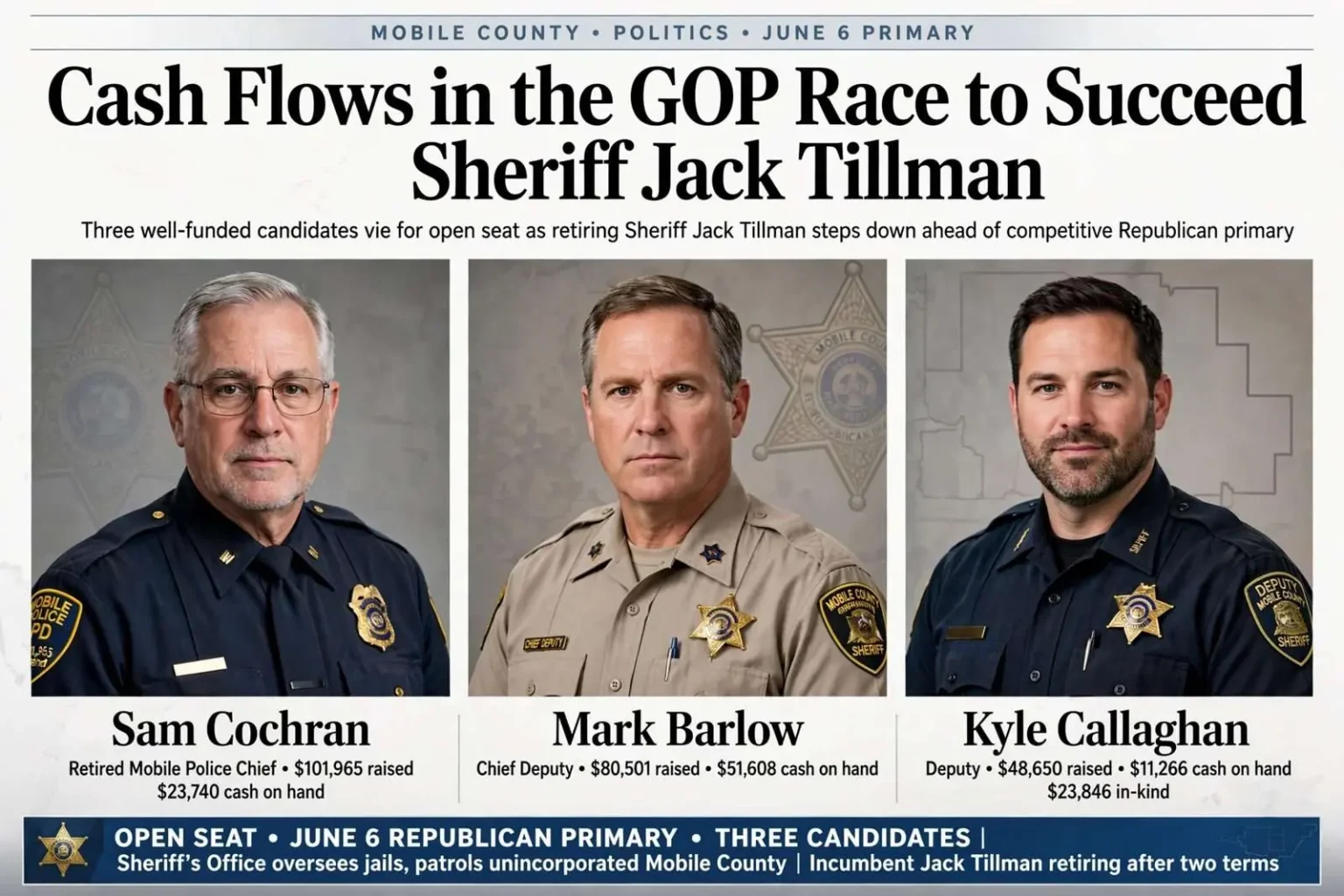
In a county where the sheriff’s office runs the metro jails, patrols unincorporated areas and employs hundreds of deputies, the open seat drew unusually broad interest. The pre-election reports told a nuanced story about who had money and who had momentum. Retired Mobile Police Chief Sam Cochran, a first-time candidate, raised the most money during the reporting period, but Chief Deputy Mark Barlow entered the campaign’s final six weeks with the most cash on hand. Deputy Kyle Callaghan was also very much in the mix, ranking third in contributions and second in spending.
Two other Republican hopefuls, Bobby Hartmann and Rick Daves, had no reports on file, effectively leaving the contest to the trio of Cochran, Barlow and Callaghan. Whoever emerged from the June 6 primary would carry the Republican label into a county where the party’s nomination has historically been the decisive hurdle in countywide races.
The Numbers Behind the Race
Cochran reported cash contributions of about $101,965, along with $9,400 in in-kind support, expenditures of roughly $78,225 and a closing balance of about $23,740. His lower cash-on-hand figure was arguably misleading, since he had already paid for television commercials that had not yet aired. In other words, much of the money he had raised was already converted into airtime that would reach voters in the campaign’s closing stretch, even though it no longer sat in his account.
His largest expenditure was about $72,000 to a local advertising firm, a figure that confirmed where the campaign’s priorities lay. In a countywide race spanning Mobile’s sprawling media market, television remains the only practical way to introduce a candidate to hundreds of thousands of voters at once, and the advertising buys dominated every serious campaign’s budget.
Barlow closed the period with roughly $51,608 on hand after raising $80,501 in cash contributions and holding expenditures to about $28,893. His biggest single outlay was roughly $11,773 to a Mobile advertising agency, modest by comparison with Cochran’s buy, which meant his financial strength took the form of a war chest still largely unspent. A candidate with cash in the bank entering the final six weeks can respond to events, counter an opponent’s advertisement or fund a late surge of yard signs and direct mail.
Callaghan raised about $48,650 in cash and led the field decisively in in-kind contributions, reporting nearly $23,846 in donated goods and services. After spending about $37,682, he ended the period with roughly $11,266 on hand. His largest expenditures went toward advertising assistance and signs. The heavy in-kind total suggested an operation built on donated labor, materials and venues — the classic signature of a campaign powered by volunteers and personal networks rather than television money.
A Broad Base of Donors
The reports read like a roster of Mobile’s business and civic life. Cochran’s contributors included construction firms, physicians, seafood and towing businesses, and a large political action committee gift, along with dozens of $500 and $1,000 donations. As a retired police chief running for an office that works hand in glove with the police department, he drew support from communities that intersect with law enforcement and the businesses that serve it along the Gulf Coast.
Barlow drew heavily on contracting, paving and industrial-supply companies, several PAC contributions and a number of fish-fry fundraisers. The pattern tracked the constituencies of a career chief deputy: road builders and suppliers with an interest in the sheriff’s work crews and jail operations, and the neighborhood fundraisers that have long anchored Mobile County’s retail politics. Fish fries remain a staple of the local campaign calendar precisely because they let candidates shake hundreds of hands in an evening while raising steady money at modest ticket prices.
Callaghan’s list featured bakeries, insurance and real-estate figures, law firms and a mix of civic donors, including notable in-kind support covering food, beverages and rent. Donations of food and venue space do not appear as cash on a finance report, but they are real campaign resources, and Callaghan’s decisive lead in that category indicated a dense network of supporters willing to give in kind what they could not or did not give in cash.
Notably, contributions crossed some of the campaign’s own lines. A committee tied to the outgoing sheriff gave to Barlow, while several donors appeared on more than one candidate’s list — a reminder of how interconnected the county’s political and business circles remained. In Mobile County, where the same family names recur across decades of local politics, hedging bets by giving to multiple candidates in an open-seat race is a well-established practice.
What the Money Signaled
With television time already purchased and advertising agencies engaged on all sides, the finance reports suggested a campaign that would be fought heavily on the airwaves in its closing weeks. Cochran’s fundraising lead, Barlow’s cash cushion and Callaghan’s organizational muscle each pointed to a different kind of strength heading into June 6, setting up one of the more closely watched local races on the ballot.
The dynamics of an open-seat race amplified every dollar. When an incumbent retires, voters who might reflexively re-elect a familiar sheriff must instead choose among strangers, and name recognition becomes the currency of the contest. Television advertising, yard signs and direct mail are how that recognition is purchased, which is why the candidates’ spending patterns tracked each other so closely despite their different donor bases.
Final campaign finance reports, due closer to the primary, were expected to show whether the candidates’ heavy advertising bets ultimately paid off at the ballot box. The sheriff’s race joined a crowded countywide ticket that had already drawn attention to courthouse contests, and the money trail offered the clearest public evidence of which campaign had converted local goodwill into a winning operation. For the candidates, the final weeks would test whether airtime, cash reserves or shoe leather mattered most in a Mobile County Republican primary.
The Office They Were Running For
The stakes of the contest reflected the breadth of the sheriff’s office itself. In Alabama, the sheriff is a constitutional officer responsible for law enforcement in unincorporated areas, court security, and the service of civil papers, and in Mobile County the office also oversees jail operations that process tens of thousands of bookings a year. The position commands one of the largest budgets in county government and a workforce of deputies, corrections officers and administrative staff spread across facilities from downtown Mobile to the outlying communities of the county.
Jack Tillman’s retirement after two terms added to a broader turnover in the county’s leadership that election year. Open seats at the top of county government tend to redraw political alignments, drawing in candidates with strong resumes but no prior countywide races, and 2006 was no exception. The three leading candidates each represented a different route to the job: a retired city police chief with decades of street and command experience, the sitting chief deputy who knew the sheriff’s office from the inside, and a serving deputy building his own profile within the department.
The Shape of the Primary
The June 6 primary date meant the campaign’s final weeks would overlap with the rest of Alabama’s statewide and county primaries, concentrating voter attention in a short window. In a summer primary with no presidential race at the top of the ticket, turnout runs low and is dominated by the most engaged voters — the very audience most responsive to advertising, yard signs and the kind of face-to-face campaigning that fish fries and civic club appearances provide.
That arithmetic gave every remaining dollar heightened value. Cochran’s early television purchases aimed to lock in recognition before opponents could define him; Barlow’s unspent balance gave him flexibility for the closing argument; Callaghan’s in-kind network translated into ground presence at events across the county. Which of those advantages mattered most would not be known until the votes were counted.
What the reports made plain, in the meantime, was that the race to succeed Tillman was no coronation. Three candidates with three distinct funding bases, two hopefuls waiting in the wings without reports, and a campaign calendar compressed into six weeks left the Republican nomination genuinely contested. In a county where the winner of the primary has historically been heavily favored in the general election, the June 6 vote was, for practical purposes, the decision that mattered — and every side had spent accordingly.