Mitt Romney Endorses Kay Ivey in Alabama’s Crowded Race for Governor
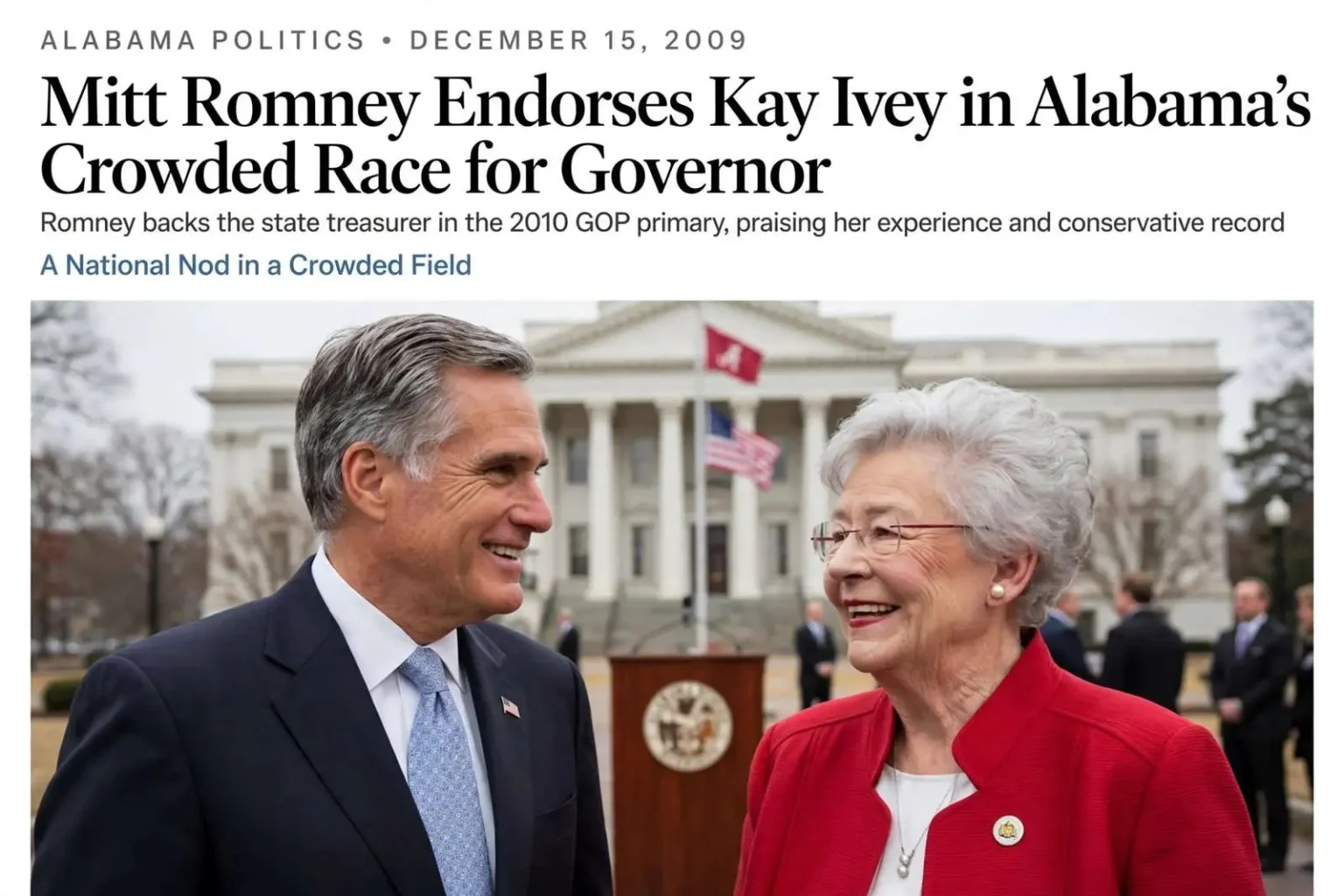
Former Massachusetts Gov. Mitt Romney endorsed State Treasurer Kay Ivey for governor of Alabama, praising her record and repaying her service as his 2008 state campaign chairwoman.
A National Nod in a Crowded Field
State Treasurer Kay Ivey collected a national endorsement in December 2009, as former Massachusetts Gov. Mitt Romney backed her campaign for governor of Alabama. Romney said Ivey had the experience and the vision to do the job well, praising her for adhering to conservative principles as state treasurer and predicting she would do the same in the governor’s office.
The endorsement arrived as Alabama’s Republican primary field was still taking shape, and it gave Ivey something no rival in the race could claim: the public backing of a national figure with presidential ambitions. For a candidate building name recognition beyond her home base in Montgomery, the December announcement landed at a moment when every edge counted.
Ivey had won the treasurer’s office in 2002 and held it through two terms by the time she entered the governor’s race, a record of statewide campaigning that most of her rivals could not match. Statewide office in Alabama carries its own network of county-level supporters, and the treasurer’s post in particular had given her a reason to appear in every corner of the state for years before she asked those voters for a promotion.
A Debt Repaid
The endorsement was, in one sense, the settling of an account. Ivey served as Romney’s Alabama campaign chairwoman during the 2008 presidential race, when the former governor was competing for the state’s delegates in a Republican primary that ultimately went to Mike Huckabee, with John McCain in close pursuit. Romney did not carry Alabama, but he built relationships in the state that he had not abandoned, and he was widely understood in 2009 to be positioning himself for another run at the presidency.
The 2008 campaign left a map of loyalists across Alabama, and Ivey’s role as chairwoman put her at the top of it. Presidential campaigns in the state are built by county chairs and grassroots organizers who remember who stood with them, and Romney’s decision to invest in an Alabama candidate two cycles later reflected that arithmetic. Loyalty of that kind is a currency in politics, and Romney spent his on Ivey.
Endorsements of that kind rarely move many votes in an Alabama primary. What they do is confer a species of legitimacy, and they open doors to donors outside the state, both of which matter to a candidate who lacks a large personal fortune or a famous surname. Ivey was running against rivals who had one or both, and a national validator helped level a race that money and name ID might otherwise have tilted.
The Field She Faced
Ivey was one of several Republicans seeking the nomination in the primary set for June 1, 2010, and the field was unusually deep. Bradley Byrne, the former chancellor of the two-year college system, was running as a reformer with backing from much of the business establishment. Tim James, son of former Gov. Fob James, was campaigning as a businessman and outsider. Bill Johnson, a former Riley cabinet member, had turned sharply against the administration he served. Others would enter before qualifying closed.
The late entrants changed the race’s math. A Tuscaloosa physician and state legislator, Robert Bentley, joined the field positioning himself as an outsider with a medical career and a church resume, and Roy Moore, the former chief justice whose fame from the Ten Commandments fight still reverberated through Alabama politics, added a social-conservative pillar to the contest. Every new name split the anti-establishment vote that candidates like James and Johnson were counting on.
The backdrop was a state Republican Party riding high. Democrats had held the governor’s office and the legislature for most of a century before the Republicans’ gains of the 2000s, and 2010 was shaping up nationally as a wave year for the GOP. Alabama Republicans believed, with reason, that whoever emerged from their primary would be favored in November, which is precisely why the primary itself attracted such a deep field.
The depth of the field shaped campaign strategy in ways voters rarely see. Television advertising in Alabama’s big markets was priced for candidates who could raise serious money, so campaigns without deep treasuries leaned on county party networks, church groups, civic clubs and free media to compete. A December endorsement from a national figure was worth as much for the fundraising letter it produced as for the headlines, because every dollar raised early bought presence on the airwaves when voters finally started paying attention in the spring.
Byrne’s candidacy carried its own complications. His tenure leading the two-year college system had been defined by its aftermath, a period of scandal and reform that gave his reformer label both substance and a target, and his business-community backing made him the establishment favorite in a year when the establishment label was not always an asset.
Ivey’s pitch rested on the office she held. As state treasurer, she managed the state’s investments and its prepaid college tuition program, and she had cultivated a reputation as a steady, unflashy administrator at a moment when the recession had made steadiness sound appealing.
The prepaid tuition program she oversaw, which had promised college tuition to tens of thousands of Alabama families, was itself under strain as the recession depressed the investments backing it, and candidates for treasurer in that cycle campaigned on its rescue. For Ivey, the program was both a credential and a caution: familiarity with the state’s finances was her strongest argument, but the program’s troubles meant rivals could question the record she pointed to.
Her style contrasted with the tone of the field. Where rivals promised shake-ups, audits and confrontations, Ivey campaigned on management, experience and the quiet machinery of state government. Alabama primary voters have rewarded both messages at different times, and the 2010 race became a test of which mood the electorate was in.
What It Meant for South Alabama
For voters in Mobile and Baldwin counties, the Romney endorsement was a reminder that the 2010 governor’s race would be fought on more than one front. The coastal counties had a strong claim on the race through Byrne, an Eastern Shore resident, and through James, whose Foley Beach Express had made his name familiar in Baldwin County. An endorsement from a national figure with presidential ambitions signaled that the Alabama contest was drawing attention beyond the state line, and that candidates without a coastal base would look for advantages wherever they could be found.
The Foley Beach Express itself was a signature of the James family’s imprint on Baldwin County, a toll bridge and corridor project that carried the family name on signage across the Eastern Shore for years. Name recognition of that concrete kind is worth real votes in a primary, and it meant Ivey’s coastal campaign had to work around two rivals who started with home-field advantages south of Mobile Bay.
Byrne’s Eastern Shore roots and his business coalition made Mobile and Baldwin counties the anchor of his campaign map, and local Republican organizations split their loyalties accordingly. County chairmen and local donors who might otherwise have been courted by a single favorite son instead found three credible candidates with coastal ties, which is one reason outside validation like Romney’s carried value.
The Runoff Arithmetic
Six months remained before Republicans would go to the polls. In a field that crowded, the practical question facing each campaign was not how to win a majority but how to make the runoff, and every endorsement, every county chairman and every donor list was being counted with that arithmetic in mind.
Alabama’s runoff system rewards campaigns that can survive the first round and consolidate. A candidate who peaks too early can be overtaken, and a candidate who strings together regional bases, as Ivey hoped to do with statewide officeholders’ support plus a national endorsement, has a path to the top two without ever leading the field outright. The December endorsement fit that strategy exactly: it was designed to keep her credible until the field splintered.
History’s verdict on the race is instructive. Bentley, the late-entering outsider, surged past the better-known field and defeated Byrne in the runoff, a result that humbled every campaign’s model of the electorate. Ivey, meanwhile, remained in statewide office and would return to the governor’s office years later, making the 2009 Romney endorsement a footnote to a career that outlasted the race it was meant to boost.
For the record, the episode captures a recurring pattern in Alabama politics: national figures bank relationships in the state early, repay them when it costs them little, and the beneficiaries convert prestige into staying power if not always into the office they sought. Ivey’s December 2009 was a case study in exactly that trade.