USA Health Pediatrics Residents and Students Present Rare Cases, Newborn Research at State AAP Meeting
USA Health pediatrics residents and South Alabama medical students presented case reports and research at the Alabama Chapter of the American Academy of Pediatrics meeting in Birmingham.
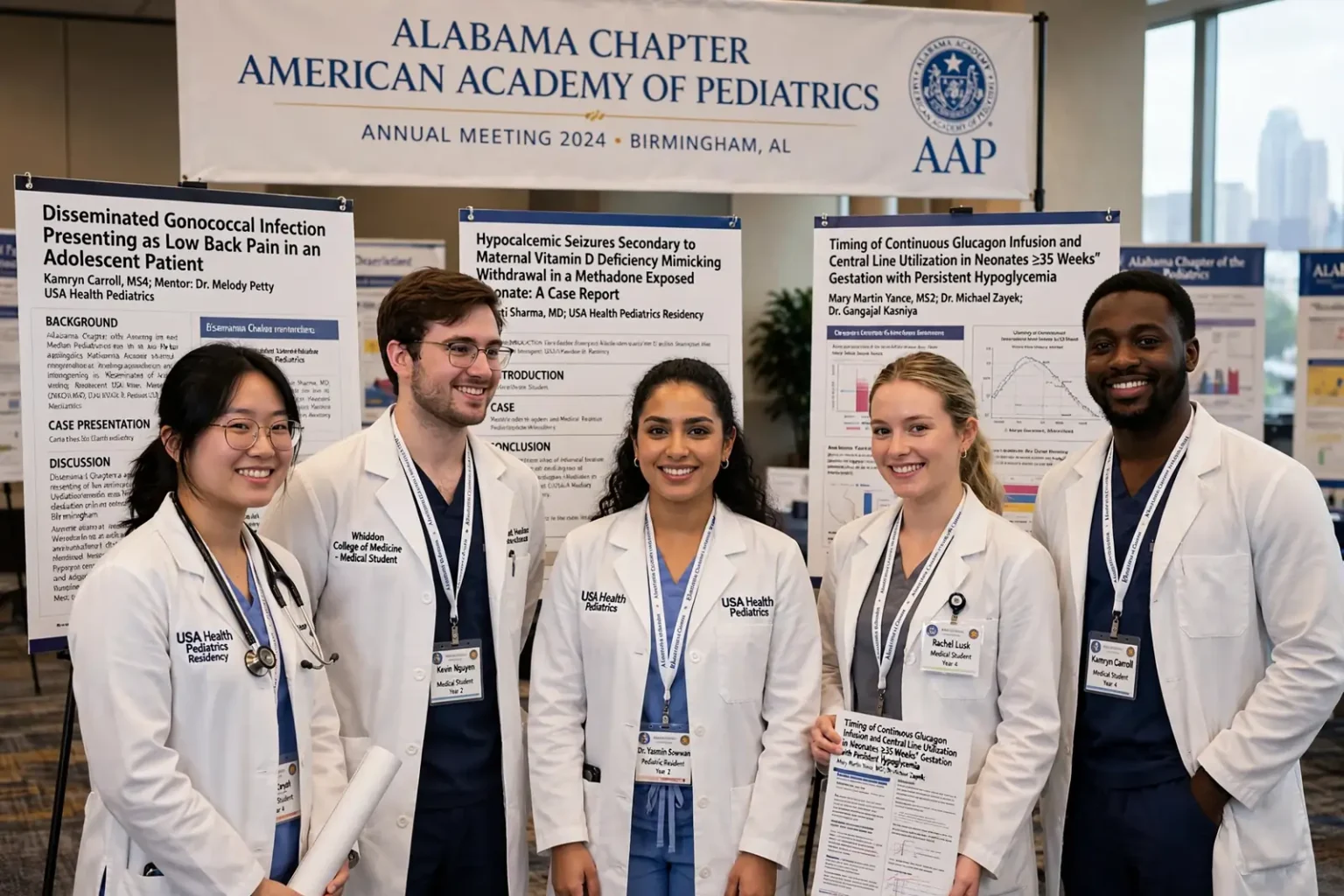
MOBILE, Ala. — USA Health pediatrics residents and University of South Alabama medical students showcased a wide range of clinical case reports and research projects at the annual meeting of the Alabama Chapter of the American Academy of Pediatrics in Birmingham, work that faculty leaders say reflects the value of close mentorship in training the next generation of children’s doctors.
The presenters, representing the Frederick P. Whiddon College of Medicine and USA Health’s pediatric residency, covered topics spanning infectious diseases, neonatology, endocrinology, cardiology and critical care. Each project was developed with guidance from faculty mentors in the Department of Pediatrics.
Turning clinical questions into research
Dr. Benjamin Estrada, professor and chair of pediatrics at the Whiddon College of Medicine, said the presentations demonstrate the department’s commitment to guiding trainees as they dig into complex medical cases, explore new approaches to patient care and grow as physician-scholars.
Case reports are a long-standing part of medical education. When a physician encounters an unusual presentation of a disease or a rare complication, documenting and sharing the case helps other clinicians recognize similar patterns in their own patients. Research projects, meanwhile, examine questions about diagnosis and treatment that can shape future care. For students and residents, the process teaches them how to review the medical literature, analyze data and communicate findings to their peers.
The range of subjects at this year’s meeting showed how faculty mentors and trainees collaborate across multiple divisions and subspecialties within the department.
Rare infections in children
Several presentations focused on unusual infectious disease cases.
- “Disseminated Gonococcal Infection Presenting as Low Back Pain in an Adolescent Patient” was presented by Kamryn Carroll, a fourth-year medical student mentored by Dr. Melody Petty. The case highlighted an uncommon way the infection can appear and underscored the importance of keeping a broad range of possible diagnoses in mind when adolescents come in with muscle or joint complaints.
- “Reactive Infectious Mucocutaneous Eruption (RIME) Secondary to Parainfluenza Virus Type 2” was presented by Rachel Lusk, a fourth-year medical student mentored by Estrada and Dr. Maria Roca Garcia. RIME is a condition in which a respiratory infection triggers painful sores and inflammation of the mouth, eyes or other mucous membranes.
- “Recurrent Group B Streptococcal Septic Shock in a Premature Infant” was presented by Katherine Sims, a fourth-year medical student mentored by Dr. Linda Hassouneh. Group B streptococcus is a common bacterium that can cause serious infections in newborns, particularly those born early.
Another case, “Austrian Syndrome with Embolic Strokes in a Child with Trisomy 21 and COVID-19 Co-infection: A Case Report of an Exceptionally Rare Pediatric Presentation,” was presented by Dr. Yasmin Sowwan and Dr. Cristina Gavrilita. Austrian syndrome is a rare combination of pneumonia, meningitis and endocarditis caused by pneumococcal bacteria. The report described this severe complication of invasive pneumococcal disease in a child with trisomy 21, the most common form of Down syndrome, who also had COVID-19.
A strong showing in newborn medicine
Neonatology, the care of newborns and particularly those who are premature or critically ill, was well represented.
Dr. Shristi Sharma and colleagues presented “Hypocalcemic Seizures Secondary to Maternal Vitamin D Deficiency Mimicking Withdrawal in a Methadone Exposed Neonate: A Case Report.” The case described a newborn whose seizures were caused by low calcium linked to the mother’s vitamin D deficiency, even though the symptoms resembled withdrawal. It serves as a reminder that clinicians should consider other causes when a newborn has seizure activity.
Mary Martin Yance, a second-year medical student, presented with Dr. Michael Zayek and Dr. Gangajal Kasniya on “Timing of Continuous Glucagon Infusion and Central Line Utilization in Neonates ≥35 Weeks’ Gestation with Persistent Hypoglycemia.” The project examined treatment strategies and procedural considerations for infants whose low blood sugar persists.
Kevin Nguyen, also a second-year medical student, presented research in neonatal cardiovascular physiology alongside Dr. Juan C. Hernandez, Dr. Induja Gajendran, Dr. Diksha Shrestha, Kasniya, Dr. Fabien Eyal and Dr. Saminathan Anbalagan. Their project, “Does Serum BNP Level Correlate with PDA Score in Extremely Preterm Neonates?”, looked at the relationship between a blood marker and a clinical scoring tool used to manage patent ductus arteriosus. That condition occurs when a blood vessel that normally closes shortly after birth stays open, and it is common in very premature infants.
Learning beyond the poster session
In addition to presenting their own work, the students and residents attended the conference’s educational sessions, where they learned about current topics and advances in child health. Estrada said the meeting also gave them valuable chances to network with pediatricians, pediatric subspecialists and fellow trainees from across Alabama, building professional relationships and opportunities for collaboration.
The Alabama Chapter of the American Academy of Pediatrics represents pediatricians and pediatric professionals across the state and works to support children’s health through education, advocacy and professional development. Its annual meeting brings together practicing physicians, academic faculty and trainees.
Training pediatricians on the Gulf Coast
USA Health’s pediatric residency trains doctors who care for children across the central Gulf Coast. Much of that training takes place at USA Health Children’s & Women’s Hospital in Mobile, which provides specialized care for infants, children and expectant mothers and operates a neonatal intensive care unit for premature and critically ill newborns.
The Whiddon College of Medicine, named for Frederick P. Whiddon, the University of South Alabama’s founding president, educates medical students and supports residency training programs across a range of specialties. Earlier this month, the pediatrics program also drew attention for building point-of-care ultrasound training into its residency curriculum.
Faculty leaders say opportunities like the state AAP meeting help trainees see how careful observation at the bedside can turn into knowledge that benefits children well beyond Mobile.