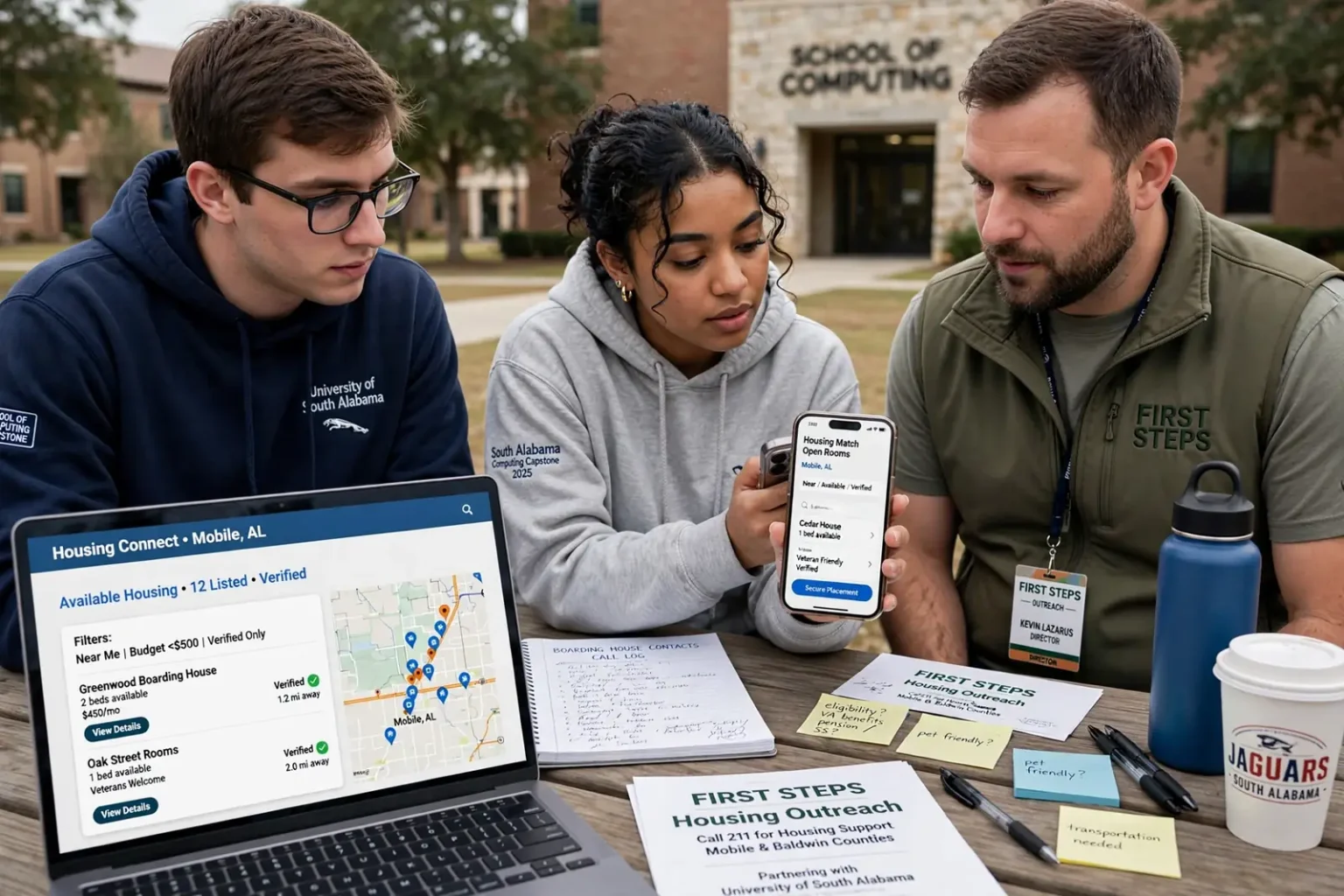
MOBILE, Ala. — A caseworker with a notebook full of phone numbers, spending the better part of an hour calling boarding houses one by one in search of an open bed, was the image that started it. Now a team of University of South Alabama computing students, a South alumnus and a Mobile homeless outreach ministry have replaced that notebook with a homeless housing app that lets outreach workers find, vet and secure an available place to live from a phone while they are still in the field.
The tool was built as a senior capstone project in South’s School of Computing, guided by two-time graduate Jay Maru, founder of the technology firm Beyond AI, in partnership with First Steps, a Mobile-based outreach ministry that works to find stable housing for people who are unhoused. Since it went live in early September, organizers say, more agencies have joined, more housing has been vetted and made available, and people who had been living without a home have moved into one.
A problem that wasn’t a lack of housing
Kevin Lazarus, director of First Steps, said many of the people his ministry works with are not without income. Some receive steady, fixed payments such as Social Security, Veterans Affairs benefits or a pension. What they lack is a way to find permanent housing that fits their budget and circumstances, and what outreach workers lacked was a fast way to match them with it.
Lazarus said the idea came into focus while he watched a caseworker try to place someone.
“He had a notebook filled with names and phone numbers for boarding houses, and for nearly an hour he just went down the list making calls,” Lazarus said. “I started thinking, what if we could put all of that in one place and could find available housing without spending an hour making phone calls?”
That kind of gap is familiar to anyone who works in homeless services. Rooms in boarding houses and other low-cost housing open and fill quickly, eligibility rules differ from one provider to the next, and information about what is available at any given moment often lives in phone logs, spreadsheets and the memories of individual caseworkers rather than in a shared system. When the information is scattered, an opening can sit empty while someone who could afford it spends another night outside.
An alumnus volunteers, then brings in the students
In December 2025, Lazarus was introduced to Maru, who holds a bachelor’s degree in information systems and an MBA from South, graduating in 2014 and 2021. Lazarus said he was hoping for a database that homeless agencies could share. Maru agreed on the spot to work on the project pro bono and began by asking questions.
“He just started mapping everything out, asking a lot of questions — how the agencies worked, where the breakdowns were, what the caseworkers needed and how we could make those connections easier,” Lazarus said.
Maru said the conversations quickly widened the scope.
“The more we talked, the clearer it became that the problem was bigger than a database, and that we could build a real platform to solve it,” he said.
Lazarus said he left that first meeting convinced the work was more than a business arrangement for Maru.
“I didn’t just feel like Jay had a viable solution,” he said. “I felt like we had found someone who genuinely cared about the problem and wanted to help us solve it.”
A few weeks later, South’s School of Computing contacted Maru looking for real-world projects for its senior capstone course, the culminating experience in which graduating students work in teams to design and build software for an outside client. Maru said the timing could not have been better.
“I had a real client, a real problem and a real deadline. The students would get to build something permanent instead of just completing a class exercise. At the same time, the community would get a working solution to a problem that has been sitting there for years,” he said.
A student who chose the project for its purpose
Kaleb Patrick was one of the students who signed on. He said students were offered about 10 possible projects, and he picked this one deliberately.
“I specifically chose this one because I felt like it had real purpose behind it,” Patrick said.
Working on it changed how he thought about homelessness. Patrick said he had not fully understood how many obstacles stand between a person and a safe place to sleep.
“It’s easy to think finding a place to stay is as simple as looking up a shelter, but there are so many other factors involved,” he said. “Knowing where to go, understanding eligibility requirements, transportation and availability. It made me realize that sometimes the problem isn’t that resources don’t exist, but it can be difficult finding them.”
The team set out to build a website that caseworkers could pull up on their phones in the field, so they could connect a person with suitable housing on the spot instead of returning to an office to make calls.
AI sped up the coding; people made the hard calls
Artificial intelligence tools cut down dramatically on the time it took to build the site, Maru said, but he stressed that the technology was not the difficult part.
“AI made the technology easy. The hard part was judgement,” he said. “Deciding what not to build while remembering that this is a tool used on behalf of vulnerable people and not a tech demo.”
That caution reflects a broader concern in social services, where tools handle information about people in vulnerable situations and where a listing that turns out to be unsafe or unavailable can do real harm. The platform’s emphasis on vetting housing before it is offered is meant to give caseworkers confidence that what they see on the screen is a real, appropriate option.
Early results since the September launch
Since the site launched in early September, according to those involved:
- More agencies have partnered with First Steps to use and contribute to the platform.
- More housing is being vetted and added as available.
- People who had been unhoused have been placed in homes.
Lazarus is careful not to oversell what software can do.
“A website isn’t going to solve homelessness,” he said. “But a housing opportunity shouldn’t go unused simply because the person who needs it and the person who has it don’t know each other. If we can make that connection, it can be the moment their life begins moving in a completely different direction.”
Part of a wider push in Mobile
The project arrives as Mobile organizations look for practical ways to remove barriers for people trying to get off the street. In September, the Social Security Administration added the homeless ID card issued by the City of Mobile’s Homeless Outreach team to its national identity document database, giving unhoused residents a new way to prove their identity when seeking a replacement Social Security card. Without identification, it can be difficult to rent a room, apply for a job or collect benefits, including the same fixed incomes that could otherwise pay for housing.
Shelters are also under strain. McKemie Place, the only homeless shelter for women in southwest Alabama, has launched a public campaign to raise $550,000 to buy its building before a Dec. 31 deadline.
For South’s students, the capstone is also a lesson in how technical skills translate into community impact. Rather than a classroom exercise that ends when the semester does, the team’s work is in daily use by people trying to help their neighbors.
How to get help or get involved
People in Mobile and Baldwin counties who are homeless or at risk of losing their housing can call 211 to be connected with local shelter, housing and social service resources. Agencies, landlords and boarding house operators interested in learning more about the platform, and organizations that work with unhoused residents, can contact First Steps.
For Maru and the students, the measure of success is simple: a room that would have gone unused now has someone living in it.