South Alabama Researchers Honored as Chakroborty Wins Mayer Mitchell Award, Four Faculty Recognized at Showcase
Dr. Debanjan Chakroborty received the 17th annual Mayer Mitchell Award for cancer research, and four University of South Alabama faculty were honored at the fifth annual Research and Technology Showcase.
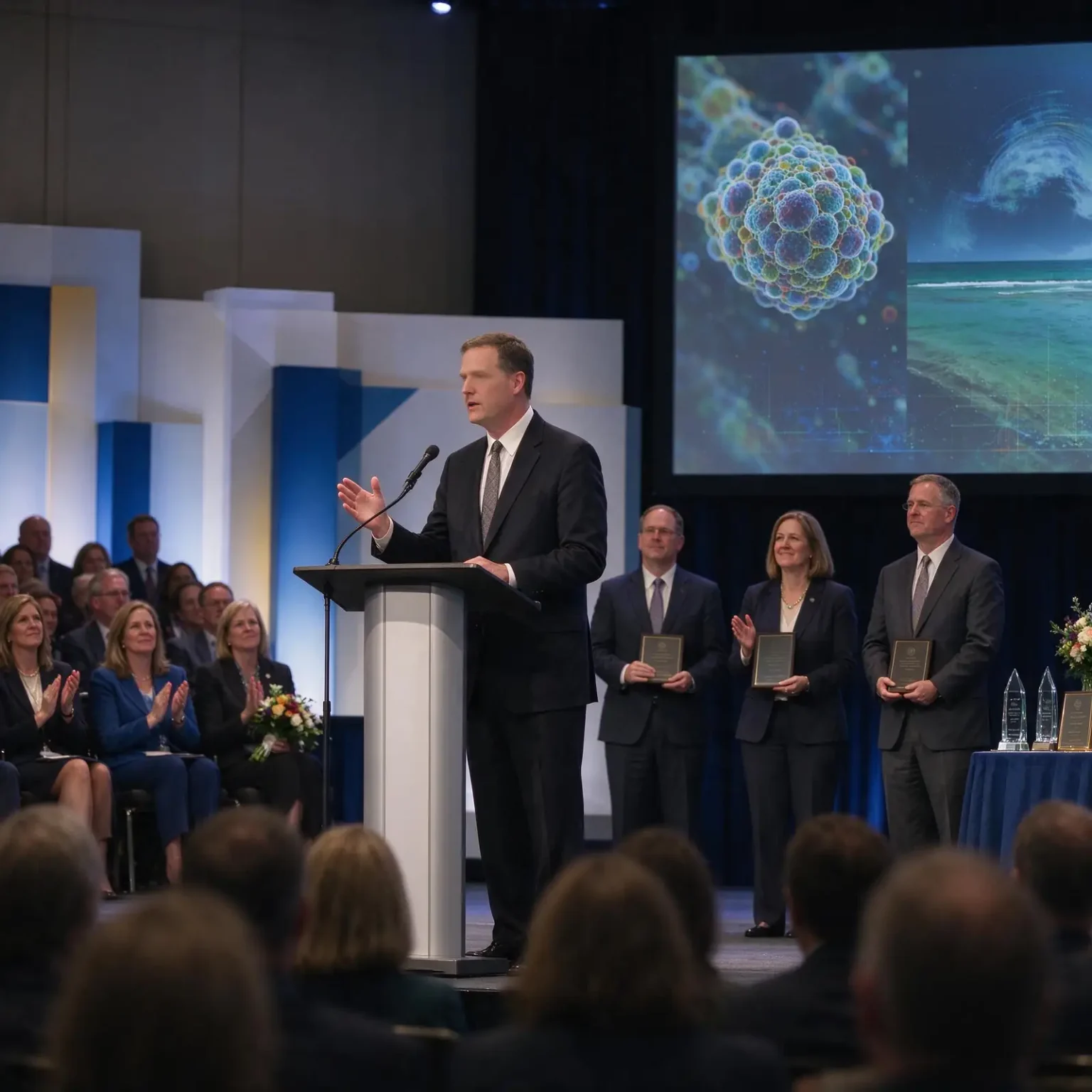
MOBILE, Ala. — Five South Alabama researchers have been honored in the span of a week for work ranging from cancer biology to weather monitoring and the health of Mobile Bay. The USA Health Mitchell Cancer Institute presented its 17th annual Mayer Mitchell Award for Excellence in Cancer Research to Dr. Debanjan Chakroborty on Oct. 14, and the University of South Alabama recognized four more faculty members Wednesday evening at its fifth annual Research and Technology Showcase.
University leaders say the honors highlight research that reaches beyond the laboratory and into the lives of people on the Gulf Coast.
Chakroborty receives Mayer Mitchell Award
Chakroborty is an associate professor of pathology at the Mitchell Cancer Institute. His work focuses on helping scientists better understand how cancers grow, spread and respond to treatment, knowledge that can open the door to future advances in cancer care.
His research has revealed new ways that the body’s own signaling systems influence how cancer progresses. Among his most notable findings is that dopamine, a chemical messenger best known for its role in the brain, also plays an important part in cancer development. His studies showed that dopamine levels drop as gastric, or stomach, cancer progresses, and that restoring dopamine signaling can slow tumor growth and limit the formation of new blood vessels that tumors rely on to survive.
The growth of new blood vessels, a process known as angiogenesis, is a major focus of cancer research because tumors need a steady blood supply to grow beyond a small size. Treatments that block angiogenesis are already used for some cancers, and research into the body’s natural regulators of the process could point toward new approaches.
More recently, Chakroborty has turned his attention to metastasis, the process by which cancer spreads from its original site to other parts of the body. Metastasis is responsible for the majority of cancer deaths, making it one of the most important targets in oncology research. One of his latest discoveries suggests that blocking a particular signaling pathway may help reduce the spread of gastric cancer by strengthening the connections between cells and helping preserve the body’s natural tissue barriers.
About the award and its namesake
The Mayer Mitchell Award was established in 2009 in memory of Mayer Mitchell, the founding champion of the Mitchell Cancer Institute and a longtime University of South Alabama trustee. Each year it honors a promising scholar-scientist chosen by the director of the Mitchell Cancer Institute on the recommendation of a faculty committee.
The award comes with unrestricted support that the recipient can use for research needs such as equipment, travel, expenses and personnel. Flexible funding of that kind can be especially valuable to scientists pursuing new lines of inquiry, since many grants are restricted to specific, pre-approved uses.
The USA Health Mitchell Cancer Institute is the cancer care and research arm of USA Health, the University of South Alabama’s academic health system. It combines patient care with laboratory and clinical research, giving people on the central Gulf Coast access to cancer specialists and clinical trials close to home.
Four faculty honored at Research and Technology Showcase
A week after the award ceremony, the university held its fifth annual Research and Technology Showcase at the MacQueen Alumni Center on campus. Four faculty members were recognized:
- Dr. Christopher Davies of the Frederick P. Whiddon College of Medicine, whose work addresses the challenge of overcoming antibiotic resistance.
- Dr. Joe Hair of the Mitchell College of Business, whose research centers on business analytics.
- Dr. Sytske Kimball of the Department of Earth Sciences’ meteorology program, whose work involves early warning weather monitoring.
- Dr. John Lehrter of the Stokes School of Marine and Environmental Sciences, whose research focuses on protecting Mobile Bay.
Each area has practical stakes. Antibiotic resistance, in which bacteria evolve to survive the drugs designed to kill them, is considered one of the most serious threats to public health worldwide because it can make common infections difficult or impossible to treat. Business analytics helps organizations turn data into better decisions. Hair is widely known for textbooks on multivariate data analysis used by students and researchers around the world.
Weather monitoring is especially important on the Gulf Coast, which faces hurricanes, severe thunderstorms, tornadoes and flash flooding. Kimball has long been associated with the South Alabama Mesonet, a network of weather stations across the region that collects real-time data on conditions such as wind, rainfall and temperature, information that supports forecasters and emergency managers. The value of that kind of data was on display earlier this month as Hurricane Isaias moved across the region.
Mobile Bay, meanwhile, is one of the largest estuaries in the country and supports fisheries, tourism, recreation and shipping. Research into water quality and the bay’s ecosystem helps inform efforts to protect it for future generations.
‘Changes the world around us’
Dr. Allen Parrish, the university’s vice president of research and economic development, said the showcase reflects the university’s emphasis on research with real-world impact.
“We are really active in terms of doing research that impacts the community. That is just not stuff that is locked up in a laboratory, but actually changes the world around us,” Parrish said.
The event’s keynote speaker was Dr. Steven M. Girvin, a physics professor at Yale University and a prominent figure in quantum information science, who spoke on “The Second Quantum Revolution.” The phrase refers to a new era of technologies, including quantum computers, sensors and secure communications, that harness the strange properties of quantum mechanics in ways the first wave of quantum-based inventions, such as lasers and transistors, did not.
Research at South Alabama
The University of South Alabama, founded in 1963, is a public research university in west Mobile with colleges and schools spanning medicine, business, engineering, the arts and sciences and marine and environmental sciences. Its research enterprise includes work at USA Health, the Mitchell Cancer Institute, the Stokes School of Marine and Environmental Sciences and the university’s Innovation Portal, which supports startup companies and commercialization of new technologies.
The Research and Technology Showcase, now in its fifth year, is one of the ways the university highlights that work for the community, business leaders and fellow researchers. Together with the Mayer Mitchell Award, this month’s honors offer a snapshot of the range of research taking place in Mobile, from microscopic cell signals to the waters of the bay.