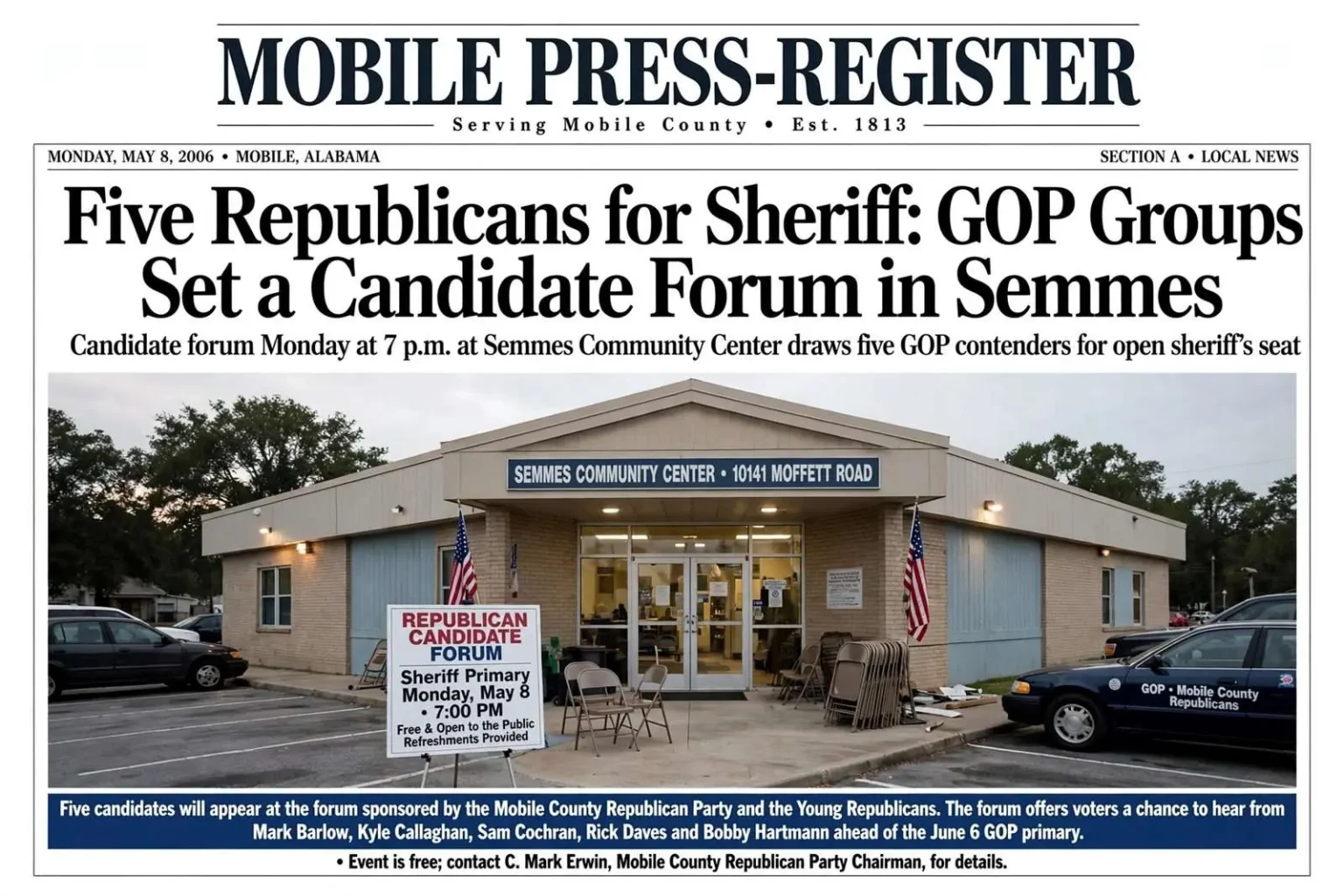
Area Republican groups scheduled a candidates forum for the GOP contenders for Mobile County sheriff on Monday, May 8, 2006, at 7 p.m. at the Semmes Community Center, 10141 Moffett Road, on U.S. 98. The Mobile County Republican Party and the Young Republicans sponsored the event. Refreshments were furnished, and the public was invited free of charge. Mobile County Republican Party Chairman C. Mark Erwin was listed as the contact for more information.
Forums of this kind fill an important gap in the month before a primary. Television advertising reaches households across the county but rarely answers a specific question, and a sheriff’s race turns on exactly the kind of specific questions — jail overcrowding, response times, civil service paperwork — that voters want to hear candidates answer in their own words. The joint sponsorship by the party’s regular organization and its younger wing also signaled that the race mattered to every faction of Mobile County’s GOP establishment.
A Five-Way Race
Five candidates were vying for the Republican nomination for sheriff in the party primary set for June 6: Mark Barlow, chief deputy. Kyle Callaghan, a sheriff’s deputy. Sam Cochran, the retired Mobile police chief. Rick Daves. Bobby Hartmann.
The field was notable for its depth of law enforcement experience. The chief deputy of the sheriff’s office, a working deputy and the recently retired chief of the city’s police department were all on the ballot, meaning the primary was less a contest between insiders and outsiders than a choice among competing law enforcement resumes. For voters, the June 6 primary was in many ways a referendum on which branch of local policing — the county office as it was currently run, or the city department’s methods and management — offered the better model for the county’s top law enforcement job.
Cochran’s presence gave the race particular weight. He had stepped down from the top job at the Mobile Police Department earlier that spring specifically to run, leaving Deputy Chief Lester Hargrove to serve as interim chief while Mayor Sam Jones selected a permanent successor. A sitting city police chief giving up the post to seek countywide office is not a decision made lightly, and it signaled that the sheriff’s race would be the most closely watched local contest of the cycle.
The sheriff’s seat was open because the incumbent was not seeking the nomination, an unusual circumstance in an office where incumbents historically hold on for term after term. Open-seat races for the office draw crowded fields precisely because the position rarely comes vacant, and the five candidates who qualified in the spring of 2006 had all timed their ambitions to the one real opening in years.
Why the Sheriff’s Office Matters
The sheriff of Mobile County is one of the most powerful elected officials in the region. The office runs the county jail, provides patrol and investigative services across the unincorporated county, serves civil process for the courts, and commands a budget and a workforce that reach into every community from the bayous of the south county to the timberlands of the north.
The jail alone makes the office a centerpiece of county government. Housing hundreds of inmates awaiting trial or serving sentences, the facility consumes a large share of the county’s general fund and has been a recurring topic in Mobile County budget debates for decades. Every circuit and district judge in Mobile County depends on the sheriff’s deputies for courtroom security and on the jail for the custody side of the criminal docket, which means the office sits at the center of the county’s entire justice system whether or not it ever makes a headline.
Unlike a police chief, who is appointed and can be removed by a mayor, the sheriff answers directly to the voters and is largely independent of any other local official. That independence is why the office draws serious candidates and why a contested primary attracts this level of attention. A sheriff answers to no council, no mayor and no commission for the day-to-day running of the department — a structural reality that makes the primary election the only real check on how the office is run.
The Forum as an Institution
The candidate forum, held in a community center on a Monday evening with refreshments and free admission, is one of the more durable rituals of American local democracy. It offers something a mailer cannot: five candidates on the same stage, answering the same questions in front of the same audience, with everyone present able to see how each handles a hard question about the jail, about response times in unincorporated areas, or about the relationship between the department and the communities it serves.
In a race between candidates with long law enforcement careers, the differences on stage were likely to be about management philosophy and priorities rather than basic ideology. How a candidate talked about deputies’ pay and retention, about cooperation with municipal police departments, about drug enforcement in the county’s rural stretches — those were the distinctions available to voters who showed up. The Young Republicans’ involvement ensured a second audience as well: younger party members looking for their first serious exposure to county-level politics and the candidates who would define it.
The choice of Semmes was practical. Moffett Road is the main artery of the county’s growing northwest, an area served by the sheriff’s office rather than a city police department, which makes its residents among the most directly affected by who holds the office. The Semmes community had been growing steadily along the U.S. 98 corridor, blending long-established farming families with new subdivisions pushing out from the city, and its residents depended on sheriff’s patrols, deputies responding from distant substations and the civil division that serves papers across the western county.
Community centers like the one on Moffett Road have long hosted this brand of retail politics in south Alabama, from probate judge contests to county commission races. The setting is deliberately accessible: no ticket, no formal seating chart, a coffee pot in the corner, and an expectation that anyone who wants to ask a question can stay afterward and shake hands. For a sheriff’s race, in an office whose holders have historically cultivated personal relationships across every corner of the county, the setting fits the job being contested.
The Larger Picture
The forum came in the middle of an unusually consequential election season in Mobile County. Legislative seats were being contested in both parties, judgeships were on the ballot, and a county commission vacancy had generated a legal fight over how it should be filled. The sheriff’s primary, with five credentialed candidates and no incumbent seeking the nomination, sat near the center of it all.
Statewide, 2006 was a general election year with every constitutional office on the November ballot, which meant the June 6 primary would set the top of the ticket in both parties and drive turnout down to the local contests. A competitive sheriff’s primary in Alabama’s second-largest county had the potential to shape that turnout, and both the party organization and the candidates knew it.
For voters who turned out on Moffett Road that May evening, the forum offered a straightforward proposition: an hour or two of listening, and a clearer sense of which of the five they would trust with the county’s largest law enforcement agency. With the primary barely four weeks away, it was one of the last chances to size up the field before early ballot decisions had to be made.
The five-way format also carried practical consequences for the campaigns. With no incumbent and no runaway front-runner, every candidate needed the same scarce asset — name recognition outside their own professional circles. Barlow had spent years running the day-to-day operations of the sheriff’s office as chief deputy; Callaghan had the perspective of a working deputy on the street; Cochran brought the highest public profile from his years leading the city’s police force; Daves and Hartmann were competing to define themselves for voters meeting them for the first time. A single evening in front of a crowded community center was worth more to all five than days of radio advertising, because it let them be judged side by side.
The June 6 primary would send one candidate to the November general election, and in heavily Republican Mobile County the nomination has historically been the decisive hurdle for countywide office. Whoever emerged from the five-way field would inherit a department with its own institutional momentum, a jail that never stops intake and a patrol district map that covers more territory than most Alabama cities contain. The voters at the Semmes Community Center were, in effect, choosing the next manager of one of the county’s largest operations, and the candidates on stage knew that the people asking questions that night were the most engaged Republican voters in the northwest part of the county — exactly the turnout core that decides a June primary.