Jack Tillman Asks Appeals Court to Reconsider, Says Sheriff’s Lawyer Broke Faith
Attorneys for former Mobile County Sheriff Jack Tillman asked the Alabama Court of Criminal Appeals to rehear his bid to undo the misdemeanor convictions that ended his career, arguing his own lawyer testified against him.
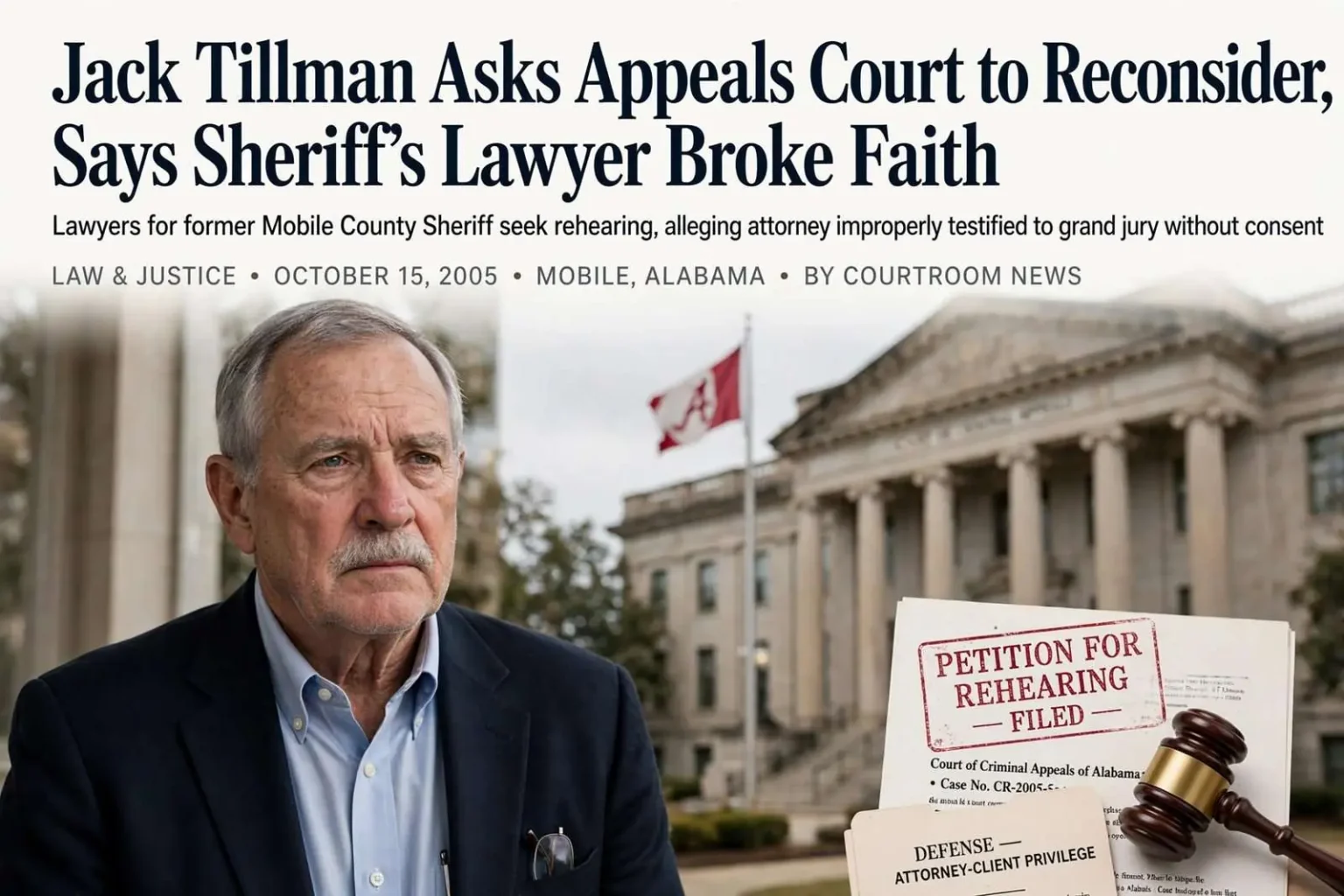
Lawyers for former Mobile County Sheriff Jack Tillman asked the Alabama Court of Criminal Appeals to reconsider its rejection of his appeal, arguing that the court had misread both the facts and the law when it upheld the misdemeanor convictions that ended one of the most durable political careers in Mobile County law enforcement. The petition for rehearing, filed after a three-judge panel turned Tillman aside in a unanimous ruling late the previous month, revived a dispute that had shadowed the case from the beginning: whether the man who once served as the sheriff’s own attorney was free to testify about him before a grand jury.
The heart of the complaint
Tillman’s attorneys, Jim Atchison and Don Beebe, contended that Mobile County District Attorney John Tyson and former sheriff’s department attorney Bob Campbell together deprived Tillman of the effective assistance of counsel. Campbell appeared before a 2002 Mobile County grand jury under a subpoena obtained by the district attorney’s office, without Tillman’s consent and without a court order, and described the history of the law governing a sheriff’s authority to keep surplus money from the jail food account.
The appeals court found nothing improper in that. Writing for the panel, Judge Sam Welch held that Campbell had not breached the attorney-client privilege by testifying about the evolution of the law and about his role in negotiating a 1996 county resolution allowing excess food money to be spent on law enforcement.
Judges Bucky McMillan and Greg Shaw concurred. Judges Pam Baschab and Kelli Wise recused themselves.
Tillman’s lawyers called that reasoning “an incorrect statement of the law” and argued the court had confused two separate ideas. “Privilege is the right of Jack Tillman,” the petition stated.
“Confidentiality, however, was and remains the obligation of Robert Campbell.” In their view, only Tillman could release his lawyer to speak, and the grand jury process was “poisoned” because prosecutors had the benefit of Campbell’s account and of files he shared, even though a different grand jury ultimately returned the indictment.
A dispute over who the lawyer represented
Campbell maintained throughout that he represented the office of the sheriff rather than Tillman personally, and the appeals court agreed, writing that Campbell “did not then, nor had he ever, represented Tillman as a private individual.” Tillman’s lawyers disputed that flatly, noting that Campbell’s office was still defending Tillman in a federal civil rights case in May 2005 — a month after his indictment — in which Tillman was sued both in his official and individual capacities.
Tillman said he learned of his former attorney’s grand jury appearance only by accident, from an offhand remark by a Campbell employee at a social gathering. “Truth is, he worked for me,” Tillman said of the lawyer he hired in 1995.
“He always represented, always defended me, always.” Campbell, 64, was unsparing in reply, calling the accusations “preposterous,” “absurd” and “frivolous” and saying he was weighing action of his own against Tillman and his attorneys. “Not only didn’t I violate attorney-client privilege, I never testified before that 2005 grand jury,” he said.
“They knew the truth and absolutely scrambled it.” Beebe declined to discuss the opinion. “I don’t comment on judges’ decisions,” he said, adding only, “Bit dog barks loudest.” Atchison said the argument belonged in court, not in the newspapers.
“It is about the client, Jack Tillman,” he said. “It’s his rights that were violated.”
How the case began
The controversy grew out of an old and peculiar feature of Alabama law that made sheriffs personally responsible for feeding county prisoners.
Under the arrangement in force at the time, the sheriff received a set allowance — $1.75 per inmate per day at the Mobile County Metro Jail — and stood to profit or to lose depending on how the money was managed. Tillman repeatedly pointed to that structure in his own defense.
The practice drew statewide scrutiny in the years that followed and was eventually curtailed by the Legislature.
Tyson’s office spent years examining Tillman’s handling of the food fund.
Tillman was indicted in April 2005 on five felony counts tied to the account and to his testimony in a 2003 case against his sister-in-law, Brenda Pate, an administrative planner in the sheriff’s department who was convicted of theft after a first trial ended in a mistrial. A former professional boxer and a three-term sheriff, Tillman ultimately pleaded guilty to two misdemeanors, perjury and an ethics offense, agreed to repay roughly $13,000 he had moved out of the food fund, and left office the same day he appeared in court.
He served no jail time and insisted he had done nothing wrong. Little noted at the time, the plea was conditional: it preserved his right to appeal the question of Campbell’s testimony.
Jefferson County Circuit Judge James H. Hard, assigned after the Mobile bench recused itself, had earlier refused to dismiss the indictment or to disqualify Tyson’s office.
The rehearing petition was widely regarded as a way station on the road to the Alabama Supreme Court. Tillman, 60, had spent the time since leaving office writing an account of his years in law enforcement, much of it as an investigator in the Mobile County Public School System.
What Comes Next Procedurally
In Alabama, a party that wants the state Supreme Court to review a Court of Criminal Appeals decision generally must first apply to the appeals court for rehearing. Once that application is decided, the party may petition the Supreme Court for a writ of certiorari. The Supreme Court then decides whether to take the case.