University of South Alabama Mobile
Montiel Seeks to Dethrone King: A Mobile Native Files for a Late Run at Attorney General
Montgomery attorney and Mobile native Mark Montiel said he would challenge incumbent Republican Attorney General Troy King in the June 6 primary, calling King unqualified and soft on public corruption.
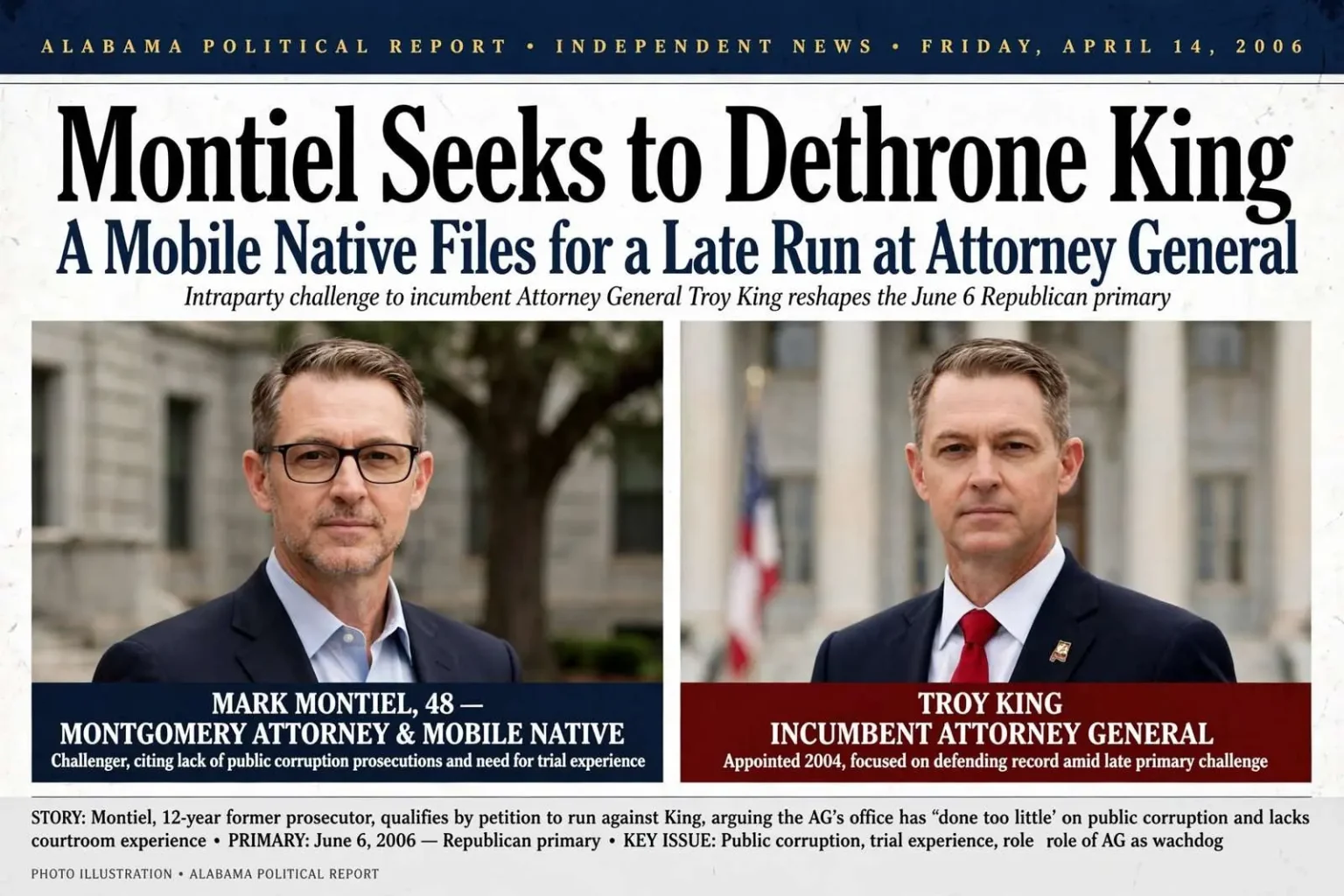
Mark Montiel was driving to Birmingham on Friday morning with his qualifying papers filled out on the seat beside him. “I might get hit by a truck before they’re filed,” the Montgomery attorney and Mobile native said, “but my plan is to qualify to run for attorney general.” With that, Montiel, 48, set himself against incumbent Republican Attorney General Troy King in the June 6 party primary — an unusual intraparty challenge to a sitting officeholder, and one launched with barely two months to campaign. Montiel’s candidacy immediately reshaped the race, forcing King to defend a record that had largely escaped serious scrutiny in the general election-focused political calendar.
‘A Job He Is Not Qualified For’
Montiel was careful to keep his criticism professional rather than personal. “Troy is a decent, nice person,” he said. “How could you not like him personally? He’s just in a job he is not qualified for.” His central indictment is that King has done too little about public corruption. “Probably at the top of the list is Troy’s absolute lack of effort in prosecuting public corruption,” Montiel said. He invoked the State Docks bid-rigging case of the 1980s as an example of what the office used to do. “We opened that file and pursued it. Bid rigging. Such a mess. Those are tough cases, but that’s an example.” Small cases matter too, he argued, for their deterrent effect. “I don’t care if it’s a $5,000 case or a $2,000 case. It deters others.”
His broader complaint is that Montgomery has lost its checks and balances: “Legislators are finding ways to pass laws that ultimately end up benefiting them personally and there are no consequences. They should be prosecuted. They’ll come after you. They’ll try to cut your budget. But those cases should be prosecuted.” Montiel’s rhetoric positioned him as a prosecutor’s prosecutor — someone who believes the attorney general’s office should be the sharpest weapon in the state’s anti-corruption arsenal, not a political shield for the powerful. He pointed to the office’s historical role in the Siegelman prosecution, the State Docks cases, and the investigation of the two-year college system as evidence of what the office could achieve when led by a trial lawyer with the will to use it.
The Trial Experience Argument
Montiel’s second line of attack concerns the courtroom. Bill Baxley was a trial lawyer, he noted; Jeff Sessions was a prosecutor; even Don Siegelman had government experience. King, appointed to the office by Gov. Bob Riley, had by Montiel’s account never tried a case before taking it — civil, criminal or otherwise. “It’s tough to sit beside a jury and ask them to do something you’ve never done,” Montiel said. He argued that the attorney general’s office handles some of the most complex litigation in state government — death penalty appeals, consumer protection suits, environmental enforcement, Medicaid fraud — and that leadership without trial experience is fundamentally compromised. The office’s lawyers, he said, deserve a leader who understands the pressures of the courtroom.
King’s appointment by Riley in 2004 came after the resignation of William H. Pryor Jr., who left for a federal judgeship. King had served as Riley’s legal advisor and as a deputy attorney general, but his background was in administrative law and policy, not litigation. Montiel contrasted this with his own career: twelve years as a prosecutor in the Montgomery County District Attorney’s office, followed by private practice focusing on white-collar defense and complex civil litigation. He had tried cases to juries in state and federal court, argued before the Alabama Supreme Court and the Eleventh Circuit, and managed multi-defendant fraud investigations. The contrast, he argued, was not about resume length but about the specific muscle memory that trial work develops — the ability to assess evidence, anticipate defense strategies, and make the split-second judgments that determine outcomes.
Mobile Roots and Montgomery Practice
Montiel’s Mobile roots figured prominently in his narrative. Born at Mobile Infirmary, raised in the Oakleigh Garden District, educated at McGill-Toolen Catholic High School and Spring Hill College, he left for law school at the University of Alabama but returned to Montgomery for his career. “Mobile made me,” he said. “The fairness, the work ethic, the sense that you look people in the eye and tell the truth — that’s Mobile.” He framed his candidacy as a return of sorts, bringing Mobile values to a Montgomery office that had, in his view, lost its way. The attorney general’s office, he noted, has a unique relationship with Mobile — it represents the state in the Mobile County courts that handle a disproportionate share of the state’s maritime, environmental, and port-related litigation.
The primary challenge faced steep structural obstacles. Alabama’s Republican primary is closed, meaning only registered Republicans can vote. King had the advantage of incumbency, the endorsement of the state party apparatus, and a war chest built over years. Montiel had to build name recognition, raise money, and organize a statewide campaign in weeks. He acknowledged the odds: “This is a steep hill. But the alternative is accepting that the office drifts further from its mission. I can’t do that.” His campaign focused on earned media — editorial board meetings, radio interviews, speaking engagements at Republican clubs — rather than paid advertising, which his budget could not sustain.
The State Docks Legacy
The State Docks bid-rigging case that Montiel cited remains a touchstone for Alabama prosecutors. In the mid-1980s, the attorney general’s office under Charles Graddick uncovered a scheme in which contractors colluded to fix bids on State Docks construction projects, costing the state millions. The investigation used wiretaps, grand jury subpoenas, and cooperating witnesses — tools that require aggressive prosecutorial leadership. The convictions sent a message that public construction contracts were not a private trough. Montiel argued that the office had not pursued a major public corruption case of similar scale since the 1990s, and that the deterrent effect had eroded.
He also criticized the office’s handling of the two-year college system scandal, in which the chancellor and multiple presidents were eventually convicted of using state funds for personal travel, vehicles, and property improvements. The investigation was ultimately driven by the governor’s office and the state auditor, not the attorney general. Montiel said the AG’s office should have been the lead, not a supporting player. “When the state’s money is stolen, the attorney general should be the first one through the door, not the last one invited.”
A Late-Entry Campaign
Montiel’s late entry meant he missed the early filing deadline for the primary ballot and had to qualify by petition — a process requiring thousands of signatures from registered Republicans across the state. He mobilized a volunteer network of former colleagues, law school classmates, and Mobile expatriates in Montgomery, Birmingham, and Huntsville to gather signatures. The effort succeeded, placing him on the ballot. But the compressed timeline left little room for the retail politics that Alabama primaries demand — the county Lincoln Day dinners, the fish fries, the courthouse square handshakes that build the personal connections decisive in low-turnout elections.
The primary results would test whether a corruption-focused message could overcome incumbency advantage in a Republican electorate that had, in recent cycles, prioritized cultural issues over governance reform. Montiel’s gamble was that enough Republican primary voters shared his frustration with the perception of unaccountable power in Montgomery. Whether that gamble paid off would be known on June 6. But by forcing the conversation onto trial experience, prosecutorial will, and the attorney general’s duty to pursue the powerful, Montiel had already altered the terms of the race — and perhaps the expectations for the office itself.
The Stakes for Alabama’s Top Lawyer
The attorney general’s office in Alabama carries a portfolio that touches nearly every aspect of state government. It represents the state in all appeals, including death penalty cases that draw national scrutiny. It enforces consumer protection laws against predatory lenders, fraudulent contractors, and deceptive trade practices. It defends state agencies against lawsuits and initiates litigation on behalf of the state’s environmental, financial, and regulatory interests. It provides legal opinions that guide local officials, school boards, and law enforcement. The person holding the office shapes the legal landscape of Alabama as much as any legislator or judge.
Montiel’s challenge raised a question that transcended the primary: what qualifications should Alabama voters expect in their attorney general? The office has been held by former prosecutors, former solicitors general, and political advisors. The variation in background reflects the office’s dual nature — part law firm, part political entity. Montiel’s argument was that the law firm side had atrophied under King, and that the political side had filled the vacuum. Whether voters agreed would be settled at the ballot box. But the debate he forced — about trial experience, prosecutorial independence, and the courage to investigate the powerful — lingered beyond the campaign, a benchmark against which future attorneys general would be measured.