University of South Alabama Theodore
Ben Brooks Set a Barbecue Rally on Highway 90 to Launch His State Senate Campaign
Mobile City Councilman Ben Brooks scheduled an April 2006 rally and barbecue on Highway 90 West to kick off his Republican campaign for Alabama Senate District 35 against George Callahan.
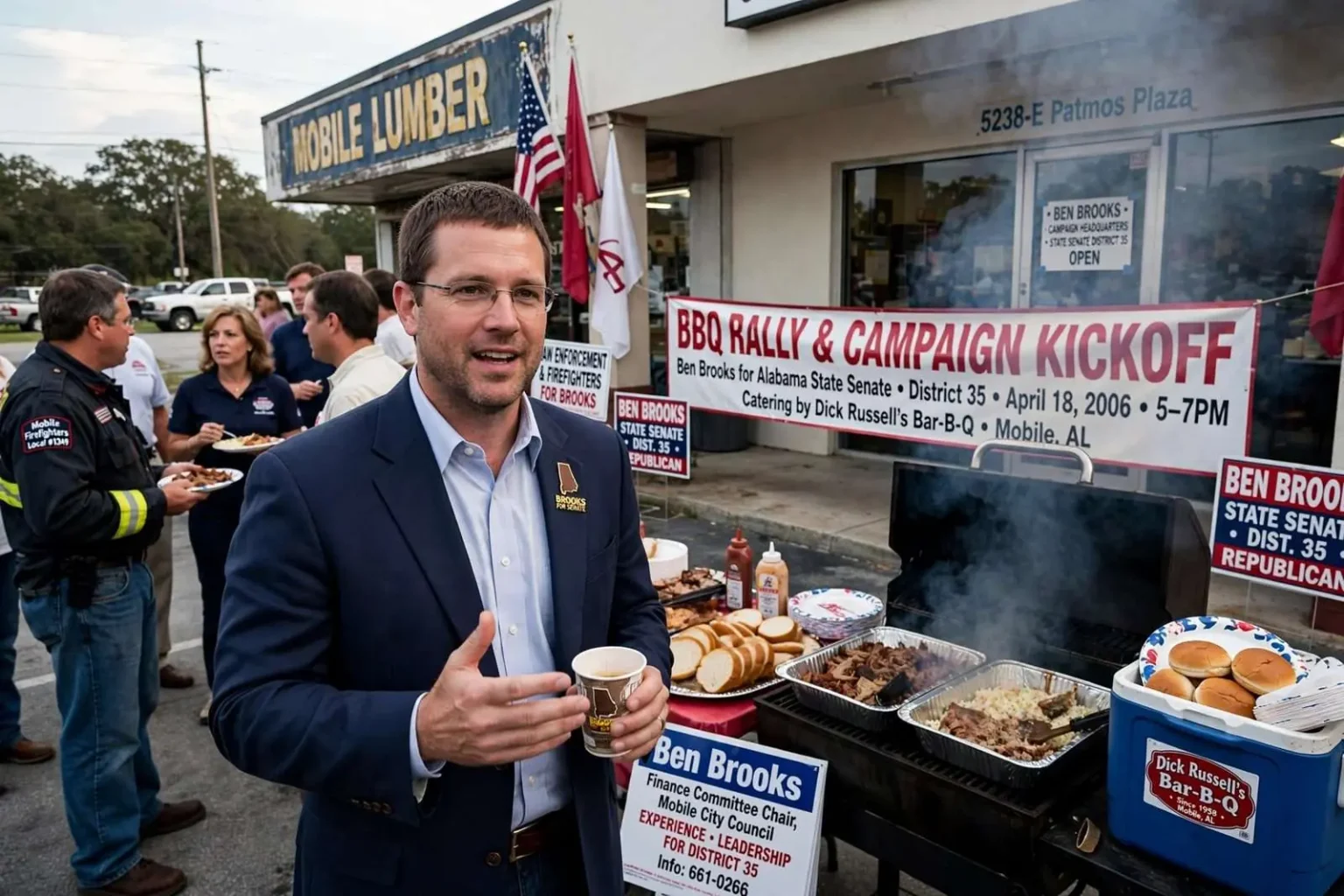
Mobile City Councilman Ben Brooks scheduled a rally and barbecue for Tuesday, April 18, 2006, from 5 to 7 p.m. to formally kick off his campaign for the Alabama Senate seat representing District 35. The event was set for his campaign headquarters at 5238-E Patmos Plaza on Highway 90 West, across from Mobile Lumber, with catering by Dick Russell’s Bar-B-Q. Those wanting more information were asked to call 661-0266.
A barbecue kickoff is the standard opening move of a south Alabama campaign, and Brooks staged his in the vernacular of the district he wanted to represent: a strip-center headquarters on the main highway, a well-known local pit providing the food, and an early-April date that gave the campaign a full spring and summer to organize before the primary. Dick Russell’s Bar-B-Q, a Mobile institution, lent the event exactly the local flavor — literal and political — that a first-time legislative candidate needs on the invitation.
The Race He Entered
Brooks faced former state Sen. George Callahan in the Republican primary set for June 6. The winner would go on to challenge Democratic incumbent state Sen. Gary Tanner in the general election on Nov. 7. The decision resolved a question Brooks had been publicly weighing since the previous fall, when he acknowledged he was considering either the Senate seat or the Mobile County Circuit judgeship being vacated by the retirement of Judge Ferrill McRae. He chose the Legislature.
The choice between a judgeship and a Senate run framed the kind of politician Brooks was. A circuit judgeship offered a secure, prestigious post and a decade-long term; the Senate seat offered a contested primary, an entrenched Democratic incumbent and the chance to shape state policy from a chamber Republicans were actively fighting to control. Under the rules governing his situation, Brooks would surrender his City Council seat only if he succeeded in becoming south Mobile County’s state senator, meaning he could run without giving up the office he already held — a safety net few challengers enjoy.
A Coalition on Paper
The honorary host committee assembled for the kickoff read as a map of the coalition Brooks was building. It led with law enforcement and firefighter organizations, including the Mobile County Law Enforcement Association, Local #1349 Mobile Firefighters and the Alabama Police Benevolent Association, endorsements that carry particular weight in suburban legislative races. Beyond the public safety groups, the committee ran to well over a hundred names drawn from the district’s civic and professional life: physicians, ministers, small business owners, engineers and neighborhood association figures, along with a community action group.
Among the names on the list was Sandy Stimpson, a Mobile businessman who would himself be elected mayor of the city seven years later. Stimpson’s presence on the 2006 committee captures the moment in hindsight: the network of west Mobile business and civic leadership that would eventually carry him into the mayor’s office was, at the time, the same network being assembled behind legislative candidates like Brooks.
Host committee lists are not merely decorative. In a primary decided by a modest number of votes, a long list of local names functions as a signal of viability, a fundraising instrument and a volunteer roster all at once. Every physician or minister on the letterhead brings a circle of acquaintances, every association brings a meeting room, and every endorsement printed on a card reminds a precinct worker that the campaign has standing in the places that matter. For a councilman known mostly inside the city limits, running in a district that stretches well beyond them, the list was his argument that the campaign could win.
Where the Rally Was Held
The choice of venue said something too. Highway 90 West, running out toward Tillmans Corner and the western reaches of the district, is the commercial spine of that part of Mobile County. Holding the launch at a strip-center campaign headquarters across from a lumber yard, with barbecue served from a locally beloved pit, placed Brooks squarely in the world of the constituents he was courting. District politics in south Mobile County have always run through those corridors — the highway businesses, the subdivisions behind them, and the schools and churches that anchor the neighborhoods in between.
The Candidate
Brooks was a Mobile attorney and chairman of the City Council’s finance committee. He was a 1976 graduate of Theodore High School, a 1980 graduate of the University of South Alabama and a 1983 graduate of the University of Alabama School of Law. He joined the City Council in 2001 after defeating two-term incumbent Mabin Hicks. He and his wife, Kathy, had three children: Megan, 20; Ben, 19; and Elizabeth, 15. Brooks had lived in the Dog River area of Mobile almost his entire life and was a member of Cypress Shores Baptist Church.
The biography was built for the district. A Theodore High graduate with a University of South Alabama degree, Brooks could claim the public institutions south Mobilians actually attended rather than the ones a more cosmopolitan candidate might list, and his five years on the City Council had given him a record on the services — roads, drainage, public safety — that district voters discuss at the grocery store. His finance committee chairmanship signaled budget credibility in a Legislature where the arguments are mostly about money. And his Dog River roots tied him to the peninsula and bayou country at the district’s heart, a geography as much as a residence.
What Was at Stake
District 35 covered south Mobile County, a region encompassing the bayou communities, Tillmans Corner, Theodore and the Dauphin Island Parkway corridor. It was held by a Democrat in a part of the state moving steadily toward the Republican column, which made it one of the more consequential legislative contests on the Alabama coast that year. The 2006 cycle found Republicans mounting challengers across south Alabama’s suburban districts, and District 35 — growing, majority-white and increasingly aligned with the GOP in federal races — was regarded by both parties as among the Senate seats a Democrat could still lose.
For Brooks, a Theodore High graduate running to represent the area where he grew up, the appeal was direct. For the Republican Party, the seat represented an opportunity. And for the voters gathering over barbecue on Highway 90 that April evening, the campaign that began there would run through a contested primary and into a fall general election, with south Mobile County’s voice in Montgomery on the line.
Primary contests against a former senator such as Callahan gave the race its first test. Callahan had held legislative office before and carried the name recognition and veteran status that a challenge from a sitting councilman had to overcome. The June 6 primary would determine which of them carried the Republican banner into November against Tanner, whose incumbency gave the Democrats their hold on the seat. Between the April barbecue and that June vote lay the whole unglamorous machinery of a legislative primary — precinct walks, Sunday visits to churches across the district, yard signs along Highway 90 and the Dauphin Island Parkway, and the identification of every sympathetic voter a modest campaign budget could reach.
The kickoff’s timing also reflected the rhythm of Alabama campaign law. Qualifying deadlines in the spring establish the field months before the June primary, and candidates who organize early — securing a headquarters, a caterer, a host committee and a phone number that will appear on every piece of literature for months — buy themselves the thing a local race most often turns on: time in front of voters. An April launch against a June primary allowed Brooks more than two months of the district’s attention, a window in which the host committee’s hundred-plus names could be converted into workers and donors.
The geometry of District 35 made such organization especially important. South Mobile County is not a compact suburb but a sprawl of distinct communities — the Dog River and peninsula neighborhoods along the bay, the dense commercial crossroads at Tillmans Corner, the Theodore area’s schools and mills, and the communities strung along the Dauphin Island Parkway toward the coast. No candidate can cover that geography from a single venue, which is precisely why the Highway 90 headquarters, planted on the spine that connects those communities, mattered as a statement. Every voter who drove the highway in the weeks after the kickoff would pass the campaign’s front door.
Brooks’s council service gave the campaign its substantive argument. On the City Council he had handled budget matters as finance chairman, fought for infrastructure spending in the western districts and built the sort of constituent-service record that translates directly into legislative campaigning. Voters in south Mobile County had seen his name on city matters for five years; the Senate run asked them to send the same record to Montgomery. Against Callahan’s experience and Tanner’s incumbency, Brooks offered the combination of local roots and institutional seasoning that both parties’ strategists considered the strongest possible profile for the district.
The April 18 rally itself followed the form such launches take on the Gulf Coast — a working evening of barbecue, handshakes and short speeches, timed so that supporters could stop after work rather than give up a weekend. What the event began would be settled in stages: first the June 6 primary against Callahan, then the November general election against Tanner, and with them the question of whether south Mobile County would send a Republican to the Alabama Senate for the first time in the district’s recent memory. For the campaign gathered at 5238-E Patmos Plaza that evening, the barbecue smoke had barely cleared before that work began.