Youth on the Winning Side Marks 35 Years With a Week of Arts Training and a Saenger Theatre Finale
Youth on the Winning Side hosts its 35th annual summer intensive July 20-23 for ages 3 to 25, combining fine arts training, mental health education and mentorship, capped by a showcase at Mobile's Saenger Theatre.
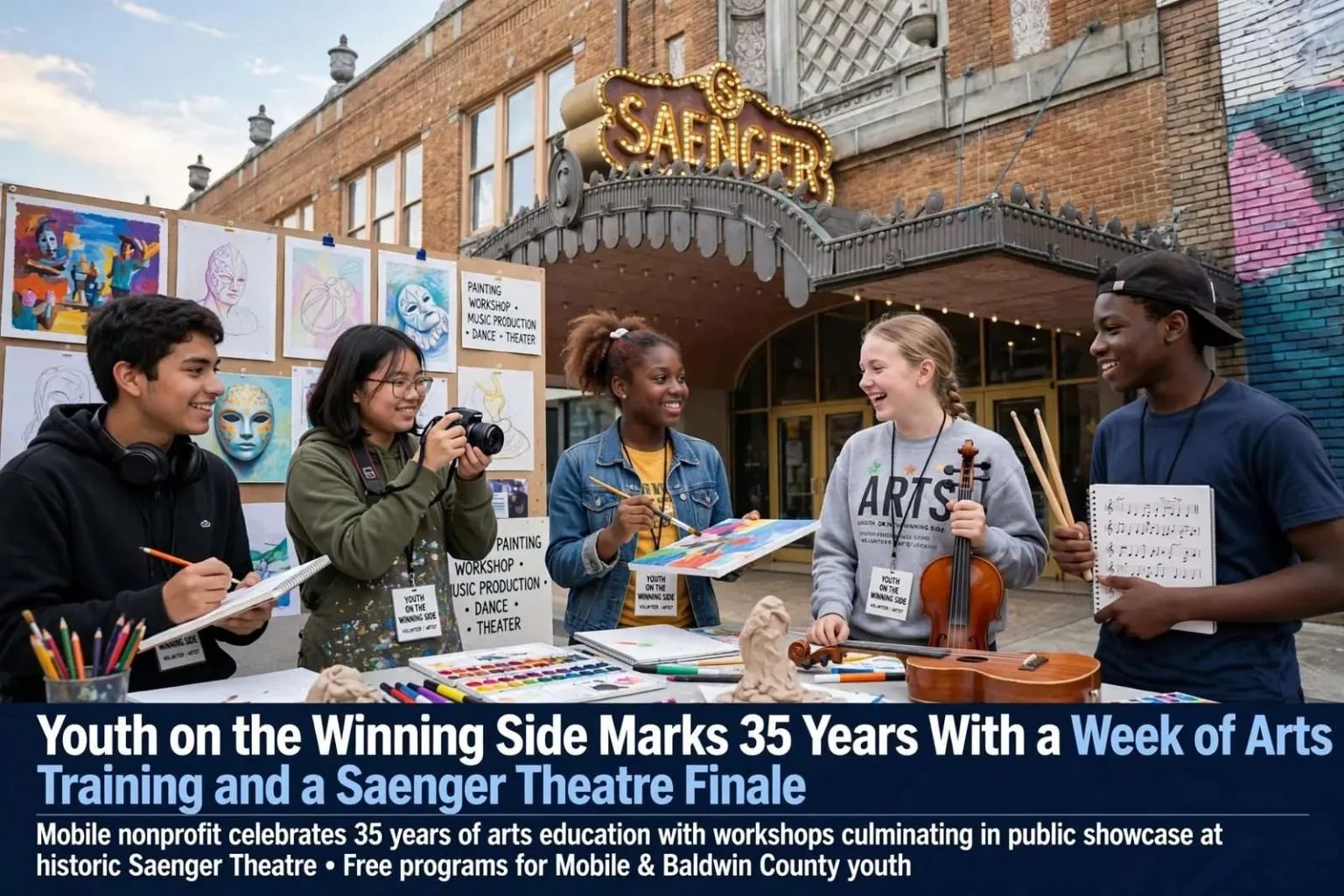
Youth on the Winning Side is marking 35 years with a week of arts programming that pulls together the same mix of visual art, music and creative expression that has defined the organization since its founding in 1990. The milestone is also an opportunity for the nonprofit to look back at the thousands of young people who have come through its programs and to introduce itself to a new generation of families along the Gulf Coast.
What the Organization Does
Youth on the Winning Side is a community-based nonprofit that runs after-school and summer programming for young people in Mobile, with a particular focus on arts education, leadership development and academic support. The organization’s flagship program, the annual Week of the Arts, draws young participants from across Mobile and Baldwin counties for a multi-day slate of workshops, performances and showcases that culminates in a public exhibition of the work the young artists have created during the week.
Beyond the Week of the Arts, the organization runs tutoring and mentoring programs, leadership academies and seasonal events that engage young people throughout the year. The programming is open to participants regardless of household income, and the organization’s funding model relies on a mix of grants, donations and volunteer support to keep participation free or low-cost for families.
How the Week of Arts Has Evolved
The Week of the Arts has grown significantly since the organization’s founding in 1990. Early programs drew small groups of participants into a single rented space for an intensive week of art-making, with local artists and educators donating their time as instructors. The current programming spreads across multiple sites and disciplines, with workshops in painting, drawing, sculpture, photography, dance, theater and music running in parallel and culminating in a public showcase that lets the young artists present their work to family members and the broader community.
The week’s expansion reflects both the growth of the organization and the broader recognition of the role arts education plays in young people’s development. Studies have repeatedly linked sustained arts participation to improved academic outcomes, stronger social skills and higher rates of high school graduation, and Youth on the Winning Side has built its programming around the principle that the arts are not a luxury but a critical part of how young people learn to express themselves and engage with their communities.
Why Arts Programming Matters in Mobile
Mobile’s arts landscape includes major institutions like the Mobile Museum of Art, the Mobile Symphony, the Mobile Opera and a range of smaller galleries and performance spaces, but the kind of sustained, free arts programming that reaches young people outside of school hours is less common. Youth on the Winning Side fills a gap that schools, with their stretched budgets and crowded calendars, are not always able to address on their own, and the organization’s programming has reached young people who would not otherwise have had access to consistent arts instruction.
The Mobile County School System and surrounding Baldwin County districts have partnered with the organization on various programs over the years, and that partnership has been a key reason the organization has been able to scale up its offerings. Teachers and school administrators often refer students to Youth on the Winning Side’s programs, and the organization has worked hard to maintain relationships with the schools that serve the families it aims to reach.
What to Expect at This Year’s Week of the Arts
This year’s Week of the Arts will follow the format that has become familiar to returning families: a multi-day slate of workshops led by local artists and educators, with a public showcase at the end of the week where participants present their work to the community. Workshops will cover a range of disciplines and skill levels, and the organization has made an effort in recent years to expand its offerings to include more digital arts, video production and music production alongside the traditional visual arts.
The public showcase, which typically takes place on the final day of the week, has become one of the most anticipated events on the local arts calendar. Families come to see what their young artists have created during the week, and the showcase is also an opportunity for community members who have not previously engaged with the organization to learn more about its year-round programming.
How the Community Can Support the Work
Youth on the Winning Side relies on a combination of grant funding, individual donations and volunteer support to keep its programming accessible. Donations can be made directly to the organization, and volunteers are needed throughout the year to serve as workshop assistants, tutors and mentors. Local artists and educators who want to share their skills with young people are also encouraged to reach out about teaching opportunities during the Week of the Arts and the organization’s other programs.
For Mobile families whose children have participated in the organization’s programming over the years, the 35th anniversary is also a reminder that the work has continued across decades. Many of the young people who went through Youth on the Winning Side’s earliest programs are now adults with children of their own, and several have returned to the organization as volunteers, board members or workshop instructors. That kind of multi-generational engagement is one of the clearest signs that the programming has staying power beyond any single week or grant cycle.
How the Organization Started
Youth on the Winning Side was founded in 1990 by a group of Mobile residents who wanted to create structured programming for young people in neighborhoods where after-school options were limited. The founders drew on the principle that young people respond to opportunities when those opportunities are presented consistently and supported by adults who know their names, and they built the organization around the idea that sustained relationships, not one-time interventions, are what move young people toward the kinds of outcomes that families and communities want to see.
From the beginning, arts programming was central to the organization’s mission. The founders believed that the disciplines of visual art, music, dance and theater gave young people tools for self-expression that traditional academic settings often did not, and they built the Week of the Arts as a flagship event that would showcase what young people could produce when given the time and resources to make art seriously.
What 35 Years of Programming Has Produced
Across 35 years of programming, Youth on the Winning Side has worked with thousands of young people in Mobile and Baldwin counties. Some have gone on to careers in the arts; others have carried the lessons they learned in the organization’s workshops into professional settings that have nothing to do with art, but where the confidence, discipline and creative problem-solving they developed through the programs continue to shape their work. The organization does not collect data on every former participant, but the steady stream of volunteers and board members who return to support the work is one indication that the programming has lasting effects.
The Week of the Arts in particular has produced a long list of alumni who look back on the experience as a formative one. For young artists who did not have access to studio space or formal training outside the Week of the Arts, the program offered a chance to work with professional artists, experiment with new media and see their work shown in a public setting. For young people who did not necessarily see themselves as artists, the program offered a low-stakes introduction to creative work that often sparked interests they carried forward.
Why the 35th Anniversary Matters
The 35th anniversary is both a celebration of past work and a moment to introduce the organization to families who have not yet engaged with its programming. For Mobile residents who have watched the organization grow over the years, the anniversary is an opportunity to reflect on what sustained arts programming looks like in a community like Mobile, and to recommit to the kind of donor and volunteer support that keeps the programming accessible. For families who have not yet participated, the anniversary is a chance to see what their own children might gain from a week of intensive arts instruction.
The organization has signaled that the 35th-anniversary programming will include some of the traditions that have defined past Week of the Arts events, along with new offerings that reflect how the local arts scene has evolved. Local artists and educators continue to be the backbone of the programming, and the showcase at the end of the week remains the most visible expression of what the young artists have created.
Families interested in signing up their children for the Week of the Arts, or in supporting the organization through donations or volunteer time, can find contact information through Youth on the Winning Side’s website and social media pages. Registration typically opens several weeks before the program begins, and the organization works with families on a case-by-case basis to address any barriers to participation.