Camp SMILE Is Running Right Now in Mobile, and It Turns Nobody Away
United Cerebral Palsy of Mobile's Camp SMILE welcomes campers with special needs of all ages for four weeks each summer — a rare model in a landscape where most camps quietly screen kids out.
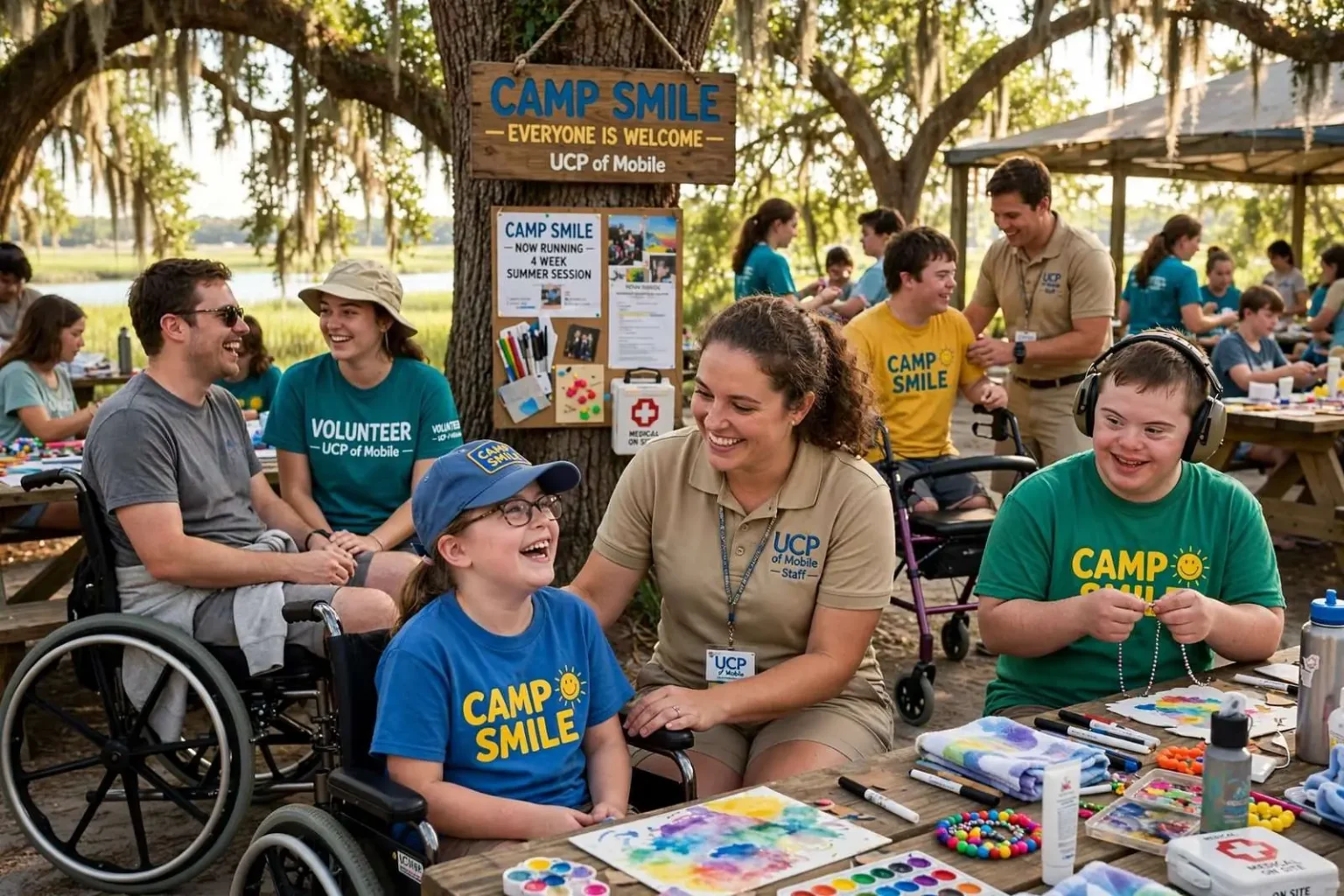
A summer camp is running on the Gulf Coast right now that operates on a principle most camps cannot manage: it takes everybody.
Camp SMILE, operated by United Cerebral Palsy of Mobile, welcomes campers with special needs of all ages for four weeks every summer. Not children who fit a narrow diagnostic profile. Not children whose support needs happen to be manageable with the staff on hand. All of them.
Why That Is Harder Than It Sounds
Families of children with disabilities know a particular kind of summer arithmetic. School provides structure, therapy, socialization and supervision for nine months of the year, and then it stops. Typical summer camps often cannot accommodate a child who needs feeding support, seizure protocols, mobility assistance or a one-to-one aide — and the rejection frequently arrives politely, framed as a staffing limitation rather than a refusal.
The result is that many families with a disabled child simply do not have a camp option at all. A parent leaves a job, or a grandparent absorbs the summer, or the child spends three months at home while siblings go to camp.
A camp that accepts campers of all ages and all support levels removes that problem. It requires a staffing ratio and a level of clinical capability that most recreational programs are not built for, which is precisely why programs like Camp SMILE are rare and why the ones that exist tend to be run by organizations like UCP that already have the expertise in-house.
What Campers Get
The four-week program gives children and adults with disabilities what camp gives everybody else: friendships, activities, time outdoors, independence away from parents, and the ordinary business of being a kid in the summer. For campers whose lives are heavily scheduled around therapy appointments and medical management, that ordinariness is the whole point.
It also gives caregivers something they rarely get — respite. The value of that to a family running on empty is difficult to overstate.
About UCP of Mobile
United Cerebral Palsy of Mobile serves people with cerebral palsy and a broad range of other disabilities across the region, offering services well beyond the summer camp — including early intervention, therapy services, and support and resources for families navigating a new diagnosis.
Families in Mobile and Baldwin counties looking for disability services, or for information about future sessions of Camp SMILE, can contact UCP of Mobile directly.
How to Support It
Programs like this run on donations, grants and volunteers. Community members who want to help can contribute financially, volunteer time, or — often just as valuable — make sure families who need the program actually know it exists. Word of mouth remains how most families find these services, and how many of them never do.
United Cerebral Palsy of Mobile has long been a cornerstone of disability services on the Gulf Coast, serving not only people with cerebral palsy but individuals with a broad range of developmental and physical disabilities across Mobile and the surrounding counties. Beyond Camp SMILE, the organization provides early intervention, therapy, employment support, and adult day programs, and it is part of a national UCP network that has advocated for the independence and inclusion of people with disabilities for decades.
Why Inclusive Camps Are So Rare
The scarcity of camps that accept children and adults of all support levels is not an accident. Running a fully inclusive camp requires nurses, trained aides, adaptive equipment, and the kind of staffing ratios that most recreational programs cannot fund. UCP’s ability to do it stems from its existing clinical infrastructure — the same expertise that powers its year-round services carries into the summer camp, which is why a camp like this is as much a continuation of care as a recreational break.
For Mobile families, Camp SMILE represents something close to a lifeline during the summer months when school-based structure disappears. The respite it offers caregivers — many of whom are parents or grandparents balancing work, appointments, and round-the-clock care — is one of the program’s quiet, essential functions. And for the campers themselves, four weeks of friendship, activity, and time outdoors are the same things every child and adult has a right to expect from summer, no exceptions made for the bodies they were born into.
The Wider Challenge of Disability Services in Alabama
The principle behind Camp SMILE — that no one should be turned away because their needs are too complex — echoes a wider challenge facing disability services across Alabama. Rural communities and under-resourced urban neighborhoods alike often lack the specialized staff and accessible facilities that inclusive programming demands. Organizations like UCP bridge that gap, and the summer camp is one of the most visible expressions of their mission. When a camper who uses a wheelchair or requires feeding support spends a week doing what their siblings do at other camps, the message to the family is unmistakable: your child belongs here too.
Mobile’s broader network of nonprofits, volunteers, and healthcare providers makes a program like this possible. Camp SMILE draws on therapists, aides, and community volunteers who give their summer to the effort, and it reflects the kind of cross-sector care that the Gulf Coast’s disability community has built over decades. As the camp runs its four weeks this summer, it is worth remembering that its quiet, everyday work — a game of catch, a swim, a friendship formed — is among the most consequential things happening in Mobile right now.
How the Camp Runs in Practice
For families considering Camp SMILE, the practical question is rarely whether their child will be accepted — the camp’s whole identity is that everyone is — but how to arrange the weeks around work and sibling schedules. UCP of Mobile handles that coordination as part of its year-round relationship with the families it serves, which is part of why the camp feels less like a transaction and more like a continuation of care. As the four weeks unfold this summer, the measure of the program’s success will not be any single achievement on a stage or a field, but the simple, radical fact that every camper who arrived was exactly where they belonged.
Mobile families who want to learn more about Camp SMILE or about other UCP of Mobile programs can reach the organization through its main office, where intake coordinators help families navigate the registration process and connect them with the year-round services the agency provides. The four-week summer camp is the most visible expression of that work, but it sits inside a much larger network of therapy, early intervention and family support that continues long after the last camper has gone home.
The Daily Rhythm of Camp SMILE
The four-week session at Camp SMILE follows a rhythm designed to feel like a regular summer camp while quietly accommodating the medical and developmental needs of every camper. Mornings typically open with arrival and check-in, where nurses and aides review any overnight concerns with caregivers before the day begins. From there, the schedule moves through structured activities — arts and crafts, music, swimming, sensory play, outdoor games — rotated so that campers experience a mix of high-energy and quieter options. Lunch and rest periods are built in, and the camp’s medical staff remains on site throughout the day to administer medications, respond to seizures and manage feeding tubes or other clinical needs as they arise.
The staff-to-camper ratio at Camp SMILE is significantly higher than at a typical summer camp, which is what allows the program to accept campers with the most complex support needs. Aides are trained in specific clinical areas relevant to their assigned campers, and volunteers from the University of South Alabama, Spring Hill College and other local programs frequently help round out the team. The result is an environment where a child who uses a wheelchair, a teen with autism who needs a structured schedule and an adult with cerebral palsy who requires feeding support can all be in the same building on the same day, doing things that look a lot like what their peers at any other summer camp would be doing.
How the Camp Is Funded
Camp SMILE is sustained through a combination of donor contributions, grants from local foundations and revenue from UCP of Mobile’s broader service contracts. Families are not charged a fee that reflects the actual cost of running the program, which is what allows the camp to be open to everyone regardless of a family’s ability to pay. The four-week session is one of the most visible lines in UCP of Mobile’s annual budget, and the agency’s development team spends much of the year securing the contributions needed to keep it running.
For donors who want their dollars to translate into something tangible, the camp is one of the easier programs to point to. A contribution of a few hundred dollars can fund a camper’s week, including the staff support and clinical coverage that allow that camper to attend. Larger gifts underwrite specialized equipment, transportation for campers who cannot get to the site on their own, and the trained aides who make the most complex cases possible.