
Anonymous Lawyer Launches Website to Cover Mobile Trials the Papers Miss
An unidentified attorney writing as 'Publius' announced a new website, alabamacourt.org, promising firsthand coverage and legal analysis of Mobile-area trials that newspapers no longer report.
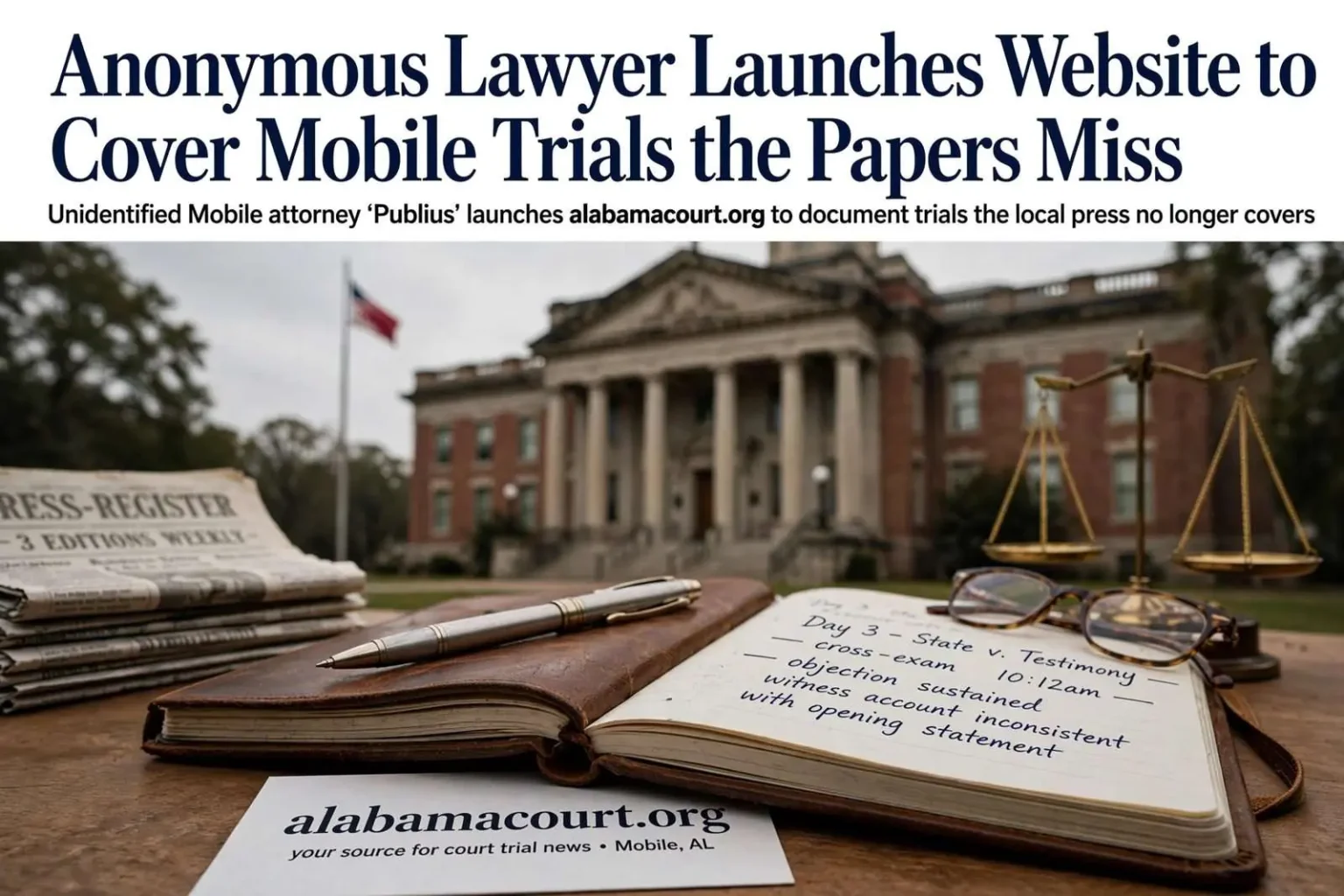
An unidentified Mobile attorney writing under the pen name “Publius” announced the creation of a new website, alabamacourt.org, billing it as “your source for court trial news” for the Mobile area.
The launch was pitched squarely as an answer to what its founders described as a growing gap in local coverage of the courts.
A lament for lost coverage
The announcement opened with a look back at how much the local news landscape had changed.
“Just 30 years ago, Mobile was fortunate to have a morning newspaper and an afternoon newspaper,” Publius wrote. “Now, we are to be left with 3 editions a week. Is there anyone that really thinks that there is less news in Mobile?”
The writer took aim at television as well, questioning whether reporters stayed in Mobile long enough to learn the community, and even to pronounce the name of Coden, the small fishing settlement in south Mobile County.
In the writer’s telling, the shrinking of print coverage rippled outward, because local television stations often took their cues from the morning newspaper. If the paper did not cover a trial, Publius argued, the television stations would not either.
The arithmetic behind the lament was familiar to newsrooms everywhere. The Mobile Register, once a broadsheet institution with competing editions, had been consolidated into the Press-Register as circulation declined and newsroom staffs shrank. A courthouse beat that might once have supported a full-time reporter with a desk on Government Street became one assignment among many, and long civil trials — the kind that run for weeks without a dramatic verdict — were among the first things to fall out of the paper.
The case for firsthand reporting
“Several judges and members of the Mobile Bar have commented that there are some spectacular trials, both criminal and civil, that are just not being reported by the newspaper,” the writer said.
In response, the site’s organizers — described only as members of the legal community — announced they had decided to report on cases of interest as they unfolded at trial, based on the facts and evidence as they emerged. The service, Publius said, would be free of charge initially.
The organizers acknowledged practical hurdles. Because of the court’s ban on cell phones, laptops and other electronic devices, real-time reporting from the courtroom would be a difficult endeavor. They pledged to follow up each case with more substantive attention on the website.
The electronic-device ban is a real constraint on modern courtroom coverage. Mobile County’s circuit courthouse, like many across Alabama, prohibits the phones and laptops that reporters in other jurisdictions use to file from the courtroom floor. A trial watcher working under those rules records testimony by hand, files from the hallway or the parking lot, and accepts that the account will trail the proceedings by hours rather than minutes — a rhythm the site’s organizers said they could live with.
Analysis over instant updates
The writer drew a deliberate distinction between the site’s ambitions and the habits of instant news. Rather than chase minute-by-minute updates, alabamacourt.org promised considered accounts of trials as they developed — reporting grounded in what the evidence actually showed, written by people trained to follow it.
The pitch leaned on the writers’ day jobs. Members of the bar are, by profession, readers of testimony, evidence and procedure. A lawyer watching a trial hears the objections, knows the motions and recognizes when a witness account has shifted from opening statement to cross-examination. That literacy, the organizers argued, could substitute for the institutional support a newspaper courtroom reporter once had.
The choice of a pen name carried its own message. “Publius” was the shared signature of Alexander Hamilton, James Madison and John Jay in the Federalist Papers — arguments about public affairs written for citizens by men with standing in the law. The allusion positioned the site not as anonymous gossip but as a continuation of a tradition in which lawyers write for the public under a classical name, letting the arguments stand on their own.
What Mobile’s courtrooms hold
The Mobile County courthouse system generates more material than its shrinking press coverage could absorb even in busier times. Circuit and district courts handle thousands of felony cases, civil suits and family matters each year, and a handful of trials in any given term — murder prosecutions, multimillion-dollar injury verdicts, contested business dissolutions — draw attention from lawyers and litigants across the region.
Those trials matter beyond their courtrooms. Civil verdicts shape insurance rates and business practices. Criminal trials test the region’s prosecution and defense systems in public. And the courtroom record — testimony under oath, evidence admitted and weighed — is the most thoroughly verified version of local events that exists, which is precisely why its absence from the news felt to the site’s founders like a civic loss rather than a merely professional one.
Publius’ reference to Coden pointed at the same problem from another angle. A newsroom whose reporters cannot pronounce the names of the communities they cover is a newsroom whose reporters have not been there long, and a community like Coden — centuries old, built on fishing and the bay — appears in local coverage mostly when something goes wrong. The writer’s jab was less about television personalities than about the churn that keeps shallow coverage shallow.
Reading the media landscape behind the launch
The announcement captured a specific moment in the economics of local news. Afternoon newspapers across the country had folded or merged decades earlier; the survivors were cutting print frequency and staff; and the web had not yet produced a working model to replace what was being lost. Court reporting, always expensive and always specialized, sat at the sharp end of the cuts.
The numbers Publius cited told the story economically. Two daily papers became one; one daily paper became three editions a week — a print schedule that assumed readers would accept their local news in bulk, days after it happened. Against that backdrop, the writer’s rhetorical question — whether anyone really believes Mobile produces less news than it did when two papers competed — made the gap between supply and demand impossible to miss. Trials had not become less interesting. The capacity to cover them had simply disappeared.
The site’s answer was volunteer professional labor. Attorneys with day jobs would watch the trials they were not involved in and write them up for free, at least at first. The organizers were explicit that the arrangement might not last forever, but the initial offering — free, fact-based, trial-focused reporting from inside the legal community — cost the readers nothing and the writers only their lunch hours.
Whether such a project can sustain itself is the standing question for every volunteer news venture. What the launch made plain is that the demand existed: judges and bar members were already complaining on the record that significant trials were going unreported, and the site’s organizers built their pitch on that complaint rather than on speculation.
What readers should expect
For readers, the promise was straightforward. The site would cover trials as they unfolded, from the facts and evidence, with follow-up analysis that gave each case its full weight. It would not be instant — the courthouse’s device ban and the writers’ court schedules made that impossible — but it aimed to be accurate, substantive and free.
The delays imposed by the device rules may even have shaped the product for the better. An account written by hand across a full day of testimony, then composed and reviewed in the evening, is naturally more considered than one typed into a phone between witnesses. The organizers’ pledge to follow each case with deeper attention on the website fits that rhythm: first a clean account of what the evidence showed, then the analysis that only someone who sat through the trial can offer.
The larger wager behind alabamacourt.org is one the whole industry is still testing: that informed members of a profession can document their own institutions for the public, filling the space that shrinking newsrooms leave behind. In Mobile’s case, the institution is the courthouse, the professionals are the bar, and the pen name on the door belongs to a tradition as old as the republic’s — lawyers arguing in public, under an assumed classical name, so that citizens can judge for themselves.
Whether the site thrives or fades, its launch stands as a documented protest against the shrinking of Mobile’s courthouse press — and as proof that the community noticed what was being lost.
The complaint at its center — that judges and bar members were watching significant trials go unreported — did not come from a media critic outside the system. It came from the people who run the system, which is perhaps the strongest evidence that the gap was real. When the professionals closest to a public institution say the public cannot see what it does, someone eventually builds a window. In Mobile, that window had a name, a website and a pen name borrowed from the Founding generation.