Alabama’s Longest-Serving Judge to Leave the Mobile Bench Three Months Early
Circuit Judge Ferrill D. McRae, appointed by George Wallace 41 years earlier and the longest continuously serving judge in Alabama history, planned to step down from the Mobile bench on Oct. 1, 2006.
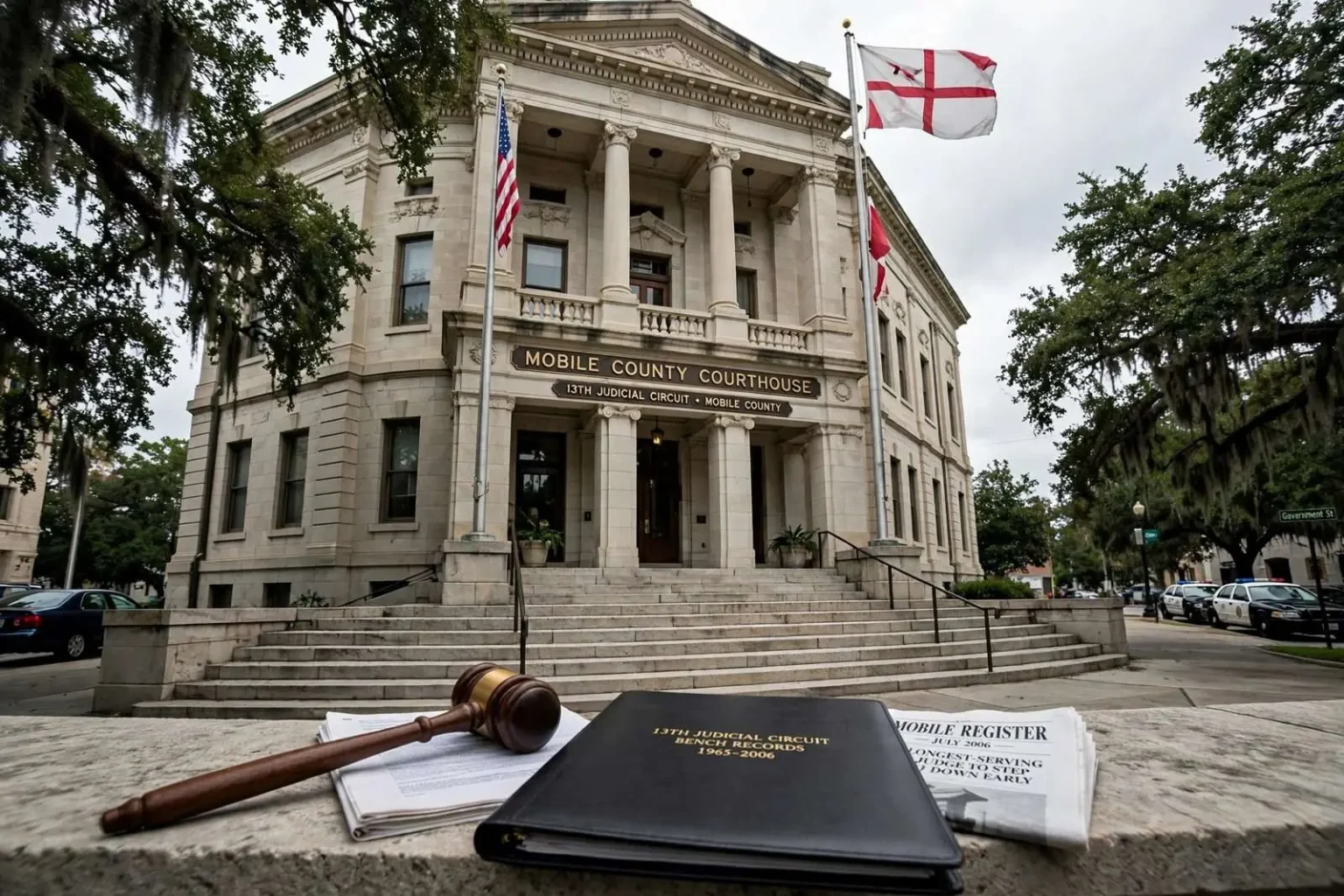
Ferrill D. McRae, the longest continuously serving judge in Alabama history, planned to step down from the 13th Judicial Circuit bench in Mobile County on Oct. 1, 2006, three months before his term of office was to expire, sources close to the judge confirmed in July of that year. McRae, then 71, had been appointed to the Mobile circuit bench 41 years earlier by Gov. George C. Wallace, and he did not seek re-election in 2006. He did not return a call seeking comment, but had a trusted intermediary confirm the report of his planned departure.
The 13th Judicial Circuit covers all of Mobile County and is one of the busiest trial courts in Alabama, handling the felony criminal docket, major civil litigation, and the county’s domestic relations caseloads. Alabama circuit judges serve six-year terms in partisan elections, so an incumbent leaving three months before his term ran out was an unusual event — and one that set the state’s judicial appointment machinery in motion.
McRae’s retirement did not come as the product of an election cycle’s usual churn. He simply decided that four decades was enough, and his early exit meant the transition would arrive months before the calendar required it.
What happened to the seat
Mobile attorney Robert Smith had won the Republican nomination for McRae’s seat, and no Democratic candidate qualified, which made him the presumptive successor when the new term began in January 2007. McRae’s early departure simply moved the calendar forward.
The county’s five-member judicial selection committee, chaired by Circuit Judge Herman Thomas, was expected to submit Smith’s name to Gov. Bob Riley, who would then appoint him to serve out the remainder of McRae’s term. The committee ordinarily forwarded three names for a governor’s consideration, but with Smith already on the verge of taking the bench in January, his name alone was expected to go to Riley.
The arrangement spared the county an awkward interregnum. Had McRae served until his term expired, the seat would have changed hands at the natural transition point with no interim appointment needed. By leaving three months early, he created a gap that only the governor and the selection committee could fill — and because the elected successor was already known, the process was expected to be a formality rather than a contest.
Alabama’s system for mid-term judicial vacancies pairs local input with gubernatorial authority. When a circuit seat opens between elections, a county committee — typically drawing on the local bar and the sitting bench — reviews prospects and forwards names, and the governor makes the appointment. In this case the vetting had effectively been done by the voters themselves: Smith had run for the seat, won his party’s nomination, and faced no opposition in the general election.
For litigants and lawyers in Mobile, the practical meaning of the shuffle was small: the same courtroom, a new name on the door, and a session already underway. For the institutions of the courthouse, it meant that one of the longest unbroken tenures in Alabama judicial history was about to be written into the record books as a closed account.
A judge people had opinions about
Few figures in the Mobile County courthouse inspired more commentary than McRae, and the reaction to his departure ran the full range from reverence to affectionate exasperation.
District Judge Judson Wells praised a “long and distinguished career” and said McRae had ruled fairly in every case Wells brought before him in private practice and had been generous and supportive once the two became colleagues on the bench. Wells also noted the passion the two men shared for the University of Alabama.
“He is one of the most ardent University of Alabama supporters you will find anywhere,” said Wells, who had recently served as president of the university’s national alumni association. “He tells you what he thinks and is not the slightest bit interested in political correctness, which I find refreshing in these times.”
“To sum up, Judge McRae, like Judge Robert E.L. Key, is one of those people you first think of when someone mentions the word ‘judge,’” Wells added, pairing his colleague with another of Mobile’s long-tenured judicial names.
The alumni association presidency Wells mentioned is an elected post atop a network of Alabama graduates that spans the globe, and leading it is a distinction judges in a football-mad state wear prominently. That two Mobile judges would bond over their Tide fandom surprised no one who had spent time in the courthouse, where Saturday football talk was as much a part of the routine as the docket itself.
A father figure to a Vigor quarterback
Scott Hunter, the former Vigor High School, Alabama Crimson Tide and Green Bay Packers quarterback, called McRae “a father figure.”
“Judge McRae recruited me, when alumni could legally do that, for and to the University of Alabama,” Hunter said. He named McRae, his Vigor coach Glen Yancey and Coach Paul Bryant as the three father figures in a life shaped first by grandparents and then a single mother.
Hunter’s path from Prichard’s Vigor High School to the Tide’s backfield and then to the Packers’ roster was one of the notable football stories of his era, and McRae’s role in it came in the years before recruiting rules restricted the contact alumni could have with prospects. The judge’s reach, in other words, extended well beyond the courtroom and into the lives of young Mobilians he believed deserved a chance.
Law and order, and something else
Capt. Jack Dove of the Mobile Police Department said McRae had “always been a great judge for justice,” tolerating neither defense smoke screens nor mistreatment of victims and witnesses by either side.
“His position will be hard to fill,” Dove said.
Bill Yeager, a Mobile advertising executive, offered a fuller accounting.
“After 41 years on the bench, it’s about time Ferrill took it easy,” he said. “The people of South Alabama owe him a debt of gratitude. He always spoke his mind, sometimes to the extreme, but he was always fair. He had his enemies in the courthouse but it was more envy than anything else.”
The view from the defense bar
Perhaps the most revealing assessment came from the defense bar, where McRae’s reputation was fiercest.
Attorney Dom Soto acknowledged that the judge called himself “el Diablo” and could terrorize a defendant. Yet Soto argued that beneath the law-and-order bombast was a jurist who reliably saw the merits of a case.
“He can be counted on to mete out a consistent justice or, as is sometimes even more important, mercy,” Soto said, describing McRae’s approach as an odd marriage of legal rigor and common sense.
“It doesn’t matter if you’re black or white, rich or poor, or if your lawyer is connected or not, you get the best shake in that courtroom,” Soto said.
Soto added that McRae had quietly helped lawyers in trouble, counseling them and enlisting other members of the bar on their behalf.
“No lawyer has a better friend on the court,” he said.
Forty-one years in context
An Alabama circuit judge stands for election every six years, so a 41-year run on a single seat meant either repeated wins or long stretches when no one bothered to file against him. Either way, the longevity made his name a fixture: defendants, victims, witnesses and lawyers could count on the same presiding presence year after year, in a courthouse where nearly everything else turned over.
The Mobile McRae entered in the mid-1960s was a port and industrial city whose economy ran on the river, the docks and the paper mills, and whose courthouse docket still carried the habits of a smaller town. He was appointed by a governor whose name was synonymous with Alabama politics of that era, joining a bench that mixed appointed incumbents with newly elected arrivals.
Over the following decades the 13th Circuit’s work grew with the county: a suburban population spreading west of the city, a criminal docket fed by a growing metro area, and civil litigation that tracked the region’s construction, maritime and medical economies. New judges came and went with each election cycle; McRae stayed.
Continuity of that kind is unusual anywhere, and rarer still in Alabama, where judicial seats change hands in most election cycles. By the 2000s, courthouse regulars used his name as shorthand for a style of judging — blunt, fast, unpretentious — that newer arrivals had to learn or adjust to.
On the day-to-day level, a 41-year incumbency meant an institutional memory of the county itself. Lawyers who appeared before him as young associates returned as senior partners with the same cautionary tales; families knew his reputation before they ever set foot in his courtroom; and the unwritten rules of practice before him passed from one generation of the bar to the next without ever being written down.
His exit also thinned one of the last connections to the Wallace-era bench. Judges appointed in the 1960s were, by 2006, nearly all gone from Alabama trial courts, their careers overlapping the professionalization of the state judiciary, the spread of continuing judicial education, and the arrival of a generation of lawyers who had never practiced in front of anyone else.
An era ends
Forty-one years is a long time to hold any office. A judge appointed by George Wallace in the mid-1960s was still hearing cases in Mobile in the age of the internet, having watched the county’s bench, bar and politics remake themselves several times over.
The Mobile of 1965 that McRae entered was a different city in almost every measurable respect — its economy, its demographics, its courthouse culture, even the vocabulary of its legal system had shifted. Through all of it, one man’s name stayed on the same courtroom door, and generations of lawyers learned what to expect when they appeared before him.
Whatever else the courthouse thought of Ferrill McRae, no one disputed that his departure closed a chapter. The 13th Judicial Circuit’s longest era had an ending date at last: the first day of October 2006, three months ahead of schedule, with a successor already chosen by default and waiting in the wings.