
Conscience or Survival? Alabama’s Political Class Weighs the Griffith Defection
Republicans, Democrats and operatives across Alabama, including Mobile County party figures, offered blunt assessments of Parker Griffith's party switch. Almost none of them called it principle.
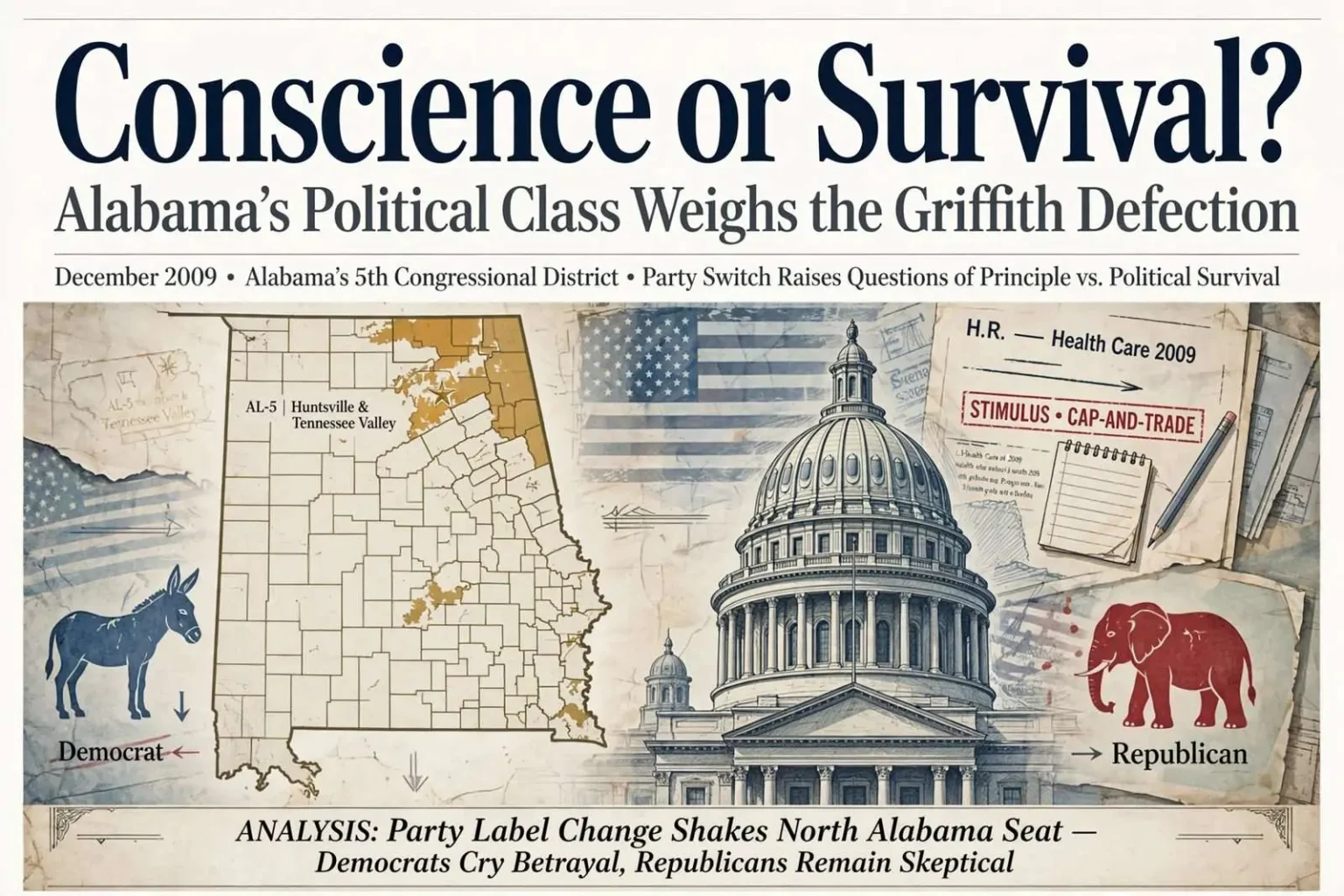
Thirteen months earlier, before Parker Griffith had even taken the oath of office, the rumblings began: he would not remain both a Democrat and a congressman for long. Something would have to give. The smart money said his party label would go first.
Riding the Obama wave in 2008 was one thing; standing for re-election in an off-year contest as a member of the party in power, in a north Alabama district that had by then developed a firmer opinion about hope and change, was another. Alabama’s 5th Congressional District, anchored by Huntsville and the Tennessee Valley, had sent conservative Democrats to Washington for decades, but the district’s voters were trending steadily Republican, and the 2010 midterm environment promised to be hostile to whichever party held the White House.
In December 2009, Griffith did what the smart money expected. He became a Republican, abandoning the party whose banner he had carried to victory the year before. A physician by profession and a familiar figure in Huntsville’s medical community, Griffith had won the open seat in 2008 as part of the Democratic wave that swept Barack Obama into the White House — a wave that crested high in the cities of north Alabama but left the district’s underlying political chemistry largely unchanged.
Asked to judge it, Alabama’s political class was, in the main, unsentimental.
The political geography explained both his election and his problem. Griffith had taken the seat formerly held by Bud Cramer, a conservative Democrat who retired after two decades, in a district where registered Republicans outnumbered Democrats and where the Democratic label had been sustained largely by incumbency and personal appeal rather than party loyalty. When Obama’s approval ratings sagged in the district through 2009 — over health care, cap-and-trade and the stimulus — Griffith’s votes for the House leadership’s agenda became the central fact of his political identity, whatever his personal conservatism on other issues.
Survival, said the Democrats
“This is just a survival decision,” said one Democratic strategist. Sen. Richard Shelby had been after him to switch, the strategist noted. The switch would keep Republican money off him. There was no strong Republican already in the field. His real vulnerability was a Democratic primary, and the switch eliminated it. His Blue Dog colleagues — the fiscally conservative Democrats whose ranks had made a Northern Alabama moderate feel at home — were retiring, removing his cover. The calculus ran in both directions: as a Democrat, Griffith would face organized primary opposition from a base that had soured on conservative Democrats who voted with the leadership on some measures and against it on others; as a Republican, his only fight would be for the nomination of a party whose voters dominated the district.
“I believe it is just a straightforward personal decision,” the strategist said. “He doesn’t think long term.”
Reggie Copeland Jr., interim chairman of the Mobile County Democratic Executive Committee, put it more simply: “If he just got elected as a Democrat, why make the switch now?” The question carried an edge, because Griffith had taken office only a year earlier, and many Democrats saw the move as a betrayal of the voters who had elected him under one label and would now be represented by another without ever getting a say.
A longtime Mobile-area Democratic committee member turned the blame on his own leadership: “Where was state party chair Joe Turnham during this? Apparently asleep at the wheel.” Party insiders could recite the warning signs — a congressman who had barely been seated was already being courted by the other side — and concluded that the state party had done nothing to hold him.
Ed Kahalley Sr., a Mobile Democrat of long standing, offered a maxim instead of an analysis: “Whenever an Alabama Democrat tries to be like an Alabama Republican, he or she loses. The record will prove this to be true almost 100 percent of the time.” In his view, Alabama voters had long ago settled the question of which party could win statewide and in most districts, and Democrats who imitated the other side only invited the comparison.
Suspicion among the Republicans
The welcome from the other side was, in places, cool. “Just two years ago in the Alabama Senate he fought bitterly with the Republican senators and the governor,” said Jerry Lathan of the state Republican executive committee. “He was a loyal, energetic servant of Lowell Barron’s ruling majority. He voted for Nancy Pelosi’s regime just a year ago. So is he a real Republican? Unless he professes to have had some see-the-light moment like Paul on the road to Damascus, he is a political opportunist. So I predict the primary voters will decide the matter in June 2010.”
Lathan’s catalog of grievances was accurate. Griffith had served in the Alabama Senate, where Democrats under Barron controlled the chamber and clashed with Gov. Bob Riley’s Republican administration, before winning the congressional seat in 2008. In his single year in Washington he had supported the House Democratic leadership’s agenda — the record Republicans were already dissecting.
A south Alabama GOP official was blunter: “Anyone who knew Parker during his two years in the Legislature will tell you that he was a liberal Democrat. The people I have talked to today can’t believe that he actually switched parties.”
One Republican legislator managed six words: “He is no more a Republican than Nancy Pelosi.”
Others were more welcoming. State Rep. Mike Hubbard, chairman of the Alabama GOP, said the congressman’s time in Washington had clarified matters: “He had to make a choice — to stand with the Obama/Pelosi/Reid agenda or join us in fighting it. I believe Parker Griffith made the right choice.”
A west Mobile Republican noted the practical rule for converts: “Party switchers are heavily watched and have to earn a primary nomination. Republicans will know if it is sincere or convenient.” History offered little comfort: convert congressmen generally found that the receiving party’s base regarded them with suspicion, and primary voters were the ones who would pass judgment.
The timing compounded the suspicion. Griffith announced the switch in late December, during the Christmas recess and in the middle of the national fight over the health care bill — after the House had already passed its version but before the final Senate-White House negotiation was complete. Critics read that as confirmation he had calculated which side of the agenda would cost him votes in 2010, and as evidence the switch was about the next election rather than principle. Supporters countered that leaving a party whose national agenda he could no longer defend was itself the honest choice, whatever the date on the announcement.
The Baldwin County read
A Baldwin County Republican saw a familiar pattern. “I remember he won by only three percent, and his Alabama Senate seat went to a Republican,” the party figure said. “I suspect Parker knew he was a goner if he remained in the Democratic party. Shades of Arlen Specter.”
The Specter comparison was immediate and, to Republicans, unflattering. The veteran Pennsylvania senator had switched from Republican to Democrat earlier in 2009 for plainly electoral reasons, and had then lost his own primary anyway. Griffith’s move ran in the opposite direction but followed the same logic, and the Baldwin figure’s arithmetic was straightforward: a narrow win in 2008, a successor Republican holding his old state Senate seat, and a red-trending district added up to no future as a Democrat.
A former Democratic state senator and Mobile County commissioner, Gary Tanner, was the rare voice for civility. “Dr. Griffith is a great man and a friend. Just because he is an R now doesn’t change my feelings toward him,” Tanner said, invoking former Congressman Sonny Callahan’s lament that politics “is not fun anymore.” Callahan, the Republican who had held south Alabama’s congressional seat before retirement, was remembered for treating the other side with personal warmth across party lines — a tone increasingly hard to find.
The larger forecast
Running beneath the individual verdicts was a prediction that would prove correct. “2010 will see Alabama become a solidly red state,” one former area Democratic leader said, forecasting the loss of a legislative chamber. He also predicted Griffith would lose his primary as voters took revenge for his former affiliation, and that Rep. Bobby Bright of Montgomery would be watching the fallout closely.
Bright, a conservative Democrat holding the southeastern Alabama district, was the state’s other freshman congressman and faced the same off-year math Griffith had fled — a point not lost on either party as the 2010 campaign approached.
Griffith’s colleague Artur Davis, the Democratic front-runner for governor, found the switch “ironic,” noting that Griffith would now carry the banner of a party that had run one of the most savage negative campaigns in the country against him in 2008. The irony was concrete: Republican-leaning groups had hammered Griffith during his 2008 race, and the very money and messaging that had tried to defeat him as a Democrat would now be deployed on his behalf.
State Treasurer Kay Ivey, alone among Republican statewide candidates, criticized Griffith directly. “I can’t help but regard this Road to Damascus conversion as solely a ploy to cling to his seat in 2010,” she said. “Political self-preservation isn’t a virtue.”
Griffith lost the June primary to Mo Brooks. The forecast about the Legislature came true that November, when Alabama’s Republican wave carried over not only the congressional delegation but the chambers of the Alabama Legislature as well — delivering both the House and the Senate to the GOP for the first time in the modern era and completing the realignment the former Democratic leader had called a year early.