Oddsmaker Made Mike Dow the Favorite for Governor. Alabama’s Political Class Was Not Buying It.
A nationally known Mobile oddsmaker installed former Mayor Mike Dow as an even-money favorite in the 2010 governor's race. Consultants, lawyers and party officials lined up to explain why the number was absurd.
An Oddsmaker Picks a Governor’s Race
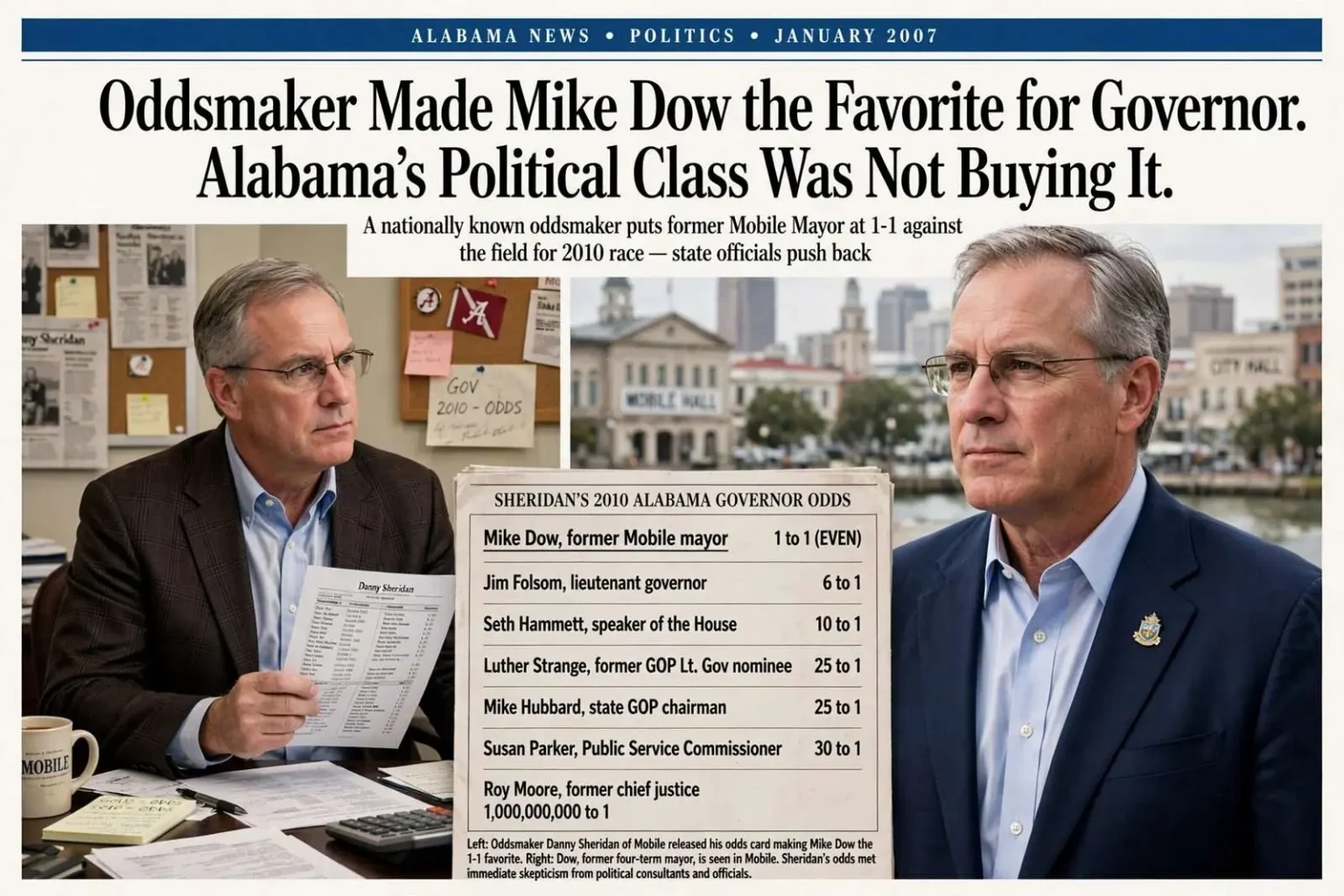
A nationally known oddsmaker made former Mobile Mayor Mike Dow the favorite to become Alabama’s next governor, and much of the state’s political class promptly told him he was wrong. Danny Sheridan of Mobile, whose sports lines were syndicated across the country, installed Dow as an even-money bet against the entire field to succeed Gov. Bob Riley, whose term would end after the 2010 election.
Sheridan’s card read like a sports betting line applied to a political field, with prices attached to each of the state’s leading figures: Mike Dow, former Mobile mayor, 1 to 1; Jim Folsom, lieutenant governor, 6 to 1; Seth Hammett, speaker of the House, 10 to 1; Luther Strange, defeated GOP lieutenant governor nominee, 25 to 1; Mike Hubbard, state representative and GOP chairman, 25 to 1; Susan Parker, newly elected Public Service Commissioner, 30 to 1; and Roy Moore, former chief justice, 1,000,000,000 to 1.
“I have Dow the clear favorite over the entire field,” Sheridan said.
The exercise caught attention precisely because Sheridan’s day job is turning judgment into numbers. His lines ran in newspapers and on broadcasts nationwide, and a national audience reading his political card saw a former Mobile mayor installed at even money, ahead of the lieutenant governor, the speaker of the House and the state’s rising Republicans. Within Alabama’s political community, the reaction was less admiration than argument.
Dow, a four-term mayor who chose not to seek re-election in 2005, had not dismissed talk of a run. He said he was keeping his powder dry while attending to other priorities, including his brother-in-law Jim Busby’s high-tech startup CentraLite Systems and a proposed $624 million motorsports park in the Prichard and Saraland area.
Dow’s silence was its own kind of positioning. A mayor who leaves office at the height of his popularity, and who declines to rule out a statewide run while pursuing major business ventures, keeps every option open without spending anything on a campaign. The motorsports park proposal alone, a project of that scale in the Prichard-Saraland corridor, kept his name attached to headline-making economic development in the region.
The Objections
Sheridan’s number ran into a wall of skepticism from consultants, lawyers, lobbyists and party officials, many of whom noted that the oddsmaker’s long friendship with Dow appeared to have colored his judgment. The most common complaint was arithmetic. Dow was genuinely popular in Mobile, but by 2010 he would have been out of office for five years, with little name recognition in north Alabama and no declared party. As mayor of Mobile, a nonpartisan office, he had never publicly disclosed a party preference.
“He is not known statewide, will be out of any city office for five years by the time of the 2010 election,” one lawyer and political adviser said. “No way he could raise the kind of money Strange, Folsom and others can raise.”
That objection went to the mechanics of a modern statewide campaign rather than to Dow’s abilities. Name recognition decays quickly once an official leaves office, particularly in a state where television markets and media markets divide Mobile from the Tennessee Valley. Fundraising compounds the problem, since donors give early and to candidates with existing organizations, and a former mayor with no party machinery starts from nothing.
A former state legislator was harsher on the strategic logic. “Four years in politics is several lifetimes,” he said. “Dow makes no sense. I like Mike but he has been gravitating Democratic for some time. Also, in four years, Mike will have been out of office a long time and how he stays relevant for the next four years is hard to imagine.”
The observation about Dow’s political drift touched the harder problem: Alabama’s governor’s race would be decided in party primaries, and a candidate who had never declared a party, and who had drifted toward the Democrats in the view of some observers, would face the choice of running in a primary against an entrenched field or trying to build a nonpartisan coalition in a state that elects governors by party.
A former state Republican official reduced the critique to two sentences: “Dow, even money? And Strange only 25-1? I don’t think so.”
The Names Sheridan Left Off
Nearly every respondent reached for the same omission: Rob Riley, the governor’s son, a Yale-educated lawyer whom several believed was looking seriously at 2010. Others pointed to Attorney General Troy King, state Treasurer Kay Ivey, Secretary of State Beth Chapman, state Sen. Bradley Byrne, Agriculture Commissioner Ron Sparks, Tim James, and U.S. Rep. Artur Davis, whom one former GOP official thought “could well take the nomination if he ran.”
The omissions were the sharpest criticism of the card, because a credible line for a governor’s race has to include the people actually positioning themselves to run. The governor’s son carried an automatic base of support in a party his family had led, statewide officeholders such as the treasurer, the attorney general and the secretary of state held platforms that translate naturally into gubernatorial campaigns, and Davis represented a congressional district with a fundraising and name-recognition base that no Mobile mayor could match statewide.
The suggestion that U.S. Sens. Richard Shelby or Jeff Sessions might trade Washington for Montgomery drew something close to derision from a veteran lobbyist, who noted that Shelby was an appropriator with real power and a taste for the capital’s food and arts. “There is NO, NADA, ZERO chance he’d leave Washington for Montgomery,” he said.
The senator question was a staple of every Alabama campaign cycle, but the lobbyist’s answer captured why it never went anywhere: a senator who chairs appropriations work holds more influence over the state’s federal funding than any governor can offer, and the Washington career Shelby had built offered a kind of power Montgomery could not replicate.
Sheridan Stands His Ground
The oddsmaker was unmoved. “They think I’m prejudiced, but they’re dead wrong,” Sheridan said. “When it comes to making odds and predictions, my lucky profession, I never predict what I want to happen but what I think will happen and, in Dow’s case, I have inside info. He will win and should be a heavy favorite now for many reasons. Things can certainly change. If the election were held now, he’d blow away his opponents.”
Sheridan’s defense rested on the claim that gave the card its intrigue: inside information. Oddsmakers live on information edges, and his argument was that those around Dow knew something the political class did not. He also drew the distinction that defines his profession, between predicting what he wants and predicting what he believes, and he acknowledged openly that circumstances could change the picture entirely before 2010 arrived.
Sheridan also picked U.S. Sen. Hillary Clinton to be the next president.
That side prediction placed the card firmly in the speculation-heavy atmosphere of an off-year, when national and state handicappers were filling the vacuum left by campaigns that had not yet begun.
The Consensus Verdict
The consensus among the professionals was less a rejection of Dow than a rejection of the price. Several conceded he could be a potent candidate if he committed, chose a party, took positions and raised money outside his traditional donors. What none of them could accept was that a former mayor with no statewide name identification and no party label belonged at even money three years out.
That distinction is worth reading closely. Nobody in the group called Dow unelectable; the objection was to the odds. A candidate with Dow’s popularity in Alabama’s second-largest city, his business credentials and his record of leading a growing downtown could, in the professionals’ judgment, build a real campaign. But real campaigns cost money, demand party machinery and require years of statewide visibility, and the price on the card assumed Dow had already done work he had not started.
The debate also exposed the gap between how oddsmakers and political professionals model races. Sheridan priced candidates the way he prices games, on information and momentum. The professionals priced them on infrastructure: who has a donor list, who has a party apparatus, who has a statewide organization that can survive three years of inactivity and reassemble on demand. By that second measure, Dow looked nothing like a favorite, whatever his local standing.
As one Mobile lawyer put it, the entire exercise proved only one thing: in Alabama, it is never too early to talk politics.
The episode has aged well as a portrait of how gubernatorial campaigns actually form in Alabama. The names the professionals added to the card, the statewide officeholders and legislators they believed were serious, became the frame through which the 2010 race was eventually understood, while the long-shot prices Sheridan posted, from Strange at 25-1 to Moore’s astronomical number, served as a reminder of how much distance there can be between a name’s political reputation and its actual position in a field.
For Mobile readers, the piece carried a local hook that went beyond speculation. Dow’s four terms as mayor had reshaped the city’s downtown and its civic ambitions, and his post-mayoral ventures, the CentraLite Systems startup and the proposed motorsports park, kept him in the region’s business headlines. The question of whether that local stature could convert to statewide office was one Mobile had asked itself before, and the oddsmaker’s card forced the state’s political community to answer it, even if the answer was no.
The deeper lesson the professionals offered was about the arithmetic of campaigns. Popularity in one city, however deserved, does not raise money in Huntsville, does not field volunteers in Birmingham and does not carry a party label into a primary. Governor’s races in Alabama are won by candidates who build those systems early and sustain them, and every objection the consultants and party officials raised to the even-money number traced back to that single reality.
Sheridan, for his part, never retreated from the position, and the disagreement itself became the story: a Mobile oddsmaker, his Mobile mayor, and a state political class that looked at the same field and saw a completely different race. Both sides agreed on one thing, though, and it was the line the Mobile lawyer closed on. In Alabama, it is never too early to talk politics, and a sports book line for a governor’s race three years out proved it better than any poll could.