Nobody Rings a Bell at the Top: A Mobile Brokerage’s Bear Market Revolt
Part eleven of a memoir of a bygone Mobile: a brutal 1962 bear market, a boss who berated a broker on the morning his mother-in-law was dying, and the plot that followed.
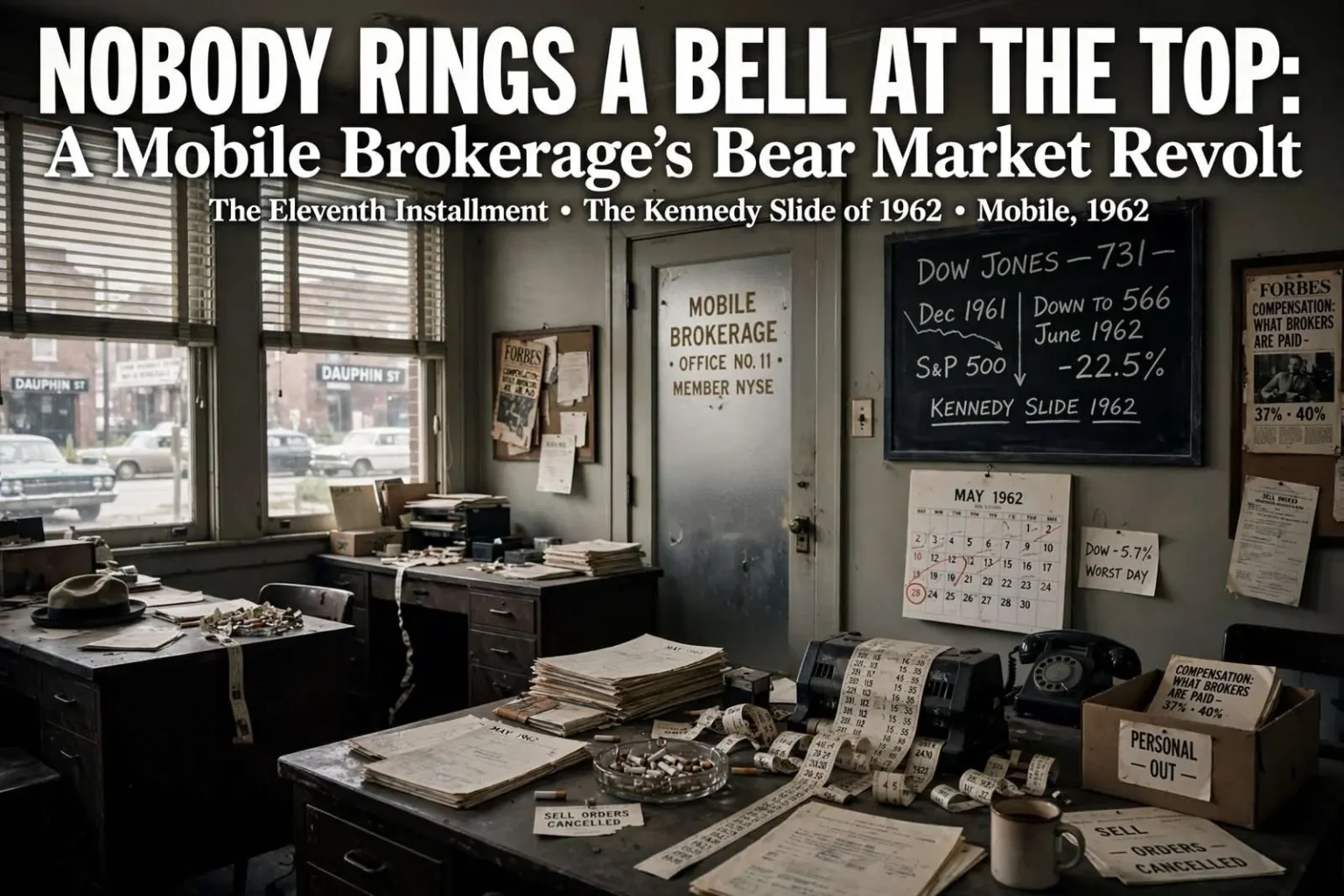
The eleventh installment of a serialized memoir of a bygone Mobile opens with a line every investor eventually learns the hard way: nobody rings a bell and says, this is the top of the market, get out. The year 1961 ended with the Dow Jones Industrial Average at 731, four points below the all-time high set a few days earlier.
Nobody in the Mobile brokerage office knew they were about to be caught in the worst bear market since the author had entered the business on St. Patrick’s Day a decade before.
It was mercifully brief, but it took its toll on Wall Street. Weak firms failed.
Account executives were given their walking papers. Almost no firm expanded.
It was, in short, a terrible year to leave an established position for another firm — which is exactly what the entire Mobile office did.
A manager who took half
By 1962 the office had five brokers under a manager the memoirist describes without softening: a real despot.
In a small office, he argues, a manager should have worked for a percentage of his own gross plus an override on profits — perhaps 10 or 15 percent, depending on what the owners judged his services to be worth. Instead the manager took for himself each year roughly 50 percent of his own production, while the men under him averaged about 25 percent of theirs.
That was not the worst of it. He was frequently hung over and seldom arrived before 10 a.m. He took twenty or more days off a year for fishing, hunting or whatever else appealed to him, usually without warning, leaving his accounts to the others. On the days he did appear, he left promptly when the market closed at 2:30.
One of the brokers told the story of a good client of the manager’s who telephoned, talked at length, received a great deal of information and placed an order — and only then, when asked whether he would like to speak to the manager, replied, “Oh, he’s THERE?” The memoirist estimates that a fifth or more of the manager’s business came from orders his colleagues placed for him.
The morning that was never forgiven
He could be charming when it suited him.
He could also be insufferable, and the memoirist offers one illustration. A late-night call from his wife’s brother brought word that her mother had suffered a severe heart attack in a hospital in Jackson, Miss., and was not expected to live through the night.
There was nothing to be done before morning, and arrangements for the children could not be made in the middle of the night, so they waited. At about 7 a.m. he telephoned the office. The manager, of course, had not arrived.
He told a colleague the situation, said he would be out that day and perhaps the next, and would be in touch. They were about to drive off at 8 a.m. when the phone rang. For once, the manager was at his desk early.
“What do you mean, you’re taking the day off? I expect you here in this office. You’d just better hope there’s a job for you when you get back.” The broker, stunned, asked whether he really meant that. He was told yes, with an oath, and the phone was slammed down.
All the way to Jackson that day, he told his wife the same thing over and over: he’ll pay for this. He did pay for it, eventually, though the memoirist insists the incident played no part in the decision that brought it about — at the time of that decision, he writes, he did not even recall the morning.
The manager never mentioned it again and never apologized.
A letter to Forbes
The brokers talked from time to time, in the empty afternoons after the manager left, about greener pastures.
What they lacked was information. The manager made a point of keeping them ignorant of ordinary industry practice, telling them repeatedly how lucky they were to work for so generous an employer.
So the memoirist wrote to Forbes magazine, asking what the normal compensation for account executives was at various firms. As luck would have it, the letter ran in the magazine’s letters column with his name beneath it — and the manager subscribed.
His heart leaped when he saw it. Apparently the manager never noticed.
The answer was that the large firms, carrying heavy advertising and research budgets, generally paid about 33 percent of the commissions a broker generated. Smaller firms, with less overhead, paid 37 percent or more, some as much as 40.
That was more than a little food for thought. On a 37 percent payout, the memoirist had been considerably underpaid in 1961 and in the years before it.
One spring afternoon, with the bear market well under way and business hard, the five of them held a serious session. They agreed to make contact with other brokerage houses and ask whether any of them would be interested in acquiring a ready-made office in Mobile.
He did not really expect anything to come of it, he writes. But the mere act of looking served as an outlet for their indignation.
The downturn he describes became known as the Kennedy Slide of 1962. From its peak in December 1961 to its low in June 1962, the S&P 500 fell 22.5 percent. The worst single day came on May 28, 1962, when the Dow Jones Industrial Average dropped 5.7 percent.
Next in the series: Hopes raised, hopes dashed, hope springs eternal.