Jack Edwards Tells Fairhope Republicans the GOP Must Widen Its Tent
The former South Alabama congressman told a packed Eastern Shore Republican Women luncheon at the Fairhope Yacht Club that the party's future depends on drawing in the voters it has long failed to reach.
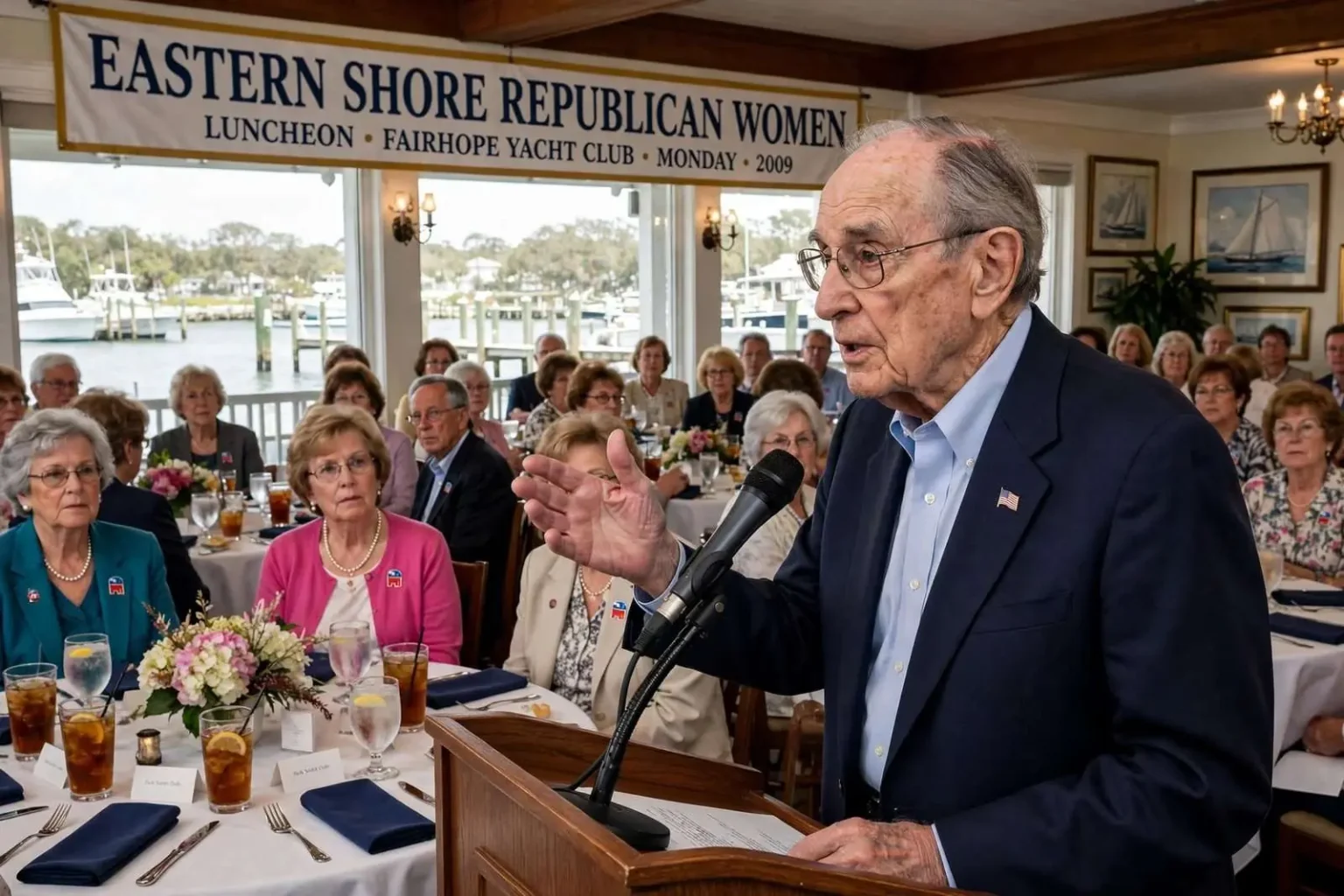
FAIRHOPE – Former U.S. Rep. Jack Edwards, the Republican who represented South Alabama in Congress for two decades, told a standing-room-only luncheon of the Eastern Shore Republican Women that his party’s survival as a governing force depends on whether it can broaden its ranks without surrendering its principles. Edwards, who held the state’s First District seat from the mid-1960s until the mid-1980s and helped build the GOP’s foothold in a region that had voted Democratic for a century, framed the argument as a matter of arithmetic as much as ideology.
More than 100 people crowded into the Fairhope Yacht Club on Monday to hear Edwards, then 80, deliver a talk titled “The Future of the Republican Party.” His message was not new, he conceded, but he argued it had lost none of its urgency: a party that cannot attract minority voters and younger voters will spend a long stretch on the sidelines of American politics. The setting was characteristic of Baldwin County politics — a civic club luncheon on Mobile Bay’s eastern shore, in one of the few Alabama counties that had swung early and decisively to the Republicans — and the crowd included much of the county’s Republican leadership.
A 45-year-old insult that still stings
Edwards opened with a story from 1964, the year he and other “Goldwater Republicans” won their first congressional seats. Pennsylvania Gov. William Scranton, he recalled, publicly complained that the GOP was becoming infested with “rednecks and racists” – a blanket judgment on Southern Republicans whom Scranton had never met. The remark came in the aftermath of Barry Goldwater’s landslide-defeat presidential campaign, when the party’s Southern wing had grown while its Northeastern moderates felt themselves displaced, and the friction between the two wings was raw.
Stung by the remark, Edwards said he got in his car and drove to Harrisburg. Scranton received him, and the two men talked for roughly 90 minutes. Afterward, Edwards said, the governor walked out onto the steps of the Pennsylvania Capitol and publicly apologized for characterizing a whole group of people on the basis of assumption and regional prejudice. Edwards offered the story less as a grievance than as an object lesson in how quickly a label can be applied to people a critic has never met — and how rare it is for the critic to retract it.
Forty-five years later, Edwards told the audience, the label had not entirely worn off. He found the charge particularly strange, he said, given that in Alabama it was the Democratic Party whose ballot emblem had once carried a rooster and the words “white supremacy.” The rooster symbol dated to the state’s post-Reconstruction contests and remained on Alabama Democratic ballots into the twentieth century, a piece of iconography Edwards considered far more damning than anything the young Southern GOP had done.
He offered his own history as further irony. In the 1960s, Edwards said, he worked on voter registration efforts on behalf of Black Alabamians, including an episode in Wilcox County in 1965 when the president of Tuskegee University traveled to Camden to vouch before the Board of Registrars for the literacy of a high school principal seeking to register. Black Belt counties like Wilcox had among the lowest Black registration rates in the state, and getting a single professional man onto the rolls required the kind of high-profile intervention Edwards described.
Each such effort, Edwards observed dryly, nudged him closer to the day he would lose the county at the ballot box. “Every time it happened, it cost me a vote,” he said. “And when there were enough, it cost me the county.” The quip carried the point that in the Alabama politics of that era, courting Black voters and courting white voters pulled in opposite directions, and Edwards chose registration work anyway.
Outreach as strategy, not sentiment
Whatever the history, Edwards said, the political reality of 2009 was a Republican Party with almost no minority representation – a problem of arithmetic as much as of conscience. The country had changed, he said, and the GOP risked irrelevance if it did not keep pace while holding to its core convictions about the proper role of government. He cast outreach not as accommodation but as the party’s only path back to durable national majorities.
He saw signs that party leaders understood the stakes. Edwards called the selection of Michael Steele as national Republican chairman a “smart move,” praising Steele’s performance as an advocate in national media forums. Steele, the party’s first Black national chairman, had taken the post that year as the GOP searched for a public face to answer a newly elected Democratic president.
Closer to home, he pointed to the elevation of George Williams of Bay Minette to a senior vice chairmanship of the Alabama Republican Party. Edwards presented the Baldwin County leader’s rise as evidence that the state party was beginning to mirror the state’s actual population in its leadership, however slowly.
Questions from the floor
Edwards spent more than half his time at the podium taking questions, and his answers ranged widely. He described former House Speaker Newt Gingrich as an exceptional revolutionary who would have been better served staying a revolutionary and leaving the speaker’s gavel to “some quiet soul.” In Edwards’s telling, Gingrich’s talents were suited to movement-building and agitation, and the compromises of governing diluted them.
On the 2012 Republican field, he said Louisiana Gov. Bobby Jindal and Alaska Gov. Sarah Palin both needed more seasoning but were good bets to return to the national stage. Jindal, then in his first term in Baton Rouge, and Palin, who had resigned the Alaska governorship that summer, were both fixtures of early speculation about the next presidential cycle.
Palin, he said, “shook up the election something fierce” when Sen. John McCain named her as his running mate, but the press “let her have it” over her inexperience. Edwards’s assessment balanced admiration for her electoral impact against a candid acknowledgment that the scrutiny had been punishing.
He said Mitt Romney had “the look of a winner,” and lamented that resistance among the Christian right to Romney’s Mormon faith had damaged his prospects in 2008. Edwards regarded the resistance as a self-inflicted wound for a party that needed every coalition partner it could find heading into a difficult cycle.
Asked about Gov. Bob Riley, Edwards did not hedge: “The best governor this state has had in my lifetime.” He added that Albert Brewer, had he been given more time in office, would have been a governor of similar quality. Brewer, who served in the late 1960s and lost a bitter 1970 race to George Wallace, is remembered by many Alabama observers as a reform-minded chief executive whose tenure was cut short by the politics of the day.
He said Bradley Byrne, then chancellor of the two-year college system, would “make an excellent governor,” while acknowledging state Treasurer Kay Ivey and businessman Tim James as serious contenders. Byrne had taken the chancellorship amid a scandal over the two-year college system and was earning a reputation as a cleanup artist — a credential Edwards valued in a prospective statewide candidate.
Byrne, he said, still had “some major battles worth winning right where he is,” chiefly against the Alabama Education Association and its longtime director, Paul Hubbert. Edwards framed the two-year system’s reform fight as unfinished business that a proven executive should finish before seeking higher office. Ivey and James, he added, were credible names in a wide-open 2010 field — an assessment that proved broadly on target when all three went on to run.
Edwards closed on the 1901 Alabama Constitution, which he said should be stripped of its racist language. It was unfortunate, he said, that the state’s political climate had grown so cynical that even a measure with that single objective could not realistically pass. The 1901 document — the longest state constitution in the nation — still contained the disfranchisement-era language its framers used to justify excluding Black Alabamians from the polls, and decades of reform efforts had foundered in the Legislature.
Among those in the room were Baldwin County District Attorney Judy Newcomb, District Judge Jody Bishop, County Commissioner David Ed Bishop, Baldwin County Republican Party chairman Don McGriff, state Sen. Ben Brooks and state Rep. Joe Faust. The gathering drew most of Baldwin County’s Republican officeholders under one roof — a reminder that whatever Edwards said about the party’s national prospects, the Eastern Shore contingent he helped create remained firmly in charge of its home ground.
Edwards’s own career traced the arc he was describing. He won his first term in 1964 as part of the Goldwater wave, kept the First District seat through two decades of Mobile-area growth, and left Congress in the mid-1980s as the GOP’s Alabama realignment — from Fob James’s first term through Guy Hunt and the county-level sweeps of the 1990s — gathered force. His message to the party he built in South Alabama was, in the end, the same one he took to Harrisburg as a young congressman: judge the people in front of you, not the caricature.