A Deer Hunt With His Son Ended Jo Bonner’s 2010 Run for Governor
The Mobile congressman was all in on a campaign for governor in mid-December. Two weeks later, on a hunting trip with his 10-year-old son, he changed his mind and never looked back.
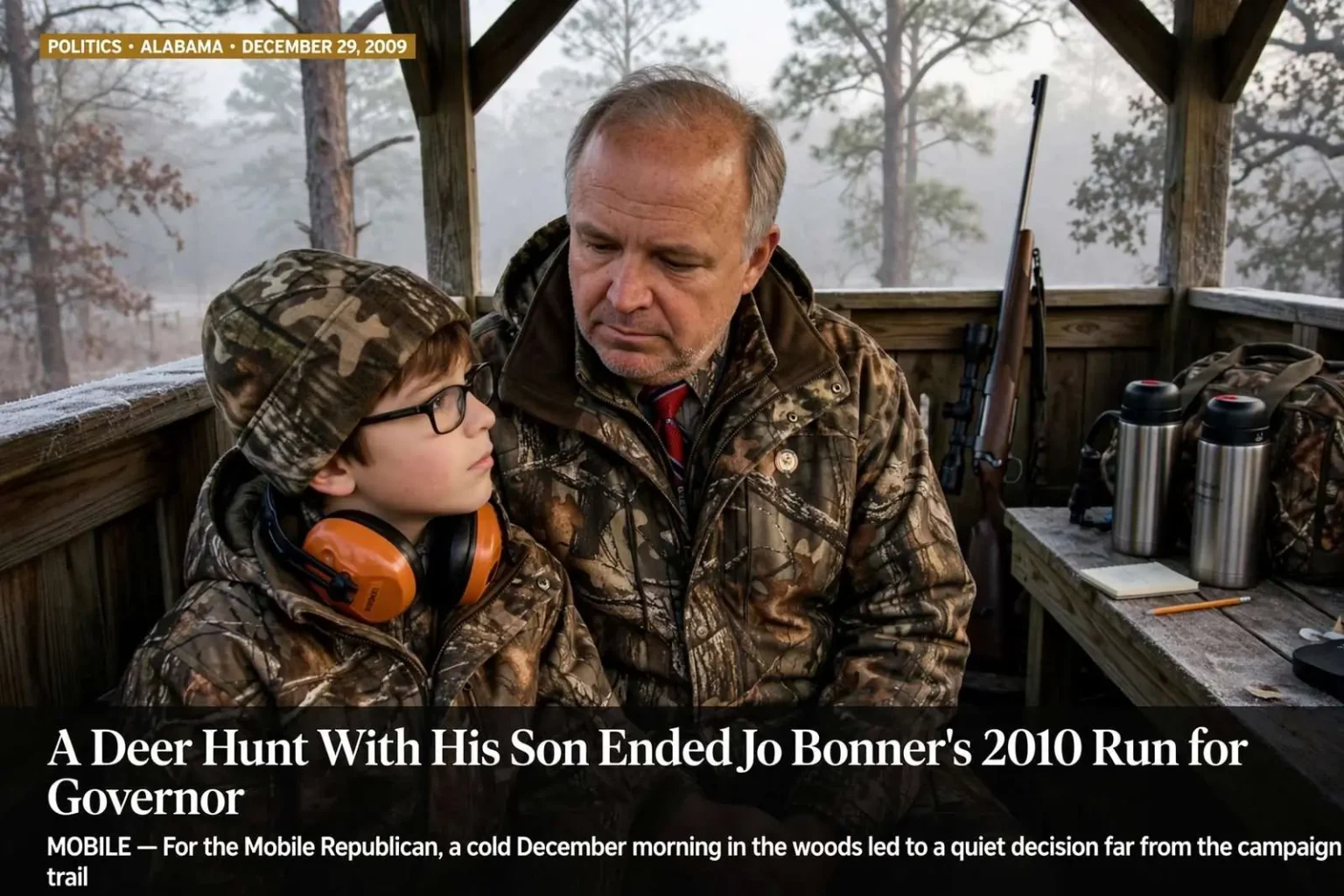
MOBILE – U.S. Rep. Jo Bonner came closer to running for governor of Alabama than most of his constituents realized. By the middle of December 2009, the Mobile Republican was, by his own account, all in. Then came Dec. 29 and a deer hunting trip with his 10-year-old son – what Bonner described as a rite of passage. Somewhere in the cold of that morning, the arithmetic of a statewide campaign hit him, he said, like a freezing north wind. He reversed course, and he said the decision came easily.
The episode has become one of the more quietly revealing stories of modern Alabama politics, a reminder that campaigns often turn not on polls or fundraising totals but on private calculations made far from any campaign office. For Bonner, the moment of clarity arrived not in a strategy session in Washington or a hotel ballroom in Birmingham, but in a deer stand in the woods of South Alabama with his son beside him.
The math of a statewide race
The picture Bonner sketched was not romantic. A serious bid for the 2010 Republican nomination meant 14- and 15-hour workdays Monday through Friday, then weekends spent in Fort Payne, Mobile, Florence and Dothan – and all of that only after raising $10 million to $15 million and surviving a grueling primary. Those cities, spread from the northeastern corner of the state to the Tennessee Valley and the Wiregrass, map out the relentless geography of a statewide campaign in Alabama, a state larger in driving time than many voters appreciate.
Bonner was 49 at the time, with a young teenager and another child close behind. Measured against those years, he said, the timing simply was not right for him or for his family. The years a child spends at home come around only once, and the congressman concluded that a race for governor – and, if successful, years in the Governor’s Mansion – would consume the better part of his son’s remaining school years.
The financial demands he described were not exaggerated by Alabama standards. Modern statewide campaigns in the state routinely cost millions of dollars, with television markets stretching from Huntsville to Mobile and candidates forced to buy advertising across all of them. A contested primary only raised the price, since the Republican nominee would emerge from a field of well-funded rivals with little money left and a general election still ahead.
The schedule he laid out was equally unforgiving. Monday through Friday would belong to fundraising calls and travel, with weekends devoted to parade appearances, fish fries, church homecomings and county party meetings in places like Fort Payne, Florence and Dothan – communities hours from Mobile on opposite ends of the state. It is a rhythm that keeps candidates away from home for most of two years, and Bonner had watched enough colleagues live it to know what he would be asking of himself.
Encouragement from outside the district
The congressman noted a wrinkle that says something about how Alabama politics worked at the end of the 2000s: much of the encouragement he received, and many of the pledges of financial support, came not from the 1st Congressional District he represented but from Huntsville, Birmingham and other places well outside South Alabama.
That pattern reflected the way statewide coalitions are assembled in Alabama. A candidate from Mobile cannot win a statewide race on the strength of his home region alone; the population centers of north and central Alabama hold too many votes and too much donor capacity. Bonner’s experience – being urged into the race more loudly by supporters in Huntsville and Birmingham than by neighbors at home – captured that reality precisely. It also meant that the people who knew his work best, the constituents who had sent him to Congress five times, were not the ones pushing hardest for him to leave.
For Mobile and Baldwin County voters, there was something reassuring in that imbalance. The district’s support for Bonner was rooted in service rather than ambition, and his hesitation to trade a seat he had held and worked at for an uncertain statewide gamble reflected the priorities of the people he answered to.
Why the seat mattered
Bonner had held the 1st District seat since 2003, when he succeeded his former boss, Sonny Callahan, whom he had served as chief of staff. The handoff from Callahan to Bonner preserved an unusual continuity of seniority for a district of South Alabama’s size, and it kept a Mobile voice embedded in the federal spending decisions that matter most to the Gulf Coast.
The district covered Mobile and Baldwin counties and much of the surrounding countryside, and its congressman carried a particular weight in the region’s economy: federal shipbuilding at Austal and what was then Northrop Grumman’s Mobile operations, the deepening of the ship channel, hurricane recovery money and the long, contentious campaign to bring Air Force aerial refueling tanker work to Brookley Field.
Each of those threads ran directly through Washington. Austal’s expanding aluminum shipbuilding operation depended on Navy contracts; the port’s future depended on channel deepening authorizations; and the recovery of Mobile after Hurricane Ivan and the damage inflicted along the coast in later storms depended on federal disaster appropriations. A congressman who understood those files, and who had relationships with the agencies and committees that controlled them, was worth more to the region than his title suggested.
A run for governor would have meant giving all of that up. Congressional seats are not held in escrow, and a defeated or retiring candidate does not return to his old committee assignments. Bonner would have been trading a position of concentrated influence over the Gulf Coast’s federal fortunes for the possibility of influence over a state government whose budget, while significant, touched fewer of the region’s signature economic projects.
The 2010 field taking shape
The 2010 governor’s race was already crowded on the Republican side, with businessman Tim James, state Treasurer Kay Ivey and two-year college chancellor Bradley Byrne all circling, and with Rep. Artur Davis of Birmingham preparing a historic Democratic bid. Davis, seeking to become Alabama’s first African American governor, had given up his own House seat to run, a measure of how much the office was worth to ambitious politicians that cycle.
The Republican primary that followed became one of the hardest-fought in recent state history, ultimately carrying Robert Bentley, a Tuscaloosa physician and little-known legislator when the race began, into the Governor’s Office after a runoff. The bruising nature of that contest vindicated, in retrospect, Bonner’s estimate of what a serious run would demand – a multi-candidate field, a costly runoff, and months of sustained travel and fundraising before a single general election vote was cast.
Byrne, the former chancellor, carried strong support in Baldwin County and among education reformers; Ivey, then completing her tenure as state treasurer, brought decades of statewide name recognition that would eventually carry her to the office herself; and James, son of a former governor, ran as an outsider businessman. Bonner would have entered that field with deep pockets of support but no guaranteed path, and every month spent campaigning was a month away from the district.
Washington money and Mobile priorities
Bonner’s decision left the region’s senior federal official in place at a moment when Washington was about to spend enormous sums. The $787 billion economic stimulus package had just been signed, and the Alabama delegation’s largely negative posture toward it raised an open question in Mobile political circles about whether opposition would cost the area leverage on the projects it wanted most.
The concern was not abstract. Stimulus-era formulas sent money through state agencies and federal departments, and communities fared best where they had advocates who knew how to compete for it. With the tanker competition also awaiting a decision, Mobile needed every experienced hand it had working the federal side of the ledger.
The aerial refueling tanker fight, in particular, was reaching its decisive phase after years of reversals – a competition that would ultimately determine whether thousands of aerospace jobs took root at Brookley Field, on the site of the former Air Force base that Mobile had fought to revive for decades. No one in the delegation had a longer history with that fight than Bonner, and leaving it midstream for a primary campaign carried a risk that was hard to quantify but easy to feel.
Bonner in Mobile
The congressman remained a fixture at hometown events. He was scheduled to headline a Mobile GOP Black History Month luncheon at 11:30 a.m. Wednesday, Feb. 18, in the Museum Hall at Bishop State Community College’s Central Campus, where the county party planned to present its Black History Month awards.
The venue itself said something about the civic fabric of Mobile. Bishop State, a historically black community college serving the city’s downtown neighborhoods, has long hosted gatherings that bring the city’s political and civic leadership together, and county party observances of Black History Month reflected the coalition-building that local politics in Mobile has always required. A congressman’s presence at such an event was less a campaign stop than a continuation of the routine visibility that had defined his tenure.
That routine – the luncheons, the ribbon cuttings, the hurricane briefings, the port and base visits – was precisely what a statewide campaign would have suspended for the better part of two years. Constituents in the 1st District had grown accustomed to a congressman who was physically present in the community, and Bonner’s own account of his decision suggests he was unwilling to give that up.
His continued presence also mattered for the practical work underway. From the ship channel to the tanker program to recovery projects still winding through federal agencies, the district’s agenda in 2010 required sustained attention from someone who knew the files cold, and Bonner’s decision kept that institutional knowledge in place at a critical moment.
A decision made in a deer stand
For a region whose fortunes turned so heavily on decisions made in Washington, the practical effect of Bonner’s choice was to keep South Alabama’s most senior federal voice in place at exactly the moment the tanker fight was reaching its climax. Whatever disappointment his supporters in Huntsville and Birmingham felt, the interests of the district he actually represented were served by his staying.
The decision he described was made not in a strategy session but in a deer stand with a 10-year-old – one of the quieter turning points in the region’s political story. It stands as a reminder that the biggest moments in politics sometimes come down to a parent’s private reckoning in the cold of an early morning, weighing the arithmetic of a campaign against the years that matter most at home.