
Alabama Democrats ‘Betrayed’ by Griffith’s Jump to the GOP, Party Chairman Says
State Democratic chairman Joe Turnham said thousands of Alabama Democrats felt betrayed by Rep. Parker Griffith's switch to the Republican Party, and demanded he return the money they raised for him.
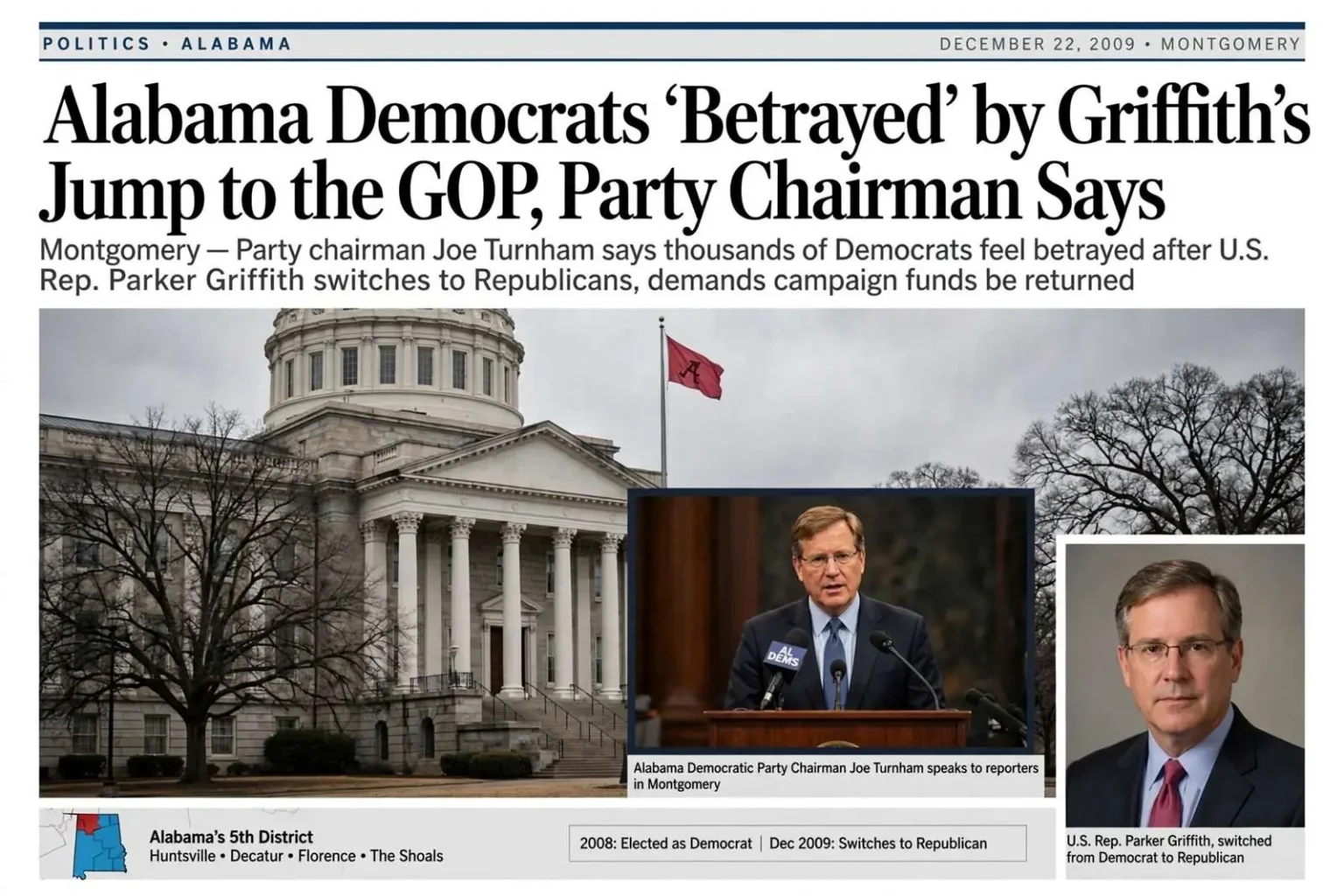
MONTGOMERY — Alabama Democratic Party chairman Joe Turnham said Tuesday that thousands of Democrats felt betrayed by U.S. Rep. Parker Griffith’s decision to leave the party he was elected under and join the Republicans, and he asked Griffith to give the money back.
Griffith, a physician and former state senator from Huntsville, won Alabama’s 5th Congressional District in 2008 as a Democrat, narrowly, succeeding the retiring Bud Cramer. Barely more than a year into his first term, he announced he was switching parties — a move that instantly transformed the politics of a district Democrats had held for generations and put the party on the defensive in one of the few Alabama congressional seats it still controlled.
For a party that had already watched its congressional delegation shrink year after year, the switch was less a surprise than a confirmation of the trend line — but the anger it produced was real, and the chairman made it public within hours.
The chairman’s statement
“Parker has been a friend for a number of years, but his announcement today, and the way in which he did it, deeply disappoints me,” Turnham said in a prepared statement. “Democrats of every stripe and philosophy sweated and bled for this man. He narrowly became a congressman through the hard work, votes and financial contributions of thousands of Democrats. Today, they feel betrayed.”
Turnham argued that Griffith had thrown away the very thing that made him useful to his district. “Congressman Griffith, like his successful predecessor, Bud Cramer, was well-positioned as a Blue Dog Democrat in the majority party in Washington to broker for his district and become the swing voice and vote for good public policy,” he said. “Yet he has left his old friends for his new friends, and will ultimately find that he has no political friends left at all at the end of the day.”
The party also called on Griffith to return the thousands of dollars in Democratic contributions he had raised — a demand with as much practical weight as legal force, since campaign committees rarely refund money after a party switch, but one aimed squarely at the political argument: the seat belonged to the voters and the volunteers, not to the man who held it.
Turnham’s statement blended personal disappointment with cold political arithmetic. He had led the state party through years of shrinking federal and statewide fortunes, and he knew better than most what it took to hold a congressional seat in a state that was trending Republican at every level above the courthouse. Losing the 5th to a party switch, rather than at the ballot box, stripped away even the consolation of a competitive race.
The district and the man
Alabama’s 5th District stretches across the Tennessee Valley in the state’s northwest corner — Huntsville, Decatur, Florence, the Shoals and the counties between them — a region whose economy runs on Redstone Arsenal, NASA’s Marshall Space Flight Center, defense contracting and the hospitals, universities and manufacturers that have grown up around them. It is a district with a long tradition of splitting its tickets: Democratic in local and congressional races for decades, even as its voters backed Republicans for president with growing regularity.
Bud Cramer, the moderate Democrat who held the seat for nine terms before retiring, had built a career on that blend — pro-defense, pro-space, culturally conservative and carefully independent of national Democratic positions that played badly at home. His retirement created the opening Griffith won in 2008, and the race was close precisely because the district’s Democratic margin had grown thin.
Griffith fit the district’s profile in style as well as background. A radiation oncologist who had served in the state Senate, he campaigned as a conservative Democrat — skeptical of the national party on social issues, attentive to the Tennessee Valley’s defense and space priorities, and comfortable with the Blue Dog label that Turnham cited. Doctors, in that tradition, had often translated well into north Alabama politics: the profession carried local standing, financial independence and a résumé built on service rather than ideology.
Why the switch mattered in Washington
A party switch in the House is never merely symbolic. With major legislation moving through a closely divided Congress, every seat changes the count, and a member crossing the aisle shifts committee ratios, floor margins and the practical majority needed to bring bills to a vote. Griffith’s move handed Republicans a pickup without an election having been held, in a cycle when both parties were already gaming out the midterm map.
For the district, the calculation cut the other way. A freshman who had spent his first year voting as a conservative Democrat now faced the task of explaining, to a Republican conference he had just joined and to Democratic constituents who had just financed his campaign, exactly what he stood for. Members who switch parties typically lose their committee assignments and begin again at the bottom of the seniority ladder — a significant cost in a district whose economy depends on federal spending decisions steered, in part, by members with clout.
That was the heart of Turnham’s “broker” argument. Cramer’s value to the Tennessee Valley came not only from his votes but from his position — a trusted moderate in the majority party whom both sides courted. A freshman Republican in the minority, or a Democrat-turned-Republican whose loyalty both parties doubted, would be years rebuilding the standing that made the seat useful.
The money and the memory
The demand that Griffith return Democratic contributions rested on an old political tradition. Campaign donors give to a candidate in part for the candidate and in part for the party label, and when a member changes labels, donors who funded the original version often ask for their money back. Refunds are rare in practice — Federal Election Commission rules allow committees to spend money as they see fit once it is given — but the demand serves its purpose by framing the switch as a taking: thousands of Alabamians bought one candidate and received another.
The deeper wound, for party regulars, was the memory of the work. Congressional campaigns in the 5th are won on the ground — door knocking in Huntsville neighborhoods, fish fries in Lawrence County, county committee meetings from Lauderdale to Jackson. The volunteers Turnham invoked had delivered a narrow win in a hard year, and the party’s position was that their investment had been converted, without their consent, into a Republican’s incumbent advantage.
That advantage was real. Incumbency is the strongest force in congressional elections, and the 5th’s voters had shown over the years that they were willing to re-elect a Democrat they knew while voting Republican above him. Griffith, as a Republican incumbent, would present the district’s conservative majority with exactly the kind of candidate it had been electing for president — with two years of congressional service already banked.
The threat, and the promise
Turnham said he had already fielded numerous calls from leaders across the Tennessee Valley pledging to back a strong Democrat in the 5th District in 2010. “Alabama Democrats have a deep political bench in the 5th District and we will nominate a formidable challenger to fill this seat next year,” he said. “If Congressman Griffith survives a Republican primary battle next year, he should be prepared to bring his lunch, because we are going to give him the fight of his political life.”
The chairman’s confidence rested on the district’s local Democratic infrastructure — mayors, county officials, legislators and community leaders who had held office as Democrats for years and who faced their own decisions now that the congressional seat had changed hands. A contested Democratic primary, followed by a general election against a party-switcher, gave the party a story to tell: the seat had been taken, not lost, and the voters deserved the chance to say so.
For his part, Griffith framed the switch — in the announcement that set off Turnham’s response — as a matter of conscience and consistency: that his conservative values aligned more naturally with the Republican Party, and that he could better represent north Alabama on the other side of the aisle. The claim assumed what the district’s recent history encouraged him to assume: that voters there chose people, not parties, and that the man mattered more than the label.
The wider political weather
Griffith’s switch did not happen in a vacuum. Across the South, the congressional map had been turning Republican for a generation, and Alabama — once represented by a Democratic delegation that included some of the most powerful committee chairmen in Washington — had watched its Democratic congressional ranks shrink to a handful. Every retirement, defeat and defection moved the state further from the coalition that had governed it for a century, and each move made the next one easier.
Nationally, the year ahead promised a difficult midterm for the party in power, with an economy climbing out of recession and an energized opposition. Political professionals in both parties read party switches as barometers: a member who has seen his district’s polling, and who concludes that his old party’s label is a liability, is telling the region something. Democrats argued Griffith had misread it; Republicans argued he had seen it first.
In Alabama, the switch also reshaped the state party’s defensive posture. With the 5th contested, Democrats’ remaining federal and statewide map had thinned to a few districts and offices, and the party organization’s resources — always modest compared with the national parties — had to stretch further. Turnham’s pledge to field a strong candidate was, in part, a signal to national Democrats that the 5th was worth investing in rather than conceding.
What it meant for the Tennessee Valley
For the people of the 5th District, the practical stakes were less partisan than programmatic. The region’s economy is uniquely dependent on federal decisions: defense authorization and appropriations, NASA budgets, base realignment processes and the contracts that flow through Redstone and Marshall to local employers. A congressman’s committee seats, seniority and relationships determine how much of that flow the district can influence — which is why the “broker” argument resonated in Huntsville and Decatur regardless of party.
Voters in the Shoals and the rural counties of the district watched the switch through a different lens: representation for communities whose economies run on hospitals, schools, manufacturing and agriculture. For them, the question was whether a party-switching freshman would still show up for the district’s town halls, constituent services and federal grant applications — the unglamorous work that makes a congressional office valuable between elections.
The year ahead would supply the answer. A Republican primary awaited Griffith, in which he would have to win over primary voters who had spent years running against the party he had just joined. A Democratic challenger awaited behind that, backed by a chairman who had promised the fight of a political lifetime and a bench of Tennessee Valley leaders already calling in.
However it resolved, the episode marked the end of an era in north Alabama politics: the last blue-dog congressional seat in Alabama, won in one party and defended in another, had become a measure of just how far the state’s political map had moved — and of how little of it the men who drew the old map would recognize.


