South Alabama Democrats Float an Independent Run for Jim Folsom Jr., and Fellow Party Members Wince
Some south Alabama supporters urged Lt. Gov. Jim Folsom Jr. to skip the 2010 Democratic primary and run for governor as an independent. Party veterans warned the math simply did not work.
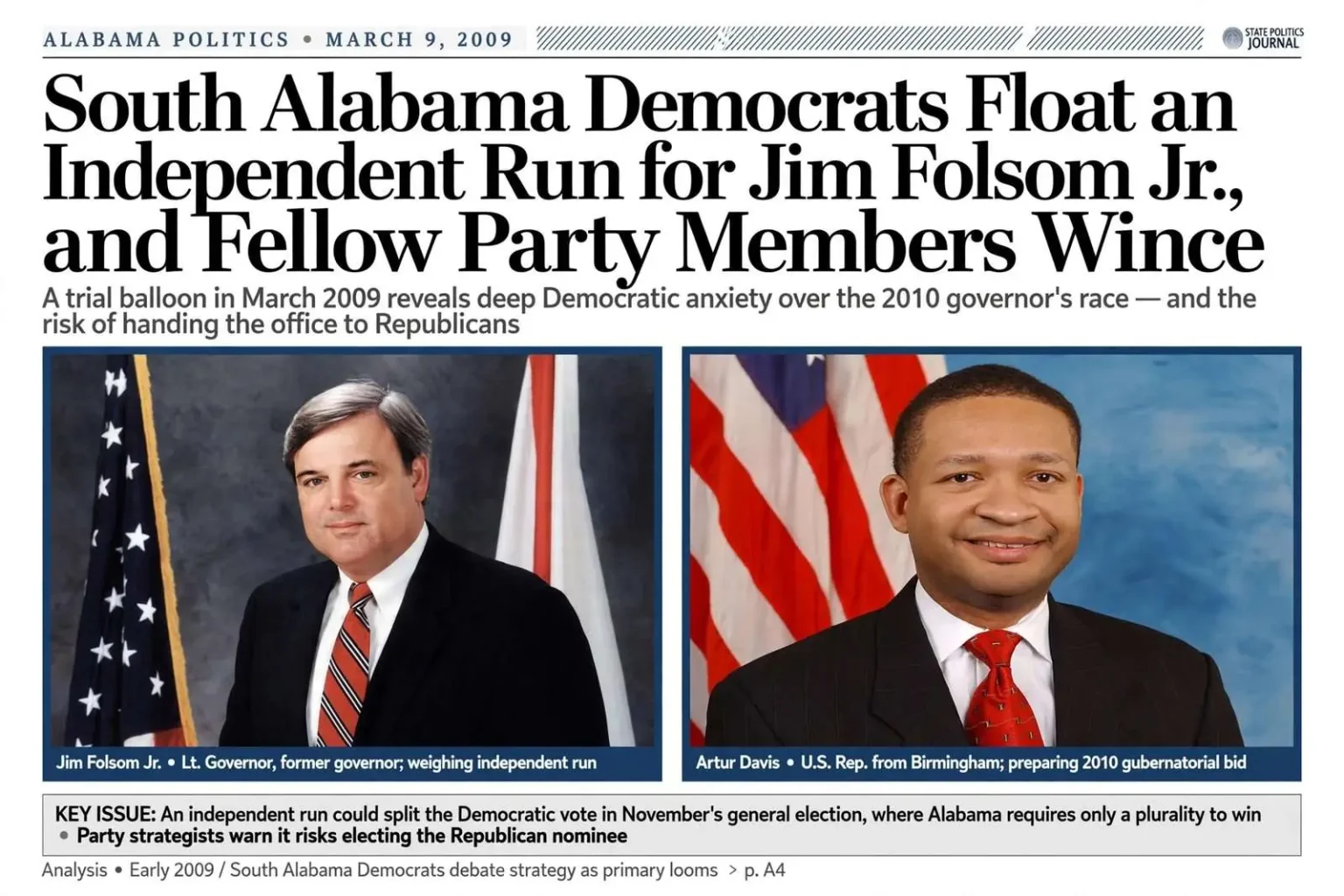
A quiet suggestion was making the rounds among south Alabama Democrats in early March 2009, and it was the kind of suggestion that reveals more about a party’s anxieties than about its plans. Some supporters of Lt. Gov. Jim Folsom Jr., a perennially mentioned prospect for the 2010 governor’s race, were encouraging him to bypass the Democratic primary altogether and run instead as an independent. The reasoning was straightforward, if unflattering: in a primary against U.S. Rep. Artur Davis, the congressman’s base might simply prove too much to overcome.
Whether the overture interested Folsom and his advisers enough for them to seriously entertain it remained uncertain. What was certain was the picture it painted of the party’s mood more than a year before the first primary vote: a Democratic establishment so uncertain of its own coalition that skipping its own primary was being floated as a serious option for its most experienced statewide officeholder.
The timing mattered. Folsom had been lieutenant governor since 2007, presiding over the state Senate after earlier serving two terms in the same office in the 1990s. Davis, the congressman from Birmingham, had spent the previous year building a campaign organization that reached into every county, and he would formally announce his candidacy later that spring. The March trial balloon was, in effect, the first public acknowledgment that the primary was not going to be a courtesy coronation for either man.
The Arithmetic Problem
The idea met immediate skepticism from other quarters of the party, and the objections were less about loyalty than about counting. An independent candidate of Folsom’s stature would all but guarantee that Alabama’s next governor would be chosen by a plurality rather than a majority. The state provides no runoff following a general election, so a three-way race would simply hand the office to whoever finished first, however modest the margin.
That is not a technicality in Alabama. The state’s constitution requires a majority for most offices in a primary, hence the runoff system, but a November general election winner needs only a plurality — a rule that has mattered in other states and would matter enormously in a fragmented 2010 field. Democratic regulars understood instinctively that a well-known independent pulling a few hundred thousand votes would not need to win, only to divide, for the Republican nominee to claim the governor’s office with far less than half the vote.
“I would think that scenario favors (the Republican nominee) pretty clearly,” said one Democratic politico, “unless I’m looking at it too simplistically or am not giving Folsom enough credit?”
Caught Between a Rock and a Hard Place
Another observer of state politics described Folsom’s position as a genuine trap, and one largely of the Democratic Party’s own construction. Inside the primary, Davis’s strength among African-American voters could well be more than Folsom could surmount. Outside the primary, running as an independent in what this observer called a three-legged stool of a governor’s race, Folsom would likely finish third.
The structural difficulty, as he described it, was that the party’s reliance on the Black vote can cripple a white candidate facing a credible Black opponent in the primary — particularly if a competitive Republican primary on the same day pulls less party-aligned voters across to the other side of the ballot.
“Jim can’t win without black votes,” he said. “He wouldn’t even be the second leading vote-getter.”
And the independent path, he argued, would not even accomplish the spoiler’s traditional purpose. “It seems to me he wouldn’t gobble up enough of the white vote to elect Artur,” he added. “What white vote he got would come more from Artur than the Republican nominee.”
The analysis reflected a hard truth about Alabama’s electorate in 2009. The state’s politics had realigned so thoroughly over the previous two decades that Democratic primaries were the only statewide contests in which the party’s coalition — Black voters in the Black Belt and the cities, white moderates in north Alabama and the Wiregrass — actually voted together. A general-election independent run would scatter that coalition across three ballots instead of gathering it behind one candidate, and no one quoted in the party’s private conversations could identify a realistic scenario in which that helped a Democrat become governor.
Why It Mattered
The conversation was, on its surface, about one man’s ballot line. Underneath, it was about whether Alabama Democrats could hold a coalition together through an open governor’s race.
Folsom carried one of the most recognizable names in Alabama politics. He had served as lieutenant governor and, after the removal of Gov. Guy Hunt in 1993, had finished out that term as governor before narrowly losing the office in 1994. He was, in the shorthand of state politics, the last Democrat many white rural voters had been comfortable supporting for the top job.
That inheritance was both asset and burden. The Folsom name came from his father, “Big Jim” Folsom, the hill-country populist whose two terms as governor in the 1940s and 1950s made the family synonymous with a biracial, rural-friendly brand of Alabama politics. Jim Folsom Jr.’s own career had followed the same logic — winning statewide by holding enough crossover and rural white votes to complement the Democratic base — and 2010 would test whether that arithmetic still worked in a state that had shifted steadily Republican in every federal contest since the 1990s.
Davis, meanwhile, represented Alabama’s 7th Congressional District and was assembling what looked like a formidable primary operation, built on a base that party strategists in both camps regarded as difficult to dislodge.
Davis’s bid carried its own historic weight: a victory in the primary would make him the first Black nominee for governor in Alabama history, and his campaign was explicitly built on expanding the party’s reach beyond its traditional base with a young, professional, tech-forward operation headquartered in Birmingham. To his supporters, that ambition was exactly what the party needed. To skeptics, it was a formula for a general-election struggle in a state where Democrats already faced steep odds against the Republican nominee, whoever emerged from that side’s own primary fight between sitting Gov. Bob Riley’s favored successor and other contenders.
An Admission, Not a Plan
The independent trial balloon was, in that light, an admission. It conceded that some in the party did not believe their strongest general-election candidate could survive their own primary, and it invited a remedy that most of the people asked about it believed would simply elect a Republican.
No one involved appeared eager to say so on the record. The politicos, officeholders and donors floating the idea all had reasons to stay anonymous: criticizing either Folsom or Davis risked making enemies in a party whose candidates would need a unified operation by November, and admitting openly that the primary looked unwinnable for a two-term lieutenant governor would have been its own kind of damage. But the fact that the idea was circulating at all, more than a year before the primary, told its own story about the state of the Alabama Democratic Party heading into 2010.
The episode also reflected a broader reality of modern Alabama politics: with Republicans dominant at the federal level and increasingly competitive statewide, the Democratic primary had become the party’s real election, and the tensions it exposed — regional, racial and generational — were the same ones the party would carry out of the 2010 cycle and into the realignment that followed. For south Alabama Democrats watching in the spring of 2009, the question was not yet whether the party would win the governor’s office, but whether it could get through its own primary without the argument spilling into public view.
Folsom, for his part, gave no public signal that he was tempted by the independent route. He continued to serve as lieutenant governor and preside over the Senate while the trial balloon drifted among supporters, and Davis continued building the campaign organization that would carry both men to the June 2010 primary. In the end the suggestion remained what it had been in March: a measure of anxiety, not a campaign plan, from a party that knew exactly how difficult its year ahead would be.
The trial balloon also said something about the independent label itself in Alabama. The state has no recent tradition of successful independent candidacies for governor, no fusion voting and no minor-party infrastructure to speak of; ballot access for a candidate without a party nomination requires a petition drive of its own. An independent run would have meant Folsom starting from scratch — building a campaign apparatus, a fundraising base and a ballot line in the space of a year — with the near-certain judgment of history being a third-place finish that helped hand the governor’s office to the opposition for another term.