The Davis-Reed Rift: A Feud That Tested the Machinery of Alabama’s Democratic Party
The public break between gubernatorial front-runner Artur Davis and Democratic power broker Joe Reed raised a question veteran Alabama strategists were happy to answer: is the old machine still the machine?
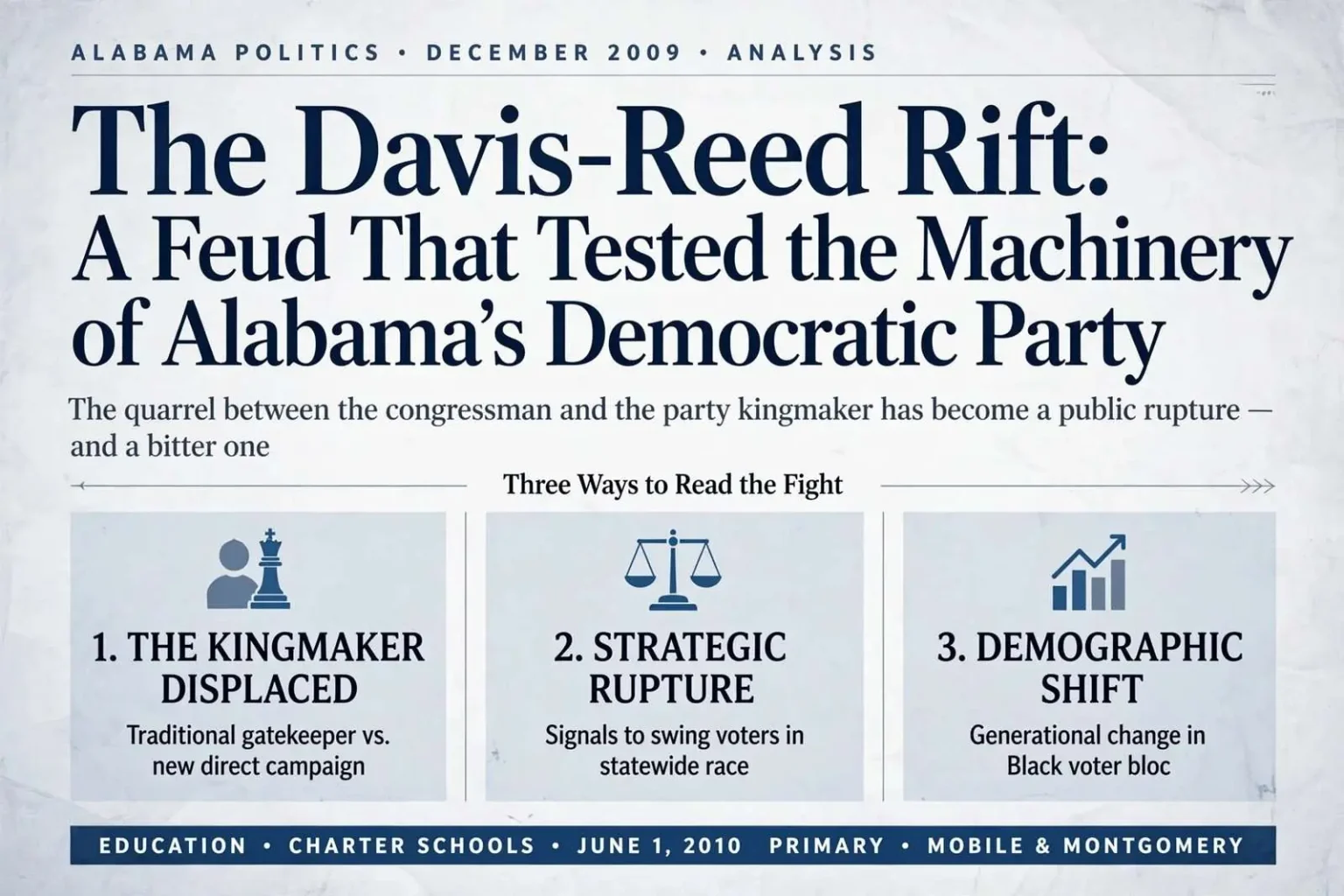
The quarrel between U.S. Rep. Artur Davis, the front-runner for the Democratic nomination for governor, and Joe Reed, the man who has done more than anyone alive to organize Alabama’s Black vote, had by December 2009 stopped being a private disagreement and become a public rupture — and a bitter one.
The question circulating among political professionals in Mobile and Montgomery was not who started it. It was what it meant.
Three Ways to Read the Fight
One reading was the simplest: a kingmaker was being displaced by a candidate who did not think he needed a king. Reed, longtime chairman of the Alabama Democratic Conference and a force within the Alabama Education Association, had for decades been the gatekeeper Democratic candidates went to see before they went to the voters. Endorsement, sample ballots and organized turnout flowed from that audience with Reed, and candidates who skipped the visit paid for it later.
Davis, a Harvard-trained congressman from Birmingham running a campaign consciously modeled on Barack Obama’s, was declining to make the pilgrimage. The model mattered: Obama’s 2008 campaign had demonstrated that a candidate could build a direct, data-driven connection to Black voters — through small donors, social networks and large events — without routing through the traditional brokers. Davis was betting the same method worked in Alabama.
A second reading held that Davis was not resisting Reed so much as using him — that a candidate seeking white votes in a state where Democrats need roughly 38 percent of them to win statewide might find a public quarrel with the party’s most visible Black power broker more useful than his blessing. In that telling, the rupture was a signal to swing voters: this Democrat is not the creature of the old organization.
A third reading was demographic. It suggested the fight was a symptom of the slow loosening of a bloc vote that had held for two generations, as a growing Black middle class developed political priorities more varied than any single organization could deliver.
What the Strategists Said
A veteran Alabama political strategist, speaking on condition of anonymity because of ongoing work with candidates in the race, argued that all three readings had some truth in them, and that the practical consequences would show up first in primaries rather than general elections.
“The rift is personal, but it is indicative of the change within the African-American community,” the strategist said. “While it won’t affect general elections for decades, if not generations, it will have an impact on primaries. No longer will the ballots be as determinative.”
The reference was to the sample ballots distributed by the Alabama Democratic Conference and similar organizations — printed cards listing endorsed candidates that had for years been handed out at polling places across the state and that could, in a low-turnout primary, decide a race outright. A card carried to the booth by a trusted civic figure had historically been worth more than weeks of television in a primary decided by a few thousand votes.
“This is a generational phenomenon,” the strategist continued. “I don’t see younger voters wanting to be seen using a ballot. On minor races, the ballots may continue to hold sway in a primary context, but they will not in upper-ballot races. The more affluent and younger the African-American voter, the less inclined to defer to a ballot.”
The same strategist was blunt about Reed’s continuing hold on the party’s machinery, and about the cost of it.
Reed, he said, “is definitely a relic. But he still controls the Democratic Party apparatus. And I suspect he will until the Lord gathers him to his bosom.”
Only a sitting Democratic governor with nothing to lose, he argued, could realistically challenge Reed’s position — and until someone did, Democrats would keep struggling to reach the share of the white vote they need to win statewide. The arithmetic was unforgiving: with a reliable base among Black voters, the party’s path to statewide office ran through tens of thousands of white swing voters, and anything that made reaching them harder carried a real price at the polls.
He pointed to Lt. Gov. Jim Folsom Jr. as the exception that proved the rule — a Democrat whose appeal crossed racial and regional lines and who managed to remain competitive statewide in a party whose other candidates rarely could.
The Charter School Inversion
Among the flashpoints was education. Davis’s support for charter schools put him at odds with the AEA, the state’s teachers’ organization and one of the most powerful institutions in Alabama politics, in which Reed held a senior role.
Charter legislation had failed repeatedly in Montgomery, largely under pressure from the AEA, and a Democratic frontrunner endorsing it was a direct challenge to the organization’s legislative position. The split went beyond a policy disagreement: it touched the money, the endorsements and the get-out-the-vote work the AEA could direct in a primary.
It also produced an oddity: some observers suggested the Democratic front-runner might end up to the right of some Republicans on the question. Davis’s charter support was more emphatic than that of several GOP contenders, inverting the usual alignment of a school debate in which the teachers’ organization anchored the Democratic side.
The campaign of GOP candidate Tim James disputed that characterization, saying James supported charter schools and a change in state law to permit them, and citing the record of Mobile’s George Hall Elementary School as evidence the model could work. The reference made the dispute concrete for South Alabama readers: George Hall had drawn attention for turning around results at a high-poverty Mobile school, and both camps were claiming its lesson.
A Fiftieth Anniversary, and an Irony
The Alabama Democratic Conference was preparing to mark its 50th anniversary in 2010. It had been founded to support the 1960 Democratic presidential ticket headed by John F. Kennedy — a ticket and a president Davis invoked regularly on the stump, with no apparent sense of contradiction.
The anniversary gave the rupture an additional edge. The organization that had spent half a century turning out Alabama’s Black Democratic vote was heading into its jubilee year fighting its own party’s most prominent candidate, in a primary where the candidate’s campaign style was itself an argument that the old structure no longer controlled the outcome.
What It Meant for South Alabama
For South Alabama Democrats, the fight was not academic. Mobile County’s Democratic organization drew on the same networks and the same sample-ballot tradition, and its leaders would have to choose, in the June 1 primary, between the party’s most nationally visible candidate in a generation and the institutional structure that had delivered their voters for fifty years.
The county presented its own version of the statewide problem. Mobile’s Democratic electorate included organized civic networks long tied to the ADC’s endorsement cards, alongside younger and more suburban voters whose political habits looked more like the ones Davis’s campaign was designed to reach. Local candidates for county and legislative offices had to calibrate which current they would follow — go with Reed’s cards and risk the emerging electorate, or side with Davis and risk the machinery that still decided close primaries.
Down the coast, the same calculus applied in Baldwin, Escambia and Monroe counties, where Democratic organizations were smaller but still ran on the ADC network for the handful of local races that appeared on the ballot. A quarrel at the top of the ticket changed how those county committees met, whom they invited to speak, and which names went onto the cards they printed — decisions that in a low-turnout off-year could shift a probate judge race or a school board seat as easily as a governor’s race.
The June 1, 2010 primary would supply the test. If Davis won decisively with or without the conference’s cards, the strategist’s generational argument would be vindicated in the most visible way possible; if the cards held and the front-runner stumbled, the old structure would claim the credit. Either result would echo into the general election, where the party’s need for roughly 38 percent of the white vote — and the difficulty of getting it while fighting among itself — remained the problem no primary could solve.
The Longer Reckoning
What no one disputed was that the fight marked a turning point in how Alabama’s Democratic Party related to its own base. The sample ballot, for decades the party’s most reliable instrument, was being displaced by the same direct-to-voter methods that had reshaped national campaigns. Whether that shift would produce new victories or simply new arguments was the question the 2010 cycle would begin to answer — in Mobile as in Birmingham, precinct by precinct, card by card.