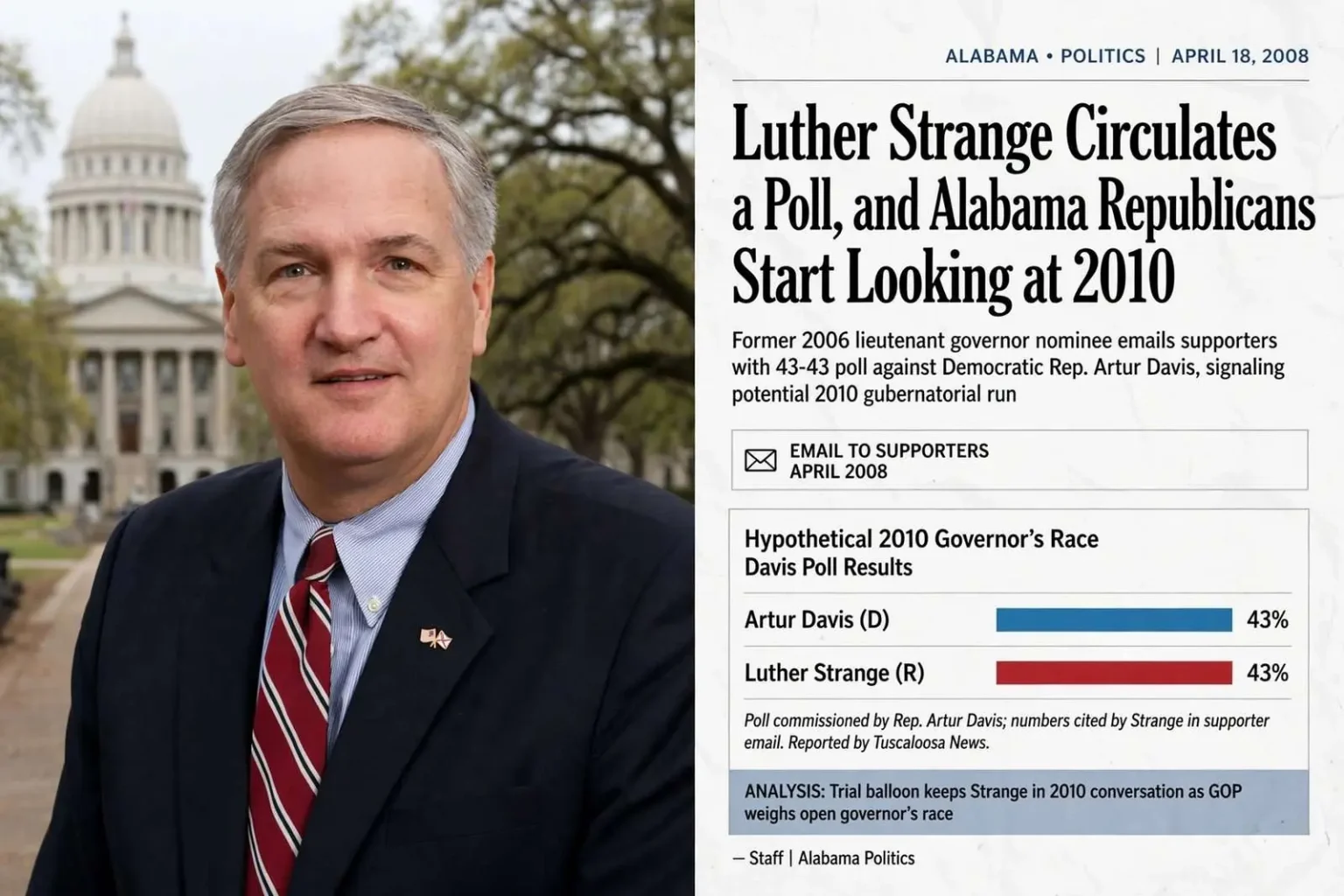
Luther Strange Circulates a Poll, and Alabama Republicans Start Looking at 2010
Two years after losing the lieutenant governor's race, attorney Luther Strange sent supporters a poll showing him tied with Congressman Artur Davis in a hypothetical 2010 matchup for governor.
Luther Strange lost his race for lieutenant governor in 2006, and in the ordinary course of Alabama politics that would have been the end of the story. It was not. In the spring of 2008, the Birmingham attorney was still regarded as a rising figure in the state Republican firmament — and he had begun reminding people of it.
Strange’s 2006 campaign had been one of the more closely watched statewide races of that cycle, a contest against a well-known Democratic incumbent in a year when Republicans otherwise performed strongly across Alabama. The loss stung, but it left him with a statewide network of donors and supporters, a fact that party operatives on both sides understood would keep his name in future conversations.
Had Strange defeated Jim Folsom two years earlier, he would have been the obvious front-runner to succeed term-limited Republican Gov. Bob Riley. Instead he lost, and a Plan B became necessary. The assumption among many in the party was that Strange had his eye on a run for attorney general in 2010, notwithstanding the likely re-election bid of Republican incumbent Troy King, who had irritated party regulars from time to time on various issues during his stint as AG.
King’s standing within his own party had grown complicated over his tenure, with disagreements over various legal positions and policies putting him at odds with segments of the Republican establishment. That friction was one reason party insiders viewed the attorney general’s office as a potentially contested seat in 2010 rather than an incumbent’s to lose, and why Strange’s name attached so naturally to it.
The Email
An email Strange sent to supporters suggested his ambitions ran higher than the attorney general’s office. “Friends,” it began. “I thought you might be interested in the results of a recent poll of hypothetical match-ups between Democratic Congressman Artur Davis of Birmingham and potential Republican candidates in the 2010 governor’s race. The poll was commissioned by Congressman Davis and the results were reported by the Tuscaloosa News.”
The numbers, as Strange described them, were flattering. “The poll showed that I was tied with Congressman Davis at 43% and leading or in the margin of error when compared with the other Republican candidates frequently mentioned, all of whom are currently holding public office,” he wrote. Then came the framing that mattered: “As a political outsider, I am particularly gratified to be considered one of the leading contenders for the governor’s mansion in 2010. That tells me that our positive message of leadership with integrity still resonates with the people of Alabama.”
Strange closed by noting that his economic development work and speaking schedule continued to take him across the state, and invited recipients to visit his website or contact him directly. The note carried none of the formal trappings of a campaign launch — no committee, no filing, no announcement date — but supporters who had followed his career read it for exactly what it signaled.
Reading Between the Lines
Circulating a poll commissioned by one’s prospective opponent is a recognized maneuver in politics. The numbers arrive with a certain credibility precisely because the other side paid for them, and the candidate who forwards them gets to present himself as a contender without formally announcing anything.
The technique also carries a secondary benefit: it forces a comparison that voters might not otherwise have considered. By relaying a Davis-commissioned survey, Strange placed his name alongside — and, by his reading, ahead of — Republicans who actually held statewide and congressional office at the time, without spending a dollar of his own on polling.
The email said, in effect, three things at once: that Strange was still in the game, that he intended to be considered for the top of the ticket rather than a consolation prize, and that the poll of a Democratic congressman’s own making had confirmed it. Political observers in the state read the missive as a classic trial balloon, floated to gauge donor and activist reaction before any decision was final.
What Was Actually Coming
The 2010 landscape Strange was surveying in April 2008 looked different from the one that eventually materialized. Artur Davis, the Harvard-educated congressman from Birmingham, was widely expected to seek the Democratic nomination for governor and to make history in doing so. Bob Riley was term-limited. The Republican field was unformed, and no obvious heir apparent had emerged.
That vacuum was precisely what made the moment valuable for a politician in Strange’s position. With two and a half years until the election, a candidate who established himself early as a serious statewide contender could collect endorsements, donor commitments and speaking invitations long before rivals holding office felt pressure to commit. In Alabama politics, where statewide races are often decided in primaries, that head start carries real weight.
For readers along the Gulf Coast, the exercise mattered because Mobile and Baldwin counties had become an increasingly important source of Republican primary votes, and any candidate serious about a statewide run in 2010 would have to spend time in south Alabama — which is precisely what Strange said his speaking schedule was already doing.
The political world that eventually produced the 2010 governor’s race looked little like the scenarios being traded among party activists in the spring of 2008. Davis would go on to run, lose a primary, and leave elected office; Strange’s own path would take a different turn than either the governor’s office or the attorney general’s. But in April 2008, none of that was knowable, and the email accomplished what trial balloons are meant to accomplish — it kept his name in every conversation about 2010.
Whether the destination turned out to be the governor’s office or the attorney general’s, the message his supporters were meant to take from the email was that they had not heard the last of him.
The email also landed in the middle of a broader conversation among Alabama Republicans about the party’s 2010 bench. With Riley barred by term limits from seeking a third term, the party faced its first open governor’s race since 2002, and the list of potential contenders circulated in political circles included congressmen, statewide officeholders and business figures — none of whom had committed. Into that vacuum, Strange’s email inserted himself as a proven statewide candidate with a recent near-miss on his record.
Strange’s position was unusual in another respect. As a private attorney who had never held elected office, he could frame himself as an outsider — a label he leaned on in the email’s closing lines — while still carrying the credibility of a campaign that had run statewide just two years earlier. That combination, “outsider” branding with insider campaign machinery, would become a recurring theme in his political career.
For Artur Davis, meanwhile, the poll’s circulation cut two ways. It confirmed that the Birmingham congressman was viewed as a formidable Democratic candidate — the measuring stick against which Republicans were testing themselves — but it also spread a favorable Republican talking point, assembled at Davis’s own expense, across his opponents’ supporter lists. Political operatives on both sides noted the irony of a candidate’s own polling serving his rivals’ fundraising letters.
The Tuscaloosa News report Strange cited was itself part of a season of political math. Newspapers across the state spent 2008 speculating about the governor’s race years in advance, publishing trial-heat polls and candidate profiles long before qualifying. In an era before social media dominated campaign communication, an email to a supporter list was a fast, cheap way for a politician to shape that coverage — and Strange’s note, forwarded among Republicans, did precisely that.
By summer, the name frequently mentioned alongside Strange’s in Republican conversations included members of Alabama’s congressional delegation and Riley administration figures, and party activists were already handicapping the field. Whether Strange would wait for 2010 or seek a different office sooner remained unresolved — but the April email ensured that any list of 2010 contenders that omitted him would be considered incomplete.
Attentive readers of the email also caught what it did not say. There was no mention of the attorney general’s race, despite the months of speculation linking Strange to it, and no acknowledgment of Troy King, the incumbent whose re-election plans complicated that path. The omission was deliberate, observers said: a candidate positioning himself for governor does not describe his plans in terms of fallback offices, even in a note as informal as this one.
The poll’s 43-43 tie with Davis, as Strange characterized it, carried particular weight because Davis was the only Democrat then viewed as capable of winning statewide in 2010. A Republican who runs even with the opposition’s strongest figure can claim front-runner status within his own primary, which is exactly the argument Strange’s note was built to make. That the other named Republicans held office — and thus had higher name recognition — made the comparison more useful still, since the poll suggested Strange’s recognition was not trailing theirs.
Alabama’s 2010 cycle would ultimately redraw the state’s political map in ways no April 2008 email anticipated, with Republicans sweeping every statewide office and both chambers of the Legislature for the first time since Reconstruction. Within that landscape, the attorney general’s office — the very consolation prize discussed in Strange’s case — would end up in Republican hands after all, illustrating how quickly the ground shifted between the email’s speculation and the election itself.