Mobile County Voters Handed Jim Folsom the Lieutenant Governor’s Office
Luther Strange ran roughly 9,000 votes behind other Republicans on the Mobile County ballot in 2006. Flip those votes and he wins statewide. Instead, Jim Folsom returned to the lieutenant governor's office.
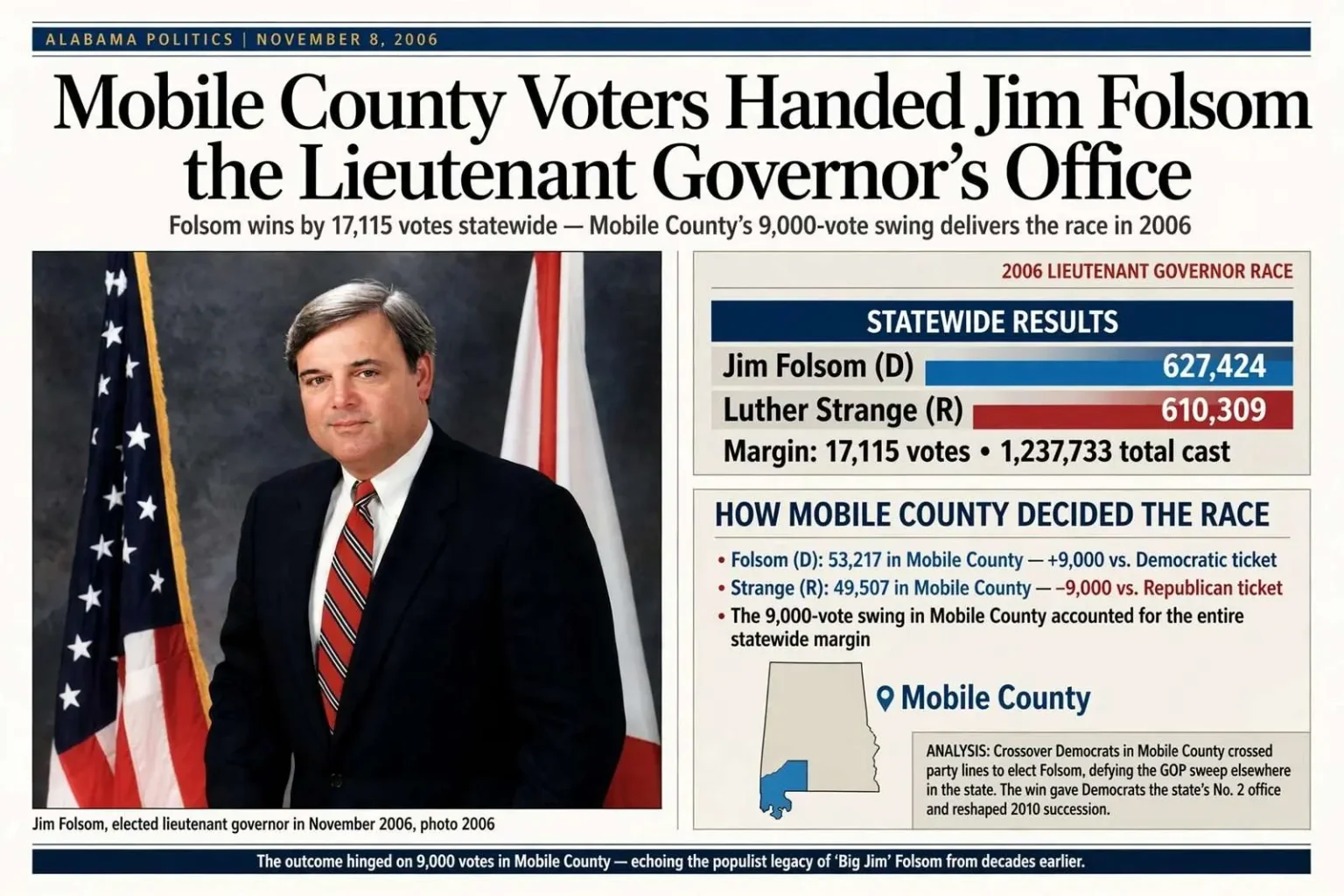
Jim Folsom’s return to statewide office in Alabama in November 2006 was, by the numbers, a gift from the voters of Mobile County, an outcome that reshaped the state’s political succession and derailed the ascent of a rising Republican star.
Folsom defeated Republican Luther Strange in the lieutenant governor’s race by a statewide count of 627,424 to 610,309, a margin of just 17,115 votes out of more than 1.2 million cast. The place to look for those votes was Mobile County.
The gap on the ballot
Strange badly underperformed his fellow Republicans on the same Mobile County ballot. The comparison is stark:
Gov. Bob Riley drew 58,690 votes in Mobile County. U.S. Rep. Jo Bonner drew 58,481 votes in Alabama’s First Congressional District, which includes Mobile County. Luther Strange drew 49,507.
Strange claimed roughly 9,000 fewer votes than the Republicans running above and alongside him. Conversely, Folsom drew about 9,000 more votes in the county than either Democratic gubernatorial nominee Lucy Baxley or Democratic congressional hopeful Vivian Beckerle.
The arithmetic is unforgiving. Lift Strange to the level of Riley and Bonner, drop Folsom to the level of Baxley and Beckerle, and Alabama has a different lieutenant governor, and quite possibly a different frontrunner to succeed Riley as governor in 2010.
Elections are decided at the margins, and this one lived entirely there. Neither candidate came close to a majority statewide; the contest turned on whether one candidate could run ahead of his ticket in the places where crossover voting was possible. Mobile County, with its long history of splitting tickets between conservative Democrats in local races and Republicans in national ones, was the place it happened.
An echo of an older Alabama
The 9,000 votes that made the difference had roots reaching back half a century. They echoed the era of Big Jim Folsom, the elder Folsom’s populist governorship, when conservative white Alabamians were far less likely to vote Republican and a Democratic label carried no automatic penalty.
Folsom, along with Sue Bell Cobb and Susan Parker, succeeded in tapping a conservative strain in the Alabama electorate that had eluded Democrats for several election cycles. They ran as Democrats without running as national Democrats, and in a state trending steadily red, that distinction was worth a great many votes.
The younger Folsom had spent his career navigating exactly that terrain. Son of the two-term populist governor from Cullman, he built his own career in southwest Alabama, and his first tour as governor came in 1993, when he moved up from lieutenant governor after the courts removed Gov. Guy Hunt following a felony conviction. He lost the 1994 race for a full term to Fob James, spent years out of statewide office, and returned to the ballot in 2006 seeking the same office he had once inherited.
Voters who remembered the Folsom name — and Alabama voters of a certain age remembered it well — heard in the candidate’s campaign a familiar promise of government that worked for ordinary people without ideological theater. In Mobile County, that appeal crossed party lines in numbers it reached nowhere else on the 2006 ballot.
Why Mobile split its ticket
Mobile County’s willingness to cross party lines for certain Democrats was not a novelty of 2006. The county had spent decades voting Republican for president and Congress while electing conservative Democrats to courthouse offices, and its electorate had produced crossover results in statewide races going back to the days when Democrats still carried the state as a whole.
Local observers pointed to several ingredients. The Folsom family’s populist brand retained genuine affection in the port city, where the elder Folsom’s coalition had once been strong. The candidate himself had gone out of his way to campaign in the county rather than treating it as Democratic territory already won or Republican territory beyond reach. And the race itself, for an open statewide office at the top of no ticket, gave voters room to vote for the person rather than the party in a way that a governor’s race rarely does.
Whatever the precise mix, the result was visible in the certified counts: a Republican who matched his ticket everywhere but Mobile, a Democrat who outran his ticket there, and a statewide margin that fit entirely inside the difference.
The star who stumbled
Strange, meanwhile, entered the race as one of the Republican Party’s most touted recruits. A Tulane-trained lawyer and lobbyist with a commanding physical presence, he had flirted with statewide runs before and finally launched one against an incumbent-free office — incumbent Gov. Bob Riley was running for re-election, and Lt. Gov. Lucy Baxley was leaving the post to run for governor, leaving the state’s second-highest office open.
The lieutenant governor’s office mattered in 2006 for reasons beyond its title. The officeholder presides over the Alabama Senate, controls much of that chamber’s flow of business, and casts the deciding vote in the event of a tie — a small constitutionally enumerated role with enormous practical consequence in a narrowly divided body. The post had also become the traditional launching pad for gubernatorial ambitions, which was precisely why political observers tagged Strange as a future contender for governor should he win.
Strange ran a campaign built on the Republican ticket’s strength, expecting to ride Riley’s re-election landslide into office. The strategy nearly worked everywhere in the state — nearly. In the Gulf Coast’s largest county, the Folsom name and the candidate’s measured style peeled off the very ticket-splitters the strategy counted on, and the deficit Strange ran there was not recovered in any other county.
For a candidate with statewide ambitions, the loss was a lesson in Alabama’s regional arithmetic: a Republican could win a statewide majority by running well almost everywhere, but a nine-vote-per-hundred falloff in Mobile County against the right Democrat could still erase the whole enterprise.
What the numbers said about the state
The 2006 election overall was a comfortable Republican year in Alabama. Riley won re-election decisively, Bonner returned to Congress without difficulty, and down the ballot the GOP generally held its ground. Yet two statewide Democrats won: Folsom in the lieutenant governor’s race and Sue Bell Cobb in her race for a statewide judgeship, both running far ahead of their ticket.
The pattern confirmed something Alabama operatives had long suspected. The state’s voters, so reliably Republican at the top of the ticket, were still willing to elect conservative Democrats to offices where the candidate’s personal identity and local reputation outweighed partisan label. Folsom’s margin in Mobile County was the clearest demonstration of the phenomenon anywhere on the 2006 ballot.
The count also settled the question of message discipline. Baxley and Beckerle, running on the same Democratic line, each drew fewer Mobile County votes than Folsom by roughly 9,000, and the differences could not be explained by name recognition alone. The candidates who ran as Alabama Democrats with local roots and local records collected the crossover votes; the pattern held from the governor’s race down the ballot, and both parties read the numbers the same way the morning after.
It also carried a warning for both parties. Democrats who ran as national Democrats would lose; Republicans who took their base for granted in old-line Democratic counties could bleed votes to a familiar name. Folsom’s win sat precisely at the intersection of those two tendencies, and it took both to produce a 17,115-vote statewide margin out of 1.2 million ballots.
The aftermath
Folsom took the oath for his second stint as lieutenant governor in January 2007, presiding over a Senate whose members had just entered one of the most contentious four-year stretches in the chamber’s modern history. The tie-breaking role he held would prove central to the era’s legislative fights, and the office’s perch for gubernatorial ambition remained as prominent as ever.
Strange returned to private life and rebuilt. He came back in 2010 to win the office Folsom still held, a rematch that flipped the 2006 result, and he later won election as state attorney general before a Republican Senate appointment placed him in Washington. His 2006 defeat, meanwhile, entered the archive of Alabama election lore as the race that Mobile County decided.
And the county itself retained its reputation. Split-ticket Mobile — Republican in most races, loyal to certain Democratic names regardless of party — delivered the state’s second-highest office to a Folsom one more time, exactly as its voters had been doing in one form or another since the era of Big Jim. The 2006 result would not have survived without those 9,000 votes, and the numbers made the point with mathematical finality: Alabama’s statewide politics is decided wherever the ticket lines break, and in 2006, they broke in Mobile.