Riley Refuses to Call a Special Session, Accuses Democrats of Breaking Their Word
Gov. Bob Riley announced he would not call the Legislature back for a fall special session, saying Democratic leaders refused to take up ethics reform or an end to annual property appraisals.
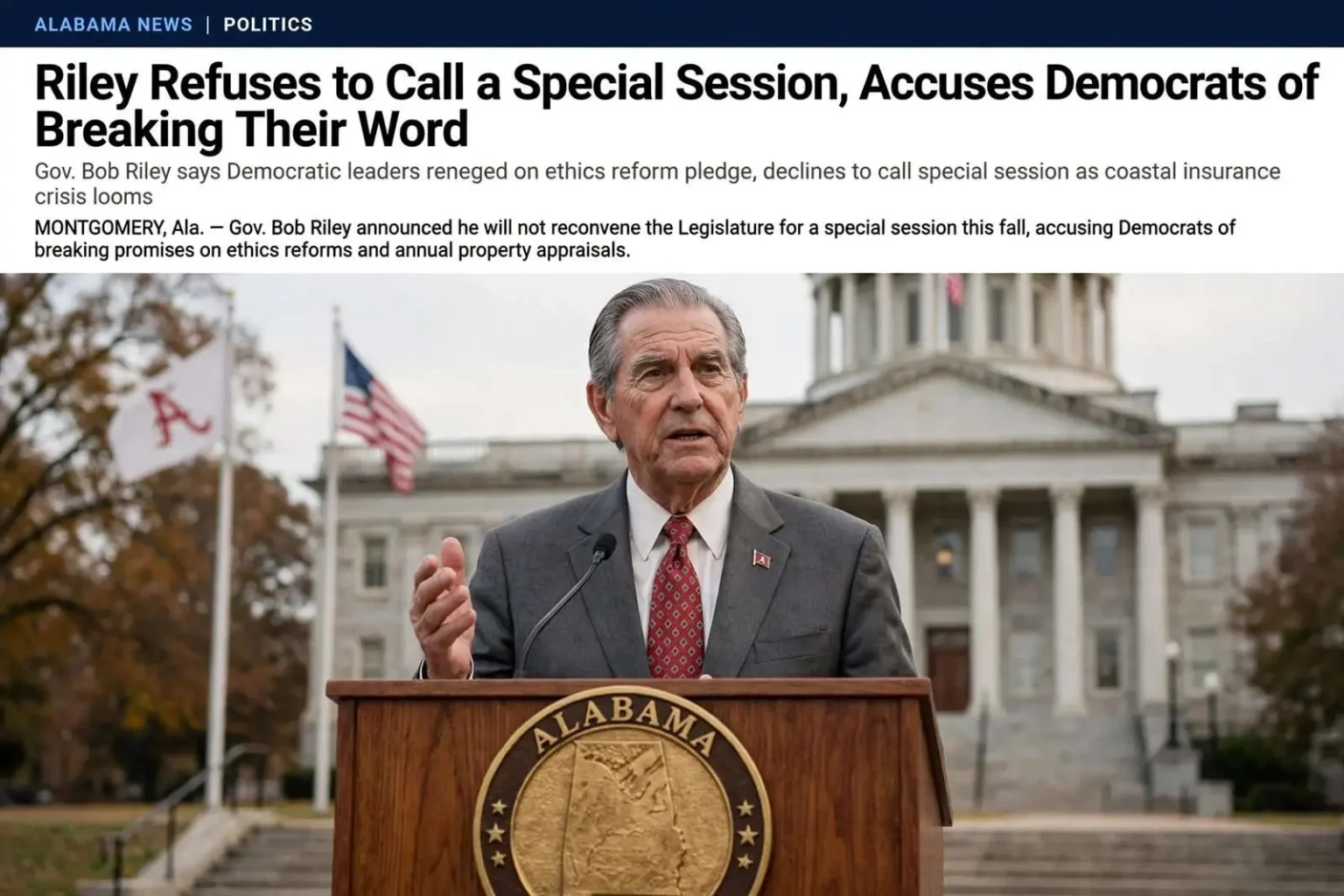
Gov. Bob Riley announced that he would not call the Alabama Legislature back to Montgomery for a special session that fall, and he did it in language that left little doubt about whom he blamed. Democratic leaders in the House and Senate, Riley said, had told him they would not support taking up ethics reforms or an end to annual property appraisals in a special session. Without a consensus, he said, he saw no point in bringing lawmakers back.
The decision ended weeks of speculation about whether Riley would use the rare leverage a special session provides. Under Alabama’s constitution the governor controls the call and the agenda; a special session limits legislators to the subjects the governor names, which is why governors have historically used the device to force votes on bills that committee chairs — in an era of one-party Democratic control of the Legislature, chairs drawn from the majority party — could simply bury in a regular session.
‘I’m disappointed they are unwilling to keep their promises’
“The leaders of the other party have told me they do not want a special session focused on ethics reforms and ending annual appraisals, despite the fact that they campaigned on those very same reforms during the last election,” Riley said. “I’m disappointed they are unwilling to keep their promises to the people,” he continued. “I’m disappointed they continue to block efforts to pass bills that ban PAC-to-PAC transfers, disclose all spending by lobbyists, permanently end pass-through pork and stop annual appraisals. These are reforms I promised to submit to the Legislature, and I kept my commitment. They haven’t and apparently won’t.”
Republicans, the governor said, had been ready to debate. He pointed to the final day of the regular session, when a bipartisan coalition in the Senate forced a vote on whether to bring up a bill banning PAC-to-PAC transfers. “The Democratic leadership killed it,” he said. “Since both parties promised to address these reforms, I believe isolating them in a special session was our best opportunity to get these bills out of committee and up for a vote,” Riley said. “But the other side won’t agree and threatened to kill the session without a single vote on these reforms. They tell me these issues can be addressed in the regular session, but their track record to date is less than encouraging.”
The remark about track record referred to a pattern Riley and reform advocates had catalogued across several sessions: ethics bills that cleared subcommittees only to die in the House and Senate rules committees, where leadership controlled the calendars. In the Alabama Legislature of that era, the rules committees were the graveyards of government reform, and supporters of Riley’s package understood that “we’ll take it up in the regular session” was, in practice, often the polite form of no.
What was on the table
The reforms Riley named had been on his agenda for most of his time in office. A ban on PAC-to-PAC transfers — the practice of moving campaign money between political action committees until its original source became impossible to trace — was the centerpiece. The transfer chain had become the defining loophole of Alabama campaign finance: a corporation or interest group could route contributions through a string of PACs until no disclosure anywhere revealed the true source, and the practice had been documented in investigation after investigation across a decade of state politics.
He also sought mandatory disclosure of what lobbyists spent entertaining public officials, a permanent statutory end to pass-through pork, and a shift from annual property appraisals to a four-year cycle. None had passed. Early in his tenure Riley signed an executive order banning pass-through pork, but he wanted it written into law, where a successor could not simply undo it.
The appraisal issue touched ordinary homeowners most directly. Annual reappraisals meant property values — and therefore tax bills — could rise every single year, and rural and suburban legislators heard about it relentlessly from constituents. Moving to a four-year cycle would slow those increases and make assessments more predictable, and it had become one of the few tax questions on which lawmakers in both parties campaigned and rarely delivered.
His frustration had a documentary basis. In his 2007 State of the State address, Riley held up his own campaign platform alongside those released by Republican and Democratic legislators, noting that all three called for banning PAC-to-PAC transfers, ending pass-through pork and requiring lobbyist disclosure, and all three called for ending annual property appraisals. “I take you at your word, and so did the voters,” Riley told legislators that March. “A man or woman is only as good as his or her word. So let’s all keep our word and finally pass ethics reform.”
The coastal question left hanging
For South Alabama, the more immediate casualty was insurance. Homeowners and businesses along the coast were facing steep premium increases and, in some cases, an inability to find coverage at all in the years after Hurricane Ivan and Hurricane Katrina. Coastal legislators had pressed for a special session to address it.
The insurance crisis had become the defining economic issue for Mobile and Baldwin counties. Ivan in 2004 and Katrina in 2005 had rewritten the risk maps along the northern Gulf, and national insurers had responded by raising premiums, tightening wind coverage or withdrawing from the coastal market altogether, pushing homeowners toward the state-backed Alabama Insurance Underwriting Association — the plan of last resort that Mobile and Baldwin residents had relied on in growing numbers. Businesses faced the same squeeze, and coastal economic development groups warned openly that unaffordable insurance could stall the region’s growth.
Riley folded the issue into his challenge rather than his agenda. “I want both parties to take the next three and a half months to come up with an acceptable approach to these issues, and ones that help solve the insurance problem we have on the coast,” he said. “We can solve these problems, but only if we work together. I, for one, continue to be ready to work with anyone who is serious about solving these problems.”
That framing did not satisfy legislators from Mobile and Baldwin counties, for whom coastal insurance was not one item on a reform list but the central economic threat facing their districts. To them, the governor’s offer — a homework assignment for both parties spanning the fall, with no session attached — sounded like a way to be seen addressing the crisis without doing anything about it before another hurricane season passed.
The governor said he made the announcement when he did so that lawmakers could make their own plans for the fall. He left the country the following day on an economic development mission to China and Japan, returning in mid-October. Requests for a Democratic response to the governor’s rebuke were outstanding when he departed.
The foreign trip was itself part of the same economic argument Riley had built his governorship around: recruiting industry to Alabama, and in particular to the coast, where port capacity and industrial sites had become the state’s strongest selling points. That the ethics stalemate and the insurance stalemate both persisted while he was abroad underlined the awkwardness of the moment — the state’s coastal economy was booming on one front and structurally exposed on another.
The insurance fight also carried a political undercurrent that made a special session on the subject doubly difficult. Any serious fix — whether through regulation, a state-backed catastrophe fund or changes to how coastal wind risk was pooled — cost money or imposed obligations on insurers, and neither party’s leadership wanted to own the bill in an election year. Coastal legislators kept pressing anyway, arguing that every session that ended without action left more Mobile and Baldwin homeowners one renewal notice away from losing their coverage, and the standoff between that pressure and Montgomery’s caution defined the region’s politics through the rest of the decade.
What came later
The ethics package Riley sought did not pass during his tenure. A comparable set of reforms — including the PAC-to-PAC ban — was enacted in a special session in December 2010, after Republicans won control of both chambers of the Legislature for the first time in more than a century.
The eventual passage in 2010 settled the argument about whether the reforms could become law — and settled it, in Riley’s telling, exactly the way he had predicted: when one party held both the governor’s office and both chambers, the bills that had died in committee for a decade passed in days. For coastal residents, however, the insurance question outlasted the ethics one, remaining the region’s most stubborn legislative problem into the following decade as premiums stayed high and the state’s wind-pool coverage continued to grow.