Tim James Put $2 Million of His Own Money Into an Early Run for Governor
The only announced candidate for governor in 2010 reported putting $2 million of his own money into his campaign, with a Montgomery headquarters, a Birmingham satellite office and 40 counties already visited.
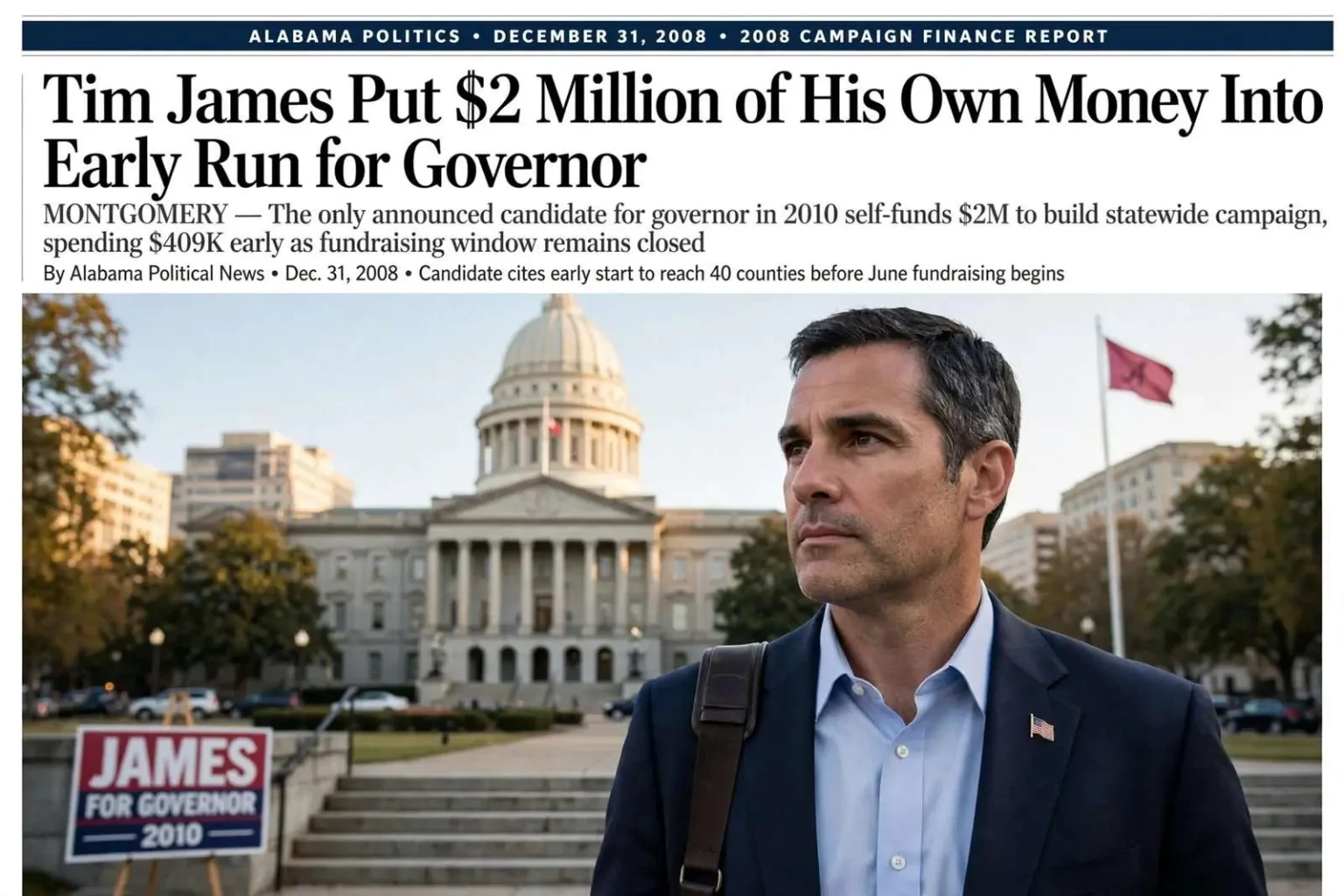
MONTGOMERY — Tim James, at that point the only announced candidate for governor of Alabama in 2010, disclosed in his campaign’s annual finance report for 2008 that he had contributed $2 million of his own money to the effort. The report showed expenditures of $409,322. The figure was a statement of intent as much as an accounting entry, filed at a moment when no other candidate had yet declared for an office that would be open the following year.
Alabama law barred candidates for state office from raising money outside a defined window, and James was still several months away from the date when his campaign could begin soliciting contributions in earnest. What the filing made plain was that the son of a former governor was not waiting on anyone’s permission to build a statewide operation.
A filing governed by Alabama’s fundraising calendar
Alabama’s campaign finance rules have long dictated the rhythm of statewide races. Candidates cannot open the spigot of contributor money until the calendar allows it, which in practical terms means the months before a fundraising window opens belong to whoever can afford to work on their own account. James’s report placed him squarely in that position: the $2 million had come from his own pocket, and the $409,322 in expenditures showed the money was already being put to work.
“I look forward to the date in June when we can begin our fund-raising efforts,” James said. “To take advantage of our early start I made a personal financial commitment which has shown encouraging results.”
The timing he described was not rhetorical flourish but the literal structure of the race. Until the June date arrived, contribution checks could not legally be solicited or accepted, so the campaign’s pace would be set by whatever the candidate himself was prepared to spend. Few aspiring nominees for governor enter that stretch of the calendar with a functioning organization; fewer still enter it having already disclosed a seven-figure personal stake in the outcome.
Self-funding as a substitute for time
The candidate’s arithmetic was straightforward. He could not yet take other people’s money, but he could spend his own — and by doing so, he could buy the one commodity that no amount of later fundraising could replace: an early start. In Alabama politics, where statewide nominations are often decided in crowded primaries on the strength of name identification and organization, a head start measured in months carries a value that is difficult to overstate.
Two million dollars bought staff, offices and a great many miles of highway. It paid for the unglamorous mechanics of a campaign — payroll, rent, travel, phones and the paperwork that turns an intention to run into an organization capable of reaching voters in every region of the state. For a campaign barred from asking anyone else for a dollar, the candidate’s own balance sheet was, for the moment, the only one that mattered.
The expenditures also served as a signal to the field that was forming behind him. A rival who waited for the fundraising window to open would find, on the first day of legal solicitation, an opponent already staffed, already headquartered and already on the road. In primary politics, where the early months are spent earning recognition that money can later amplify, that difference is not cosmetic.
An organization ahead of the calendar
Since announcing his campaign for governor the previous year, James had engaged a campaign staff, opened a headquarters in Montgomery and established a satellite office in Birmingham. The two-city structure reflected the practical geography of Alabama politics, which runs through the capital’s government circles and the state’s largest population center alike. A headquarters in Montgomery put the campaign next door to the Capitol and the state agencies that dominate Capitol-hill coverage, while the Birmingham office anchored the campaign in the metro area that supplies the largest single bloc of primary votes.
He had campaigned in 40 of Alabama’s 67 counties and had assembled campaign leadership across the state. That pace — outreach to more than half the state’s counties before a single contribution could legally be solicited — was the visible return on the personal financial commitment, and it signaled to prospective rivals that the field they would be entering was already partially occupied.
The county-by-county approach also matters in an Alabama primary in ways that national observers sometimes miss. The state’s 67 counties range from the Gulf Coast’s resort communities to the Black Belt’s small towns to the industrial corridors of the Tennessee Valley, and voters in each region expect to be courted in person. A campaign that has physically visited 40 counties has, in effect, already run the preliminary laps of a statewide race while its potential opponents were still deciding whether to enter.
A name Alabama voters already knew
A Republican, James is the son of former Gov. Fob James, who served Alabama as both a Democrat and a Republican across two non-consecutive terms — a fact that gave the younger James near-universal name recognition and, depending on the voter, a set of expectations to live up to or live down. Few entering candidates for governor begin with that kind of standing in the electorate, and fewer still with a family surname that has already appeared on statewide ballots multiple times.
The father’s unusual path — first elected as a Democrat, later returning to office as a Republican after a party switch — made the James name familiar to voters of both generations and both parties, a form of political capital that could not be purchased at any price. It also meant the son would be measured against a standard that many Alabama voters remembered vividly.
He and his wife, Angela, have three children and live in Greenville, where he operates his business interests. Greenville, the seat of Butler County along the Interstate 65 corridor between Montgomery and the Gulf Coast, anchored both his family life and his business identity in south-central Alabama, a base that placed him close to the Black Belt and within easy reach of the state’s growing Wiregrass and coastal vote.
In the toll-road and construction business, James had built the kind of private-sector record that Alabama Republican primary voters have historically rewarded, and he ran as a businessman rather than as a career officeholder. The profile — an entrepreneur who builds roads rather than a politician who budgets them — was a deliberate contrast to the lawyers and longtime officeholders who populate most statewide fields, and it foreshadowed the argument about jobs and infrastructure that would run through the campaign to come.
The field that was coming
James’s early start looked less lonely with each passing month. The 2010 governor’s race was expected to draw a crowded Republican field, with names such as Bradley Byrne, then chancellor of the state’s two-year college system, and State Treasurer Kay Ivey in circulation, while Democrats looked to Lt. Gov. Jim Folsom Jr., Agriculture Commissioner Ron Sparks and U.S. Rep. Artur Davis.
Gov. Bob Riley was term-limited and could not seek a third consecutive term, leaving the office genuinely open for the first time in eight years. Open-seat governor’s races in Alabama reliably produce crowded primaries, expensive campaigns and long ballots of candidates introducing themselves to voters — which is precisely why an early, self-funded organization carries such weight. An incumbent’s retirement removes the penalty for challenging a sitting governor and invites every ambitious officeholder in the state to consider the jump.
The prospective Democratic field illustrated the same dynamic from the other side. Folsom, as lieutenant governor, held the state’s second-highest office; Sparks had built a statewide constituency through the Agriculture Department; and Davis, representing the Birmingham-area district in Congress, had been assembling a campaign apparatus of his own. Each would face the same fundraising calendar that constrained James, but none of them could claim to be the race’s only announced candidate — a distinction James held alone through the period covered by the 2008 report.
For South Alabama, the shape of that field mattered. Several of the prospective candidates had ties to Mobile, Baldwin County or the southwest corner of the state, and the region’s voters stood to be courted with unusual attention. Gubernatorial candidates who might otherwise spend their time in Huntsville or Birmingham would have reason to work the coast, the Port City and the I-65 corridor, and local issues — from coastal restoration to port development to the region’s rapid growth — were likely to figure in the campaign as a result. A candidate who had already put $2 million of his own money on the table was, at minimum, going to be part of that conversation.
What the money signaled
Candidates who self-fund invite two readings. The generous one is that a man willing to risk his own fortune believes in his campaign and owes nothing to anyone. The skeptical one is that early money can substitute for the organic support a campaign is supposed to earn. Alabama voters have seen both kinds of self-funded campaigns over the years, and they have learned to wait and see which kind a candidate turns out to be.
James, by putting a number on the record 16 months before the primary, was betting that Alabama Republicans would take the first view. His remarks pointed to June — the month the fundraising window would open — as the true beginning of the race. Until then, the campaign would run on the candidate’s own account, and on the 40 counties’ worth of handshakes he had already banked.
Whether that gamble aged well or poorly, the 2008 report captured a simple truth about the race to come. In an open contest for the state’s highest office, Tim James intended to be the candidate who was ready first — staffed, headquartered and visible while his potential rivals were still raising the money that would let them begin — and he was willing to pay for that privilege out of his own pocket rather than wait for the calendar to permit anyone else to help.