After a Bruising Loss, Luther Strange Looks at the Attorney General’s Office
Sources said the Birmingham lawyer and lobbyist, whose 2006 run for lieutenant governor ended in defeat, was measuring a 2010 campaign for attorney general against incumbent Republican Troy King.
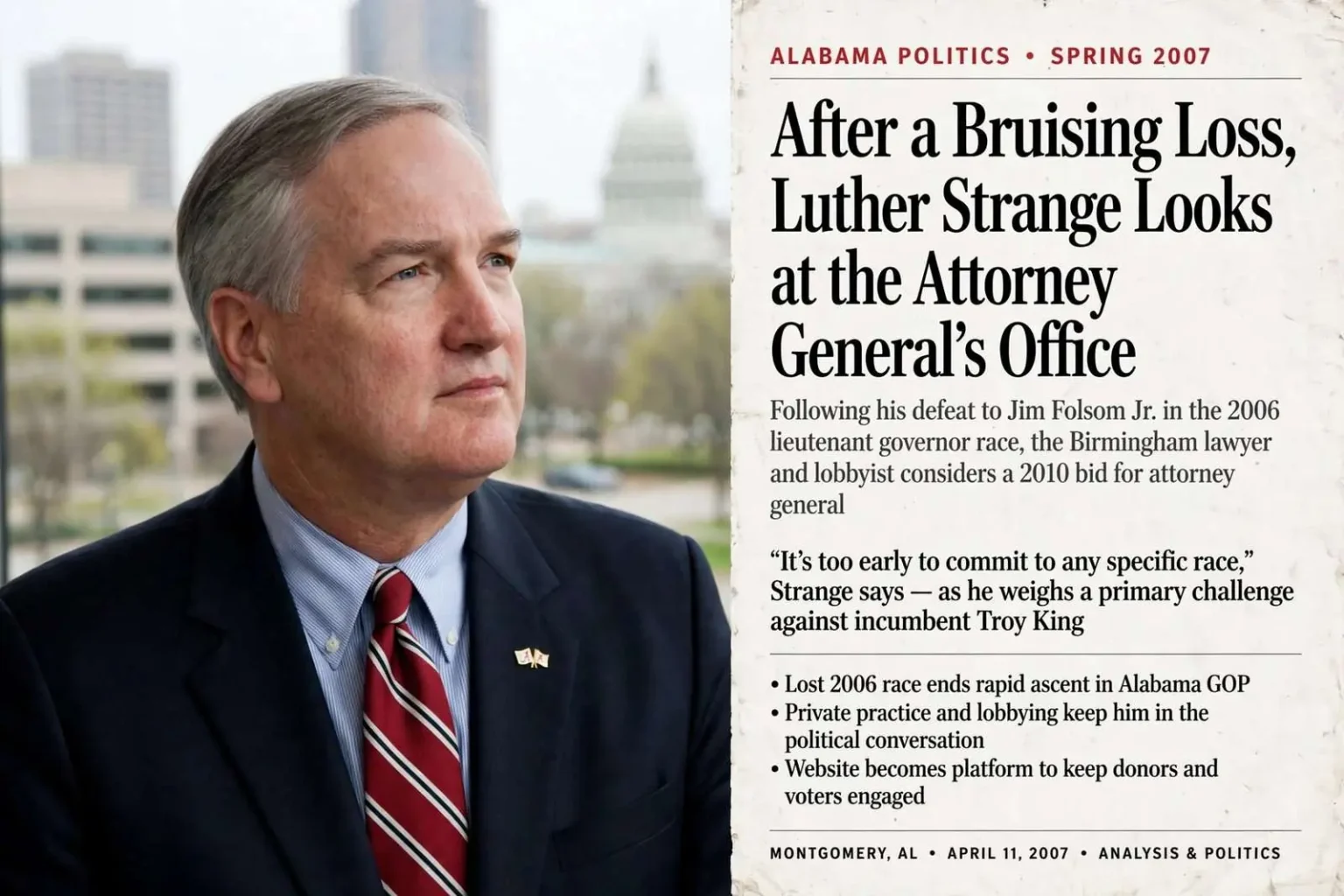
Luther Strange was supposed to be on his way up. Instead, in the spring of 2007, he was a Birmingham lawyer and lobbyist with a website, a lost race behind him and, according to sources familiar with his thinking, a growing interest in becoming Alabama’s attorney general in 2010. The detour said a great deal about how Alabama politics actually works — and about how quickly a trajectory that looks inevitable can flatten out.
Strange himself would not confirm it, or deny it. “It’s too early to commit to any specific race,” he said. “I plan to continue to work to improve the state in whatever way I can and right now that means continuing to speak out on the important issues.” It was the answer of a politician keeping every option open: neither a declaration of candidacy nor a retreat to private life, but a holding pattern that keeps donors interested and critics paying attention.
One vehicle for that speaking out, he indicated, would be his website, a comparatively novel instrument for an Alabama politician in 2007 and a reliable signal that the politician in question has no intention of going away. A generation of Alabama officeholders had built careers entirely on courting county chairmen, sheriffs and the AEA; a personal website — part platform, part press operation, part mailing list — was the tool of a different kind of campaign, one aimed at building a constituency directly rather than borrowing one from the party establishment.
The Crash
The context for all of this was a defeat that had genuinely surprised the Alabama political class. Strange’s campaign for lieutenant governor in 2006 had been, by every conventional measure, a success in progress. He won the Republican primary by defeating George Wallace Jr., a name that carried more raw recognition in Alabama than almost any other — the son of George and Lurleen Wallace, and himself a veteran of statewide office on the Public Service Commission.
Having disposed of one political legacy, he faced another in the general election: Jim Folsom Jr., the Democratic former governor and son of a former governor, a lanky veteran of state politics whom many Republicans had written off as a formality on Strange’s path to the lieutenant governorship — and from there, the presumption ran, to the governor’s office and points beyond. Folsom had already served a term as lieutenant governor and had ascended to the governorship once before, completing the term of Guy Hunt after Hunt’s 1993 conviction removed him from office.
Folsom won. The 2006 general election turned out to be a good Democratic year down the ballot even as Republican Bob Riley cruised to re-election as governor, and Folsom’s easygoing, familiar presence proved sturdier than the GOP’s expectations. The trajectory that had looked so smooth ended abruptly, and Strange was left to find another door into statewide office.
The Obstacle
The attorney general’s office presented an obvious opportunity and an obvious complication. The incumbent, Troy King, was also a Republican, which meant that any Strange campaign would have to go through a sitting officeholder of his own party in a primary rather than around a Democrat in a general election. That was not a small consideration. primaries against incumbents are the most expensive, most personal contests in Alabama politics, and a loss there — Strange had just absorbed one — does real damage to a politician’s standing with donors.
The attorney general’s office, moreover, was not a quiet post. It is the state’s chief legal office, charged with representing state agencies, issuing formal opinions that shape policy, and prosecuting public corruption cases that inevitably land on the front pages. Alabama’s attorneys general have historically used the office as a launch pad — several governors and a U.S. senator served there first — and its occupant is a fixture in every fight over gambling, education policy and legislative ethics.
King himself had arrived at the office by an unusual route: appointed in 2004 to fill the remainder of William Pryor’s term after Pryor’s federal appellate appointment, then elected in his own right in 2006. His relationship with the Riley administration had grown strained in spots, with public disagreements over legal opinions and authority — the kind of friction that Republican primary voters would be asked to referee if a challenger emerged.
For Strange, the calculation was straightforward but risky. Waiting for an open seat meant four more years in the wilderness; running against King meant an immediate, expensive primary with an incumbent who had the resources of the office and the loyalty of those he had appointed or endorsed. Sources familiar with Strange’s thinking suggested he was prepared to make that case. The 2010 cycle was far enough away to build, and Alabama Republicans, fresh off mixed results in 2006, were already mapping which offices could be taken back.
A Lobbyist’s Path to Statewide Office
Strange’s day job complicated the picture. Lobbying is a common way station for former candidates — it pays well, keeps a politician inside the process, and builds relationships with the business interests that fund campaigns. It also supplies ammunition for future opponents, who can mine a client list for conflicts to run in attack ads. Any Strange-for-AG campaign would have to answer for the years between races, and every contract he signed in the meantime would become part of the record.
The years Strange spent building that record had a pattern. A Virginia native and University of Alabama-trained lawyer, he had spent time in Washington before returning to Alabama, and his 2006 campaign had positioned him as a conservative reformer focused on corruption in Montgomery. That message — running against the Establishment while asking the Establishment for money — is standard in Alabama campaigns, but it works best for a candidate with a fresh face and a clean ledger, and every cycle in the private sector eroded one of those two assets.
The lieutenant governor’s office he had sought was itself a curious prize. Alabama’s lieutenant governor presides over the Senate and casts tie-breaking votes, but the office’s real power depends on which party controls the chamber and how the Senate organizes itself. In the mid-2000s the office had become a perch for ambitious politicians precisely because it is visible without being accountable — a statewide platform with no department to run and no budget crisis to own.
The attorney general’s office offered the opposite trade: less visibility, far more power. An attorney general can reshape the state’s legal landscape through opinions, settlements and selective prosecution, and the office’s independence from the governor has historically made it a rival power center rather than an annex. For a politician whose brand was anti-corruption, no other office in the state fit better.
The 2010 Horizon
The 2010 landscape was three years distant, and Alabama politics had a way of rearranging itself between election cycles. Governors’ races reshape everything: a departing incumbent frees up multiple offices, and the dominoes — a congressman running for governor, a statewide official running for his seat — cascade down the ballot. Whoever occupied the attorney general’s office in 2010 would depend partly on decisions that had not yet been made, including King’s own plans and the ambitions of other Republicans circling the same offices.
Strange’s public posture reflected that uncertainty. By declining to rule out any race — the attorney general’s office, the governor’s office, even a rematch — he preserved the flexibility that defeat had taught him to value. His website, meanwhile, gave him the standing to weigh in on the issues of the day: legislative fights, court decisions and the corruption stories that never stop generating in Montgomery. In an era when Alabama’s political conversation was migrating from newsprint to email lists and blogs, an officeless politician with an online platform could stay in the game indefinitely.
The spring of 2007 was, in the end, a rebuilding season. The loss to Folsom had ended one of the fastest rises in recent Alabama Republican politics, but it had not discredited the candidate — he had won a hard primary and run a competitive general election against a former governor. Party donors remembered the campaign’s professionalism, and the party’s activists remembered that Strange had put a Wallace on the defensive.
Whether the next act would begin in the attorney general’s race remained, formally, an open question. What was clear was that Strange had no intention of letting the question be answered without him — and that in Alabama, a lawyer-lobbyist with a website, a list of supporters and a grievance to nurse is never really out of a race that is three years away from being held.
The episodes of that spring — the website, the non-denials, the quiet conversations — were, in their way, the first declarations. Alabama politicians rarely announce their intentions in a single sentence; they assemble them, one careful signal at a time, until the race is effectively running long before anyone has filed a single piece of paperwork.