A GOP Loyalty Fight Fizzled in the Race for Baldwin County’s Open Senate Seat
A threatened challenge to Baldwin County Commissioner David Ed Bishop's Republican credentials collapsed in July 2007 after a Democratic senator said a $150 contribution in his records had never been made.
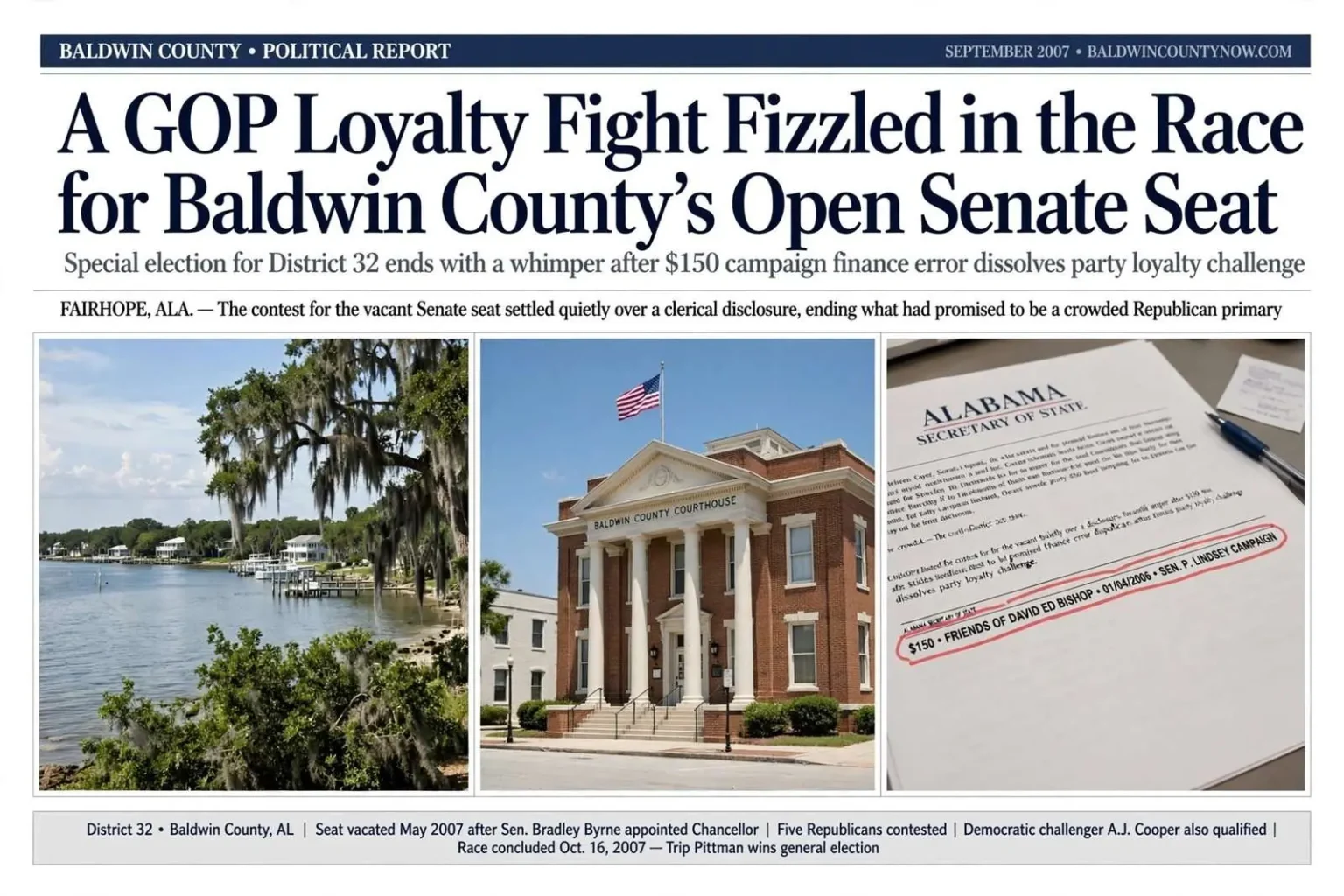
The special election to fill Baldwin County’s vacant state Senate seat briefly promised a genuine Republican brawl in the summer of 2007. It ended with a whimper. For a few weeks, the race for District 32 looked like the kind of crowded, hard-fought primary that fast-growing Baldwin County had become known for — five Republicans with deep roots in local government, a well-traveled Democratic challenger, and a party loyalty dispute that threatened to knock one of the front-runners off the ballot entirely. Instead, the fight dissolved over a single $150 campaign finance entry, and the contest settled into the kind of quiet, low-drama special election that rarely makes history books but often shapes them.
The vacancy
The District 32 seat came open in May when Bradley Byrne accepted Gov. Bob Riley’s appointment as chancellor of Alabama’s two-year college system. The post was among the most demanding in state government at the time: Riley had restructured the chancellorship amid sweeping scrutiny of the two-year college system, and the job came with a mandate to clean up hiring practices and governance across campuses statewide. Byrne, a Mobile-area attorney and former state school board member, took the appointment and would go on from it to run for governor and, later, for Congress, but in the spring of 2007 his departure left Baldwin County without a voice in the Senate and set the special-election machinery in motion.
The scramble to succeed him drew a crowded Republican field. Baldwin County Commissioner David Ed Bishop of Fairhope brought a sitting county office and years of Eastern Shore name recognition. State school board member Randy McKinney had a district-wide education platform. Eastern Shore businessman Trip Pittman offered a fiscal conservative profile and personal wealth for a campaign. Former state Sen. Albert Lipscomb knew the ins and outs of Montgomery from prior service in the chamber, and party chairman Don McGriff — a former nominee for lieutenant governor — rounded out a field that touched nearly every faction of Baldwin County Republican politics.
On the Democratic side, Eastern Shore attorney A.J. Cooper qualified for the race. Cooper was formerly the mayor of Prichard in Mobile County, and his candidacy gave Democrats a credible name in a district that had been trending steadily toward Republicans. A Republican runoff, if needed, was set for Sept. 11, with the general election to follow on Oct. 16 — a compressed calendar that left little room for extended intra-party warfare, which made the loyalty-rule challenge looming over Bishop all the more consequential.
The district at stake was a plum by any measure. Centered on Baldwin County — long one of the fastest-growing counties in Alabama and the anchor of the Mobile Bay metropolitan area’s eastern half — District 32 took in the Eastern Shore communities of Fairhope, Daphne, and Spanish Fort along with sprawling inland territory, and its state senator carried real weight on growth, infrastructure, and coastal policy questions. A decade of subdivision construction, school growth, and highway expansion had made the county’s legislative delegation one of the most closely watched in Montgomery, and both parties understood that an open seat there was worth contesting seriously.
Special elections of this kind also ran on their own compressed rhythm. With party qualifying followed quickly by a summer primary and an autumn general, campaigns had a matter of weeks rather than months to raise money, introduce themselves, and stake out positions. That timeline rewarded candidates with existing name identification and organization — an edge the crowded Republican field’s officeholders all assumed they possessed, and one that the threat of a ballot-access challenge could have upended entirely for whichever candidate it landed on.
The loyalty rule
The trouble for Bishop arose from a rule the state Republican Party had recently adopted. Under it, party officials reserved the right to deny ballot access to a candidate who, as a Republican officeholder in a prior election, had publicly participated in another party’s primary or publicly supported another party’s nominee. The rule reached back six years, meaning Bishop’s entire recent record as a county commissioner was fair game for review. For a county officeholder whose friends, neighbors, and political acquaintances spanned both parties — as was common in Baldwin County’s civic culture — the standard was a wide net, and party insiders made clear they were prepared to cast it.
The evidence pointed at Bishop came from a campaign finance report filed with the Alabama Secretary of State by Sen. Pat Lindsey, D-Butler, whose District 22 took in part of north Baldwin County. Lindsey’s disclosure recorded a $150 contribution on Jan. 4, 2006, from the Friends of David Ed Bishop Campaign, and a $250 contribution the day before from the Friends of Jody Bishop Campaign. Jody Bishop, a Republican judge in Baldwin County, is the commissioner’s son. On paper, the two entries suggested that a sitting Republican county commissioner had helped fund a Democratic senator’s re-election — precisely the kind of cross-party support the new loyalty rule was written to punish.
The senator contradicted his own report
In a June 28 letter addressed to whom it may concern, Lindsey refuted his own filing. Bishop, he wrote, did not make a contribution to his re-election campaign. Lindsey acknowledged that the name appeared on the report, but said that further checking of campaign documents had produced no verification of any contribution — no deposit record, no receipt, no corroborating entry anywhere in his campaign’s books.
The listing, he said, was inadvertent, and most likely occurred because Bishop was a personal friend whose name and address sat in the campaign’s office and rolodex files. Lindsey noted that his 30-page report listed more than 280 individual contributors, said a double-check showed no record of a Bishop contribution, and pledged to file an amended report correcting the error. The episode was an unflattering look at the state of small-dollar campaign bookkeeping, but it landed on the side that mattered to Bishop: the paper trail supporting the challenge had evaporated under its author’s own signature.
Bishop’s campaign spokesman, Jon Gray, was unequivocal: Ed Bishop never made a political contribution to Sen. Lindsey. The campaign had no further comment, and the threatened challenge to his candidacy went away. Without a verified cross-party contribution to hang the loyalty rule on, party officials had no case to bar Bishop from the ballot, and the summer’s most promising Republican brawl fizzled before a single vote was counted.
What loyalty rules were really about
The episode is a small window into a large transition. In 2007, Alabama Republicans were consolidating a majority that had been decades in the making, and party loyalty rules were one instrument for policing the boundary between old-line conservative Democrats and the newer Republican coalition. Nowhere was the blending more pronounced than in fast-growing Baldwin County, where many longtime residents had come of age in a Democratic South, where crossover friendships and small local contributions were ordinary features of political life, and where candidates from both parties frequently shared pews, civic clubs, and campaign donors. A rule written to punish party-switchers inevitably brushed up against that culture.
The rules also carried real teeth: barring a candidate from the primary ballot is a far blunter tool than opposing him in it. A denied ballot access ends a candidacy before voters have any say, which is why party officials treated the power seriously and why even the specter of a challenge could consume weeks of a campaign’s attention. Bishop’s field of rivals, meanwhile, could simply keep campaigning while the dispute was sorted out — an advantage that cost nothing but the passage of a summer.
The outcome
The District 32 special election was won by Trip Pittman, who defeated A.J. Cooper in the general election and went on to hold the seat for more than a decade, eventually chairing the Senate’s budget committee and becoming one of the chamber’s influential voices on fiscal matters. What had promised to be a defining loyalty fight instead faded into a footnote of the race’s history.
Bishop remained on the Baldwin County Commission, continuing his service in county government without the Senate seat he had sought. And Lindsey’s $150 clerical error, having threatened to reshape a Senate race and test the reach of party discipline, disappeared into an amended campaign finance report — remembered, if at all, as the moment when a summer of Republican fratricide in Baldwin County ended not with a primary battle, but with a rolodex and a signature.
For the voters of District 32, the quiet resolution meant the campaign could proceed on substance rather than procedural combat — roads and schools and growth management instead of challenges filed with party headquarters. The race’s lasting lesson, though, belonged to the candidates and parties watching from elsewhere in the state: in an era of tightening party discipline, even a $150 line item in someone else’s disclosure could become a weapon, and even a weapon could dissolve the moment its own author re-read the books.