Long Road Nears Its End in Baldwin County’s Senate District 32 Race
Republican Trip Pittman and Democrat A.J. Cooper faced voters after a special election season that proved one thing above all: in Baldwin County, it costs far more to win a nomination than to accept one.
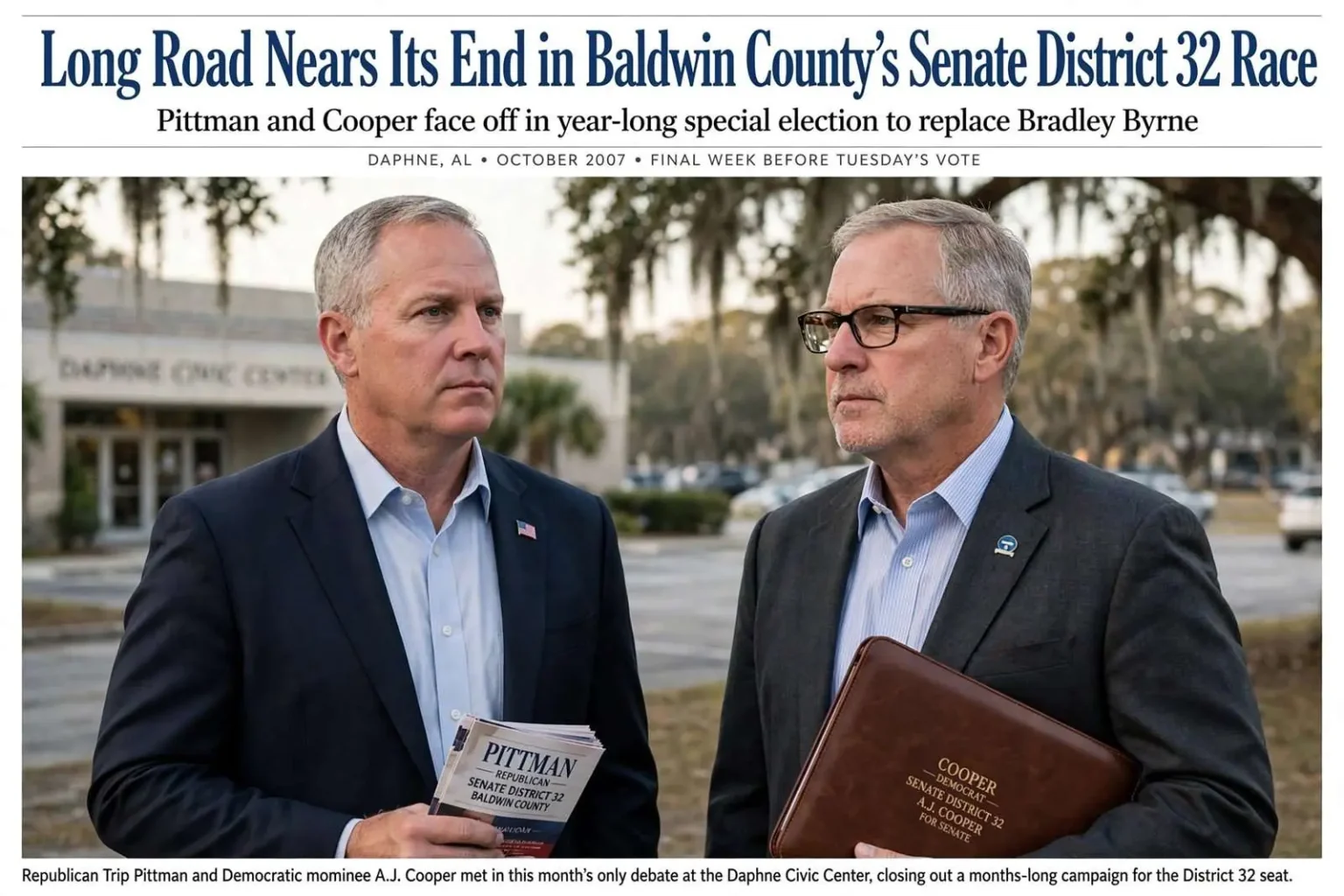
Of the many lessons in the long process of choosing a new state senator from Baldwin County’s District 32, one seemed unassailable: it cost a great deal more to become the Republican nominee than the Democratic one.
Republican Trip Pittman, who no longer had the look of a rookie candidate, headed into Tuesday’s showdown against Democratic nominee and political veteran A.J. Cooper after months of handshakes, speeches and spending.
The special election had consumed most of a year, from the moment the vacancy opened through a summer primary, a late-summer runoff and a fall general election, and it had given Baldwin County’s political community its most sustained contest in years. By the final week, both campaigns had settled into the familiar rhythm of a coastal Alabama race: civic club breakfasts, church suppers, a debate on the Eastern Shore and a last push through the neighborhoods and fire stations that make up the county’s informal political map.
Two very different paths to the ballot
Pittman emerged from a grueling five-man primary and then a testy runoff, in which he defeated the front-runner, Randy McKinney. The two men differed little in political philosophy, but the contest still went sour for many Baldwin County Republicans when Gov. Bob Riley endorsed McKinney. Whether Pittman overcame the snub or was helped by it is a question that was argued in the county long afterward. Either way, it did not stop him.
The runoff had been hard-fought in a way that surprised some observers, given that the candidates shared most of the same positions on taxes, education and state government. Local races in Baldwin County are often decided on biography, relationships and organization rather than ideology, and this one was no exception. The governor’s endorsement of McKinney, whose service on the State Board of Education had made him Riley’s closest education ally, gave the contest a statewide shadow, and county Republicans divided over whether to follow the governor’s lead or to resent what some saw as outside interference in a local race.
Cooper, an Eastern Shore attorney, took a shorter and considerably cheaper road: he locked up the Democratic nomination by paying the qualifying fee. With no primary to fight, he launched his general election effort about 12 weeks before the vote.
Cooper was no newcomer — his long history in county and state politics made him one of the better-known Democrats in Baldwin County — but the math of the seat was unforgiving. In a county that Republican presidential and statewide candidates carried by overwhelming margins, the Democratic nomination was a formality, and the general election campaign that followed asked him to do what Democrats in Baldwin County had rarely been able to do: make a credible race of a general election against a well-funded Republican in a year when the national climate favored the GOP.
The seat had come open when Bradley Byrne resigned from the Senate to become chancellor of Alabama’s two-year college system, setting off a special election in one of the most reliably Republican counties in the state.
Byrne’s departure was itself part of a larger story. The governor had appointed him to run the troubled two-year college system as it faced investigations and reform, and Byrne’s resignation handed Gov. Riley the power to call a special election and handed Baldwin County’s voters an unexpected mid-cycle campaign. Special elections tend to reward the party and the candidates with the deepest benches, and in District 32 that meant a crowded Republican field that took months and substantial money to sort out.
The money
Pittman proved an adept fundraiser from the beginning, and his five-to-10-day pre-election disclosure showed him raising roughly twice what Cooper raised over the same period.
He opened the reporting stage with $62,891.81 on hand and raised another $23,835 in cash, plus $7,235 in in-kind contributions. He reported $71,453.88 in expenditures, leaving $25,072.93 for the final push.
The in-kind figure — contributions of goods and services rather than cash — reflected the way county campaigns are actually supplied: signs printed, food catered, office space and advertising provided by supporters. Pittman’s spending had gone largely into the staples of a Baldwin County race, direct mail and yard signage chief among them, aimed at the low-turnout electorate a special election always produces.
Cooper began with nothing in his account. He raised $11,867 in itemized cash contributions, another $1,000 in non-itemized contributions and $300 in-kind, and lent his campaign $2,209.46 from his law practice. He spent $12,800.40 and had $2,276.56 on hand when his report was filed with the Alabama Secretary of State on Oct. 12.
The gap in cash on hand — roughly ten times what the Democratic nominee held in the closing days — meant Cooper would run his final week on fumes while Pittman kept advertising through election eve. Neither campaign pretended otherwise; the financial disparity simply reflected the county’s political arithmetic.
The donor lists tell their own story about the two coalitions. Pittman’s contributors included Gulf Coast businesses and business figures — Volkert & Associates, Quality Filters, Vulcan Inc., Millette Administrators, Harris Morrissette, Elliot B. Maisel, Craig Dyas, John McMillan, Charles E. Klumb and Tracy Young among them, along with the political committee Alabamians for Luther Strange and a company associated with former Lt. Gov. Steve Windom.
The Strange committee’s presence connected the race to statewide politics — Strange was then campaigning for the office he would win that fall — and Windom’s involvement reached back into Baldwin’s factional history, since the former lieutenant governor had his own long memory of county Republican politics. The rest of the list read like a directory of the coastal business establishment: engineering firms, manufacturers, developers and professionals whose industries track the county’s growth.
Cooper’s list ran through the county’s Democratic organizations and its professional class: the State Democratic Executive Committee, South Baldwin Democrats, Eastern Shore Democrats, Kuykendall & Associates, WHL Architecture & Interiors, Nero Masonry, Agriculture Commissioner Ron Sparks, Prichard Mayor Ronald K. Davis, restaurateur Lucy Buffett and a long tail of $25 and $50 contributions from individuals.
That long tail mattered to the campaign’s self-image even if it did little for its treasury. Small donations from individuals signaled the kind of grassroots enthusiasm that money cannot buy, and the contributions from Democratic officeholders in Mobile County — the agriculture commissioner, the mayor of Prichard — tied the Baldwin campaign to the broader Democratic network of the two-county coast.
What the race said about Baldwin County
The disparity was not merely financial. In a county where the Republican nomination had become effectively decisive, the competitive contest necessarily happened in the primary, and the money followed it there. The general election, for all its formal importance, functioned in large part as a ratification.
Baldwin County had also been transformed by growth. Once agricultural and coastal, it had become one of the fastest-growing counties in Alabama, its population swelled by retirees, commuters to Mobile and beach development along the Gulf. That growth brought the issues that dominated the race: coastal insurance rates that had climbed to punishing levels after Hurricanes Ivan and Katrina, road and school capacity, and how quickly the county’s institutions could keep up with the subdivisions.
Insurance was the issue voters raised most often. Two hurricanes in the span of a year had pushed premiums on the coast to levels that made headlines and emptied escrow accounts, and homeowners from Gulf Shores to Fairhope wanted a state senator who would treat the market’s retreat as an emergency. Schools were the second constant: the county system was adding students by the hundreds each year, and communities east of Mobile Bay were demanding the classroom space and teachers that growth required.
Pittman won the election and went on to represent District 32 in the Alabama Senate for well over a decade, becoming chairman of the chamber’s education budget committee.
The longevity of his tenure — through multiple terms in a district that kept growing — made the 2007 special election a hinge in the county’s political history. What had begun as a scramble to replace a departing senator ended with a new figure entrenched in one of the Senate’s most consequential committee posts, with a say over the education budgets that mattered to Baldwin’s expanding school systems.
The League of Women Voters of Baldwin County had sponsored a debate between the two candidates at the Daphne Civic Center in the closing week, moderated by broadcast and print journalists — the kind of civic exercise that, in a county accustomed to being an afterthought in statewide politics, drew a genuine crowd.
For the League, the debate was the sort of nonpartisan work it had done for decades across Alabama, putting candidates before voters without the filter of campaign advertising. For the county, it was a small sign of its own growing weight: a state legislative race that could fill a civic center was a mark of how far Baldwin County’s politics had come, and of how much more was at stake in the district than either campaign’s bankroll could measure.