Baldwin Insiders Split on Senate Runoff: ‘Razor Thin’ or a McKinney Win
On the eve of the Baldwin County Senate District 32 runoff, political veterans offered sharply divided predictions, with negative mail and the governor's endorsement dominating the closing arguments.
The Republican hunt for a nominee in the special election for Baldwin County’s District 32 state Senate seat began some seven weeks earlier with five mostly gung-ho candidates. It would straggle to the finish Tuesday a little worse for the wear — but with a nominee.
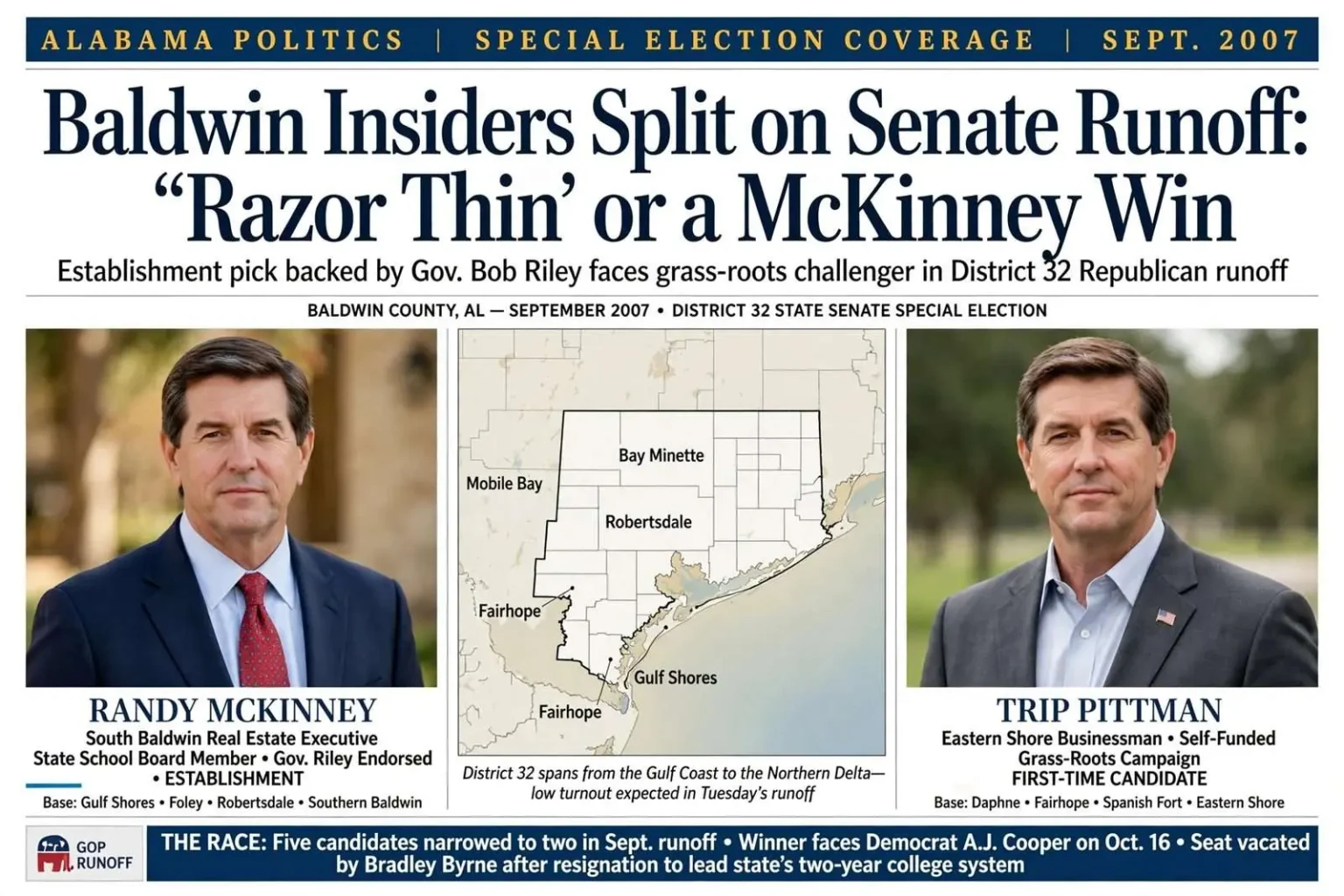
Who that would be was anybody’s guess. Early favorite Randy McKinney, a south Baldwin real estate executive, state school board member and the choice of Gov. Bob Riley? Or Trip Pittman, the Eastern Shore businessman and first-time candidate who bypassed the establishment for a grass-roots appeal?
The winner would face Democratic nominee A.J. Cooper, an Eastern Shore attorney who took his party’s nomination unopposed, in the Oct. 16 general election. The seat opened when Bradley Byrne resigned to lead the state’s troubled two-year college system.
Special elections are strange creatures in Alabama politics. Without a presidential or gubernatorial race at the top of the ticket, turnout collapses to the parties’ most engaged voters, and the campaign becomes an exercise in mobilization rather than persuasion. District 32 — encompassing the breadth of Baldwin County from the beaches to the Northern Delta communities — had been Byrne’s seat, and his departure to the state’s two-year college chancellorship mid-term forced the county’s Republicans into a compressed, summer-long scramble to replace him.
Five candidates had entered that scramble, and after the first primary winnowed the field, the runoff came down to two men who represented two theories of Baldwin County politics: the establishment candidate with the governor’s endorsement and a network built over years, or the newcomer with personal resources, a fresh face and an argument about Montgomery’s PAC-money politics.
Political observers across Baldwin County — elected officials, party veterans, business figures and consultants, most speaking on condition of anonymity — offered their reads on the race.
The case for Pittman
“Trip Pittman will win the election on Tuesday,” said one Baldwin County elected official. “McKinney’s move to go negative in his mail pieces and his need to bring in the ‘big guns’ (a.k.a. Gov. Riley) for televised endorsements shows the acts of a candidate who is trailing in the last few days before the election.”
That read — that desperation is legible in a campaign’s tactics — was a common one among Pittman’s supporters. In their telling, McKinney’s late negative mail and the heavy deployment of the governor signaled a campaign that knew it was behind and was spending its remaining credibility to close the gap.
A tourism executive predicted a 51-49 Pittman win on geography: “McKinney hasn’t done much north of Robertsdale.” But he warned that Pittman’s own closing message — hammering Montgomery PAC money — would not help him govern afterward.
The geography argument reflected a real division in the county. Baldwin is Alabama’s largest county by area, and its politics have long sorted along geographic lines: the Eastern Shore communities of Daphne, Fairhope and Spanish Fort, growing rapidly with suburban professionals; the beach communities of Gulf Shores and Orange Beach along the coast; and the agricultural and small-town middle of the county running from Foley and Robertsdale north toward Bay Minette. A candidate strong on one end of that map can lose it on another.
A Baldwin attorney forecast “low voter turnout and a razor thin margin,” adding that “Riley’s endorsement of McKinney proves to be a net negative, and Pittman wins by a nose.”
A road contractor was blunter, putting Pittman at 54 percent and arguing that McKinney had raised less than $30,000 from individual Baldwin County donors across two cycles. “The governor’s endorsement I believe has backfired,” he said.
The fundraising observation cut against McKinney in a way that stung precisely because he was the establishment candidate. If the party’s preferred standard-bearer could not raise significant money from the county’s own donors, the argument ran, then the establishment’s hold on Baldwin County’s Republican electorate was weaker than anyone assumed — and the governor’s endorsement, usually a bankable asset, was drawing active resistance rather than deference.
The case for McKinney
A veteran Baldwin politico laid out the most detailed map of the county. He predicted McKinney would win 53-47 in a turnout of perhaps 12 percent, carrying Gulf Shores, Orange Beach, Perdido, Lillian, Elberta, Foley, Robertsdale, Summerdale, Loxley, Magnolia Springs and Bon Secour by margins large enough to offset Pittman’s expected strength in Barnwell, Marlow, Bay Minette, Spanish Fort, Daphne and Fairhope.
It was a precise forecast, and it mapped the contest exactly as the two campaigns understood it. Pittman’s home turf was the Eastern Shore — the fast-growing, higher-income communities along Mobile Bay — while McKinney’s base ran through the southern and central county, from the beach towns through Foley, Robertsdale and the small communities between. The politico’s arithmetic assumed each man would dominate his own geography and that the southern end simply contained more runoff voters.
“Randy is a seasoned campaigner and has a good organization in place,” he said. “In the end I think an experienced organization and good name identification will beat an inexperienced candidate and organization.”
That was the establishment case in a sentence. McKinney had run for and held the District 1 seat on the State Board of Education, had name recognition built across two countywide or districtwide campaigns, and had the year-round precinct network that only repeated campaigns create. Pittman, running his first race, was relying on personal network, personal resources and message. In a 12-percent-turnout election, organization — knowing which three hundred voters in each precinct actually show up for a September runoff — can matter more than any television advertisement.
A Baldwin native and financial consultant agreed McKinney would hold on, though the late negative turn told him “his polls show it is real close.”
A veteran GOP spokesperson said much the same while criticizing the governor’s involvement: “I do not like the fact that Gov. Riley got involved in a primary race. I do not think this is good for the party in the long run.”
That objection came from inside the Republican family, and it illuminated a tension that would outlast the election. A governor’s endorsement in a legislative primary forces the party’s other factions to choose between loyalty to the governor and loyalty to their own local candidates. When the endorsed candidate wins, the party coheres behind the choice; when the endorsement fails, the governor’s influence becomes a talking point for the next challenger. Either way, some portion of the losing side’s voters carries a grievance into the general election — a cost the spokesperson considered too high to pay for a state Senate seat.
The property tax undercurrent
Running beneath the campaign was Baldwin County’s property reappraisal controversy — annual valuations that had driven up tax bills in a county where coastal land values were climbing fast, and which some residents blamed on Riley.
Baldwin County’s real estate market in the mid-2000s was one of the fastest-appreciating in the Southeast, as coastal migration and resort development pushed land values sharply upward. Alabama’s system of annual reappraisal meant those rising values translated into rising assessments — and rising tax bills — every year, landing on homeowners, retirees and landowners just as the market peaked. In a county of long-rooted property owners, the annual valuation notice became the most resented piece of mail the government sent.
One real estate executive who picked McKinney to win by 5 percent, or about 7,000 votes, argued the governor was being wrongly blamed. “What Realtors despise the most is anything that affects property rights and ownership,” he said. “This miscarriage of justice caused by this screwed-up legislation is an abomination and possibly will force some out of their homes. However, I do not feel the governor should be tagged with (it).” He pointed the finger instead at the Legislature.
The distinction mattered to anyone who understood the machinery. Annual reappraisal was written into state law and carried out under state revenue department rules; the governor of the moment administered a system the Legislature had built. But blame in politics follows proximity and recognition, not statutory drafting, and Riley — the state’s most visible Republican — absorbed the anger of homeowners who had watched their assessments climb for several straight years.
For McKinney, the anger was doubly awkward: he was the endorsed candidate of the governor many voters blamed, and he sat on the State Board of Education, a state-level office whose association with “Montgomery” made it a plausible target for the same anti-government mood. His supporters’ hope was that the runoff’s tiny, informed electorate would distinguish between the reappraisal system and the men on the ballot.
An ex-south Baldwin official summarized the closing dynamic in a sentence: “I predict Pittman will win 51-49 percent. The PAC money and negative campaigning at the end has made the difference.”
The PAC-money theme deserves its own accounting, because it was the intellectual center of Pittman’s challenge. Alabama politics in that era ran on political action committee money — committees that bundled contributions from legislators and interests and passed them along to other candidates, laundering the source in the process. The practice had become a symbol of everything reform-minded Alabama resented about Montgomery, and Bradley Byrne’s own resignation from the Senate seat — to lead the state’s two-year college system amid the developing scrutiny of that system — had put institutional reform at the center of District 32’s political conversation.
Pittman’s closing message aimed directly at that symbol: a self-funded businessman, unencumbered by Montgomery obligations, against a candidate endorsed by the sitting governor and supported by the capital’s machinery. It was a potent frame in a county whose voters had been watching their property tax bills rise while Montgomery’s politics looked, from the Eastern Shore’s perspective, increasingly distant and self-dealing.
McKinney’s negative mail in the final days was, by the accounts of even some sympathetic observers, the riskier play. Negative mail works in a high-turnout race where persuasion matters at the margins; in a 12-percent-turnout special election, it mostly reaches the already-engaged voters on both sides, hardening the opposition without adding votes. Whether it moved the numbers or merely confirmed each camp’s view of the other was one of the questions the count would answer.
What happened next, and what it revealed
The one thing on which nearly everyone agreed was that turnout would be low and the outcome would hinge on which side’s voters bothered to show up on a Tuesday in September.
September runoffs are the purest test of organization in Alabama politics. There is no coattail effect from a top-of-ticket race, no advertising saturation capable of manufacturing an electorate, and no ambiguity about who the voters are: the small, committed slice of the county’s Republican electorate that treats a special election as a civic appointment. Both campaigns spent the final week doing the same unglamorous work — calling identified supporters, arranging rides, and reminding the handful of voters who decide such contests that the election was, in fact, that Tuesday.
Whoever won would inherit a constituency that had just spent seven weeks arguing with itself. The losing side’s supporters — whether establishment Republicans whose candidate was upset, or grass-roots conservatives who had watched the governor’s choice prevail — would form the opening chapter of the nominee’s relationship with his own party. And the general election against A.J. Cooper in October, in a district where the Democratic nominee would run hard but the Republican baseline was overwhelming, was in one sense the easy part: the real election had been the runoff, and everyone quoted in the week before the vote knew it.
The race also served as an early signal of a shift that would define Baldwin County politics for the next decade — the rise of the self-funded Eastern Shore businessman as a recurring figure in local elections, the growing voter allergy to Montgomery’s institutional politics, and the fragility of a governor’s endorsement as a campaign asset in a county that prided itself on making up its own mind. The observers who handicapped the race anonymously that September week were, in effect, taking the county’s political temperature — and every one of them found a fever.