Lawsuit Calls West Mobile Annexation Vote a ‘Sham’ and Seeks to Halt It
Three residents sued to stop Mobile's Sept. 18 annexation election, arguing the city drew its four voting areas to capture Schillinger Road tax revenue while stranding neighbors as unincorporated islands.
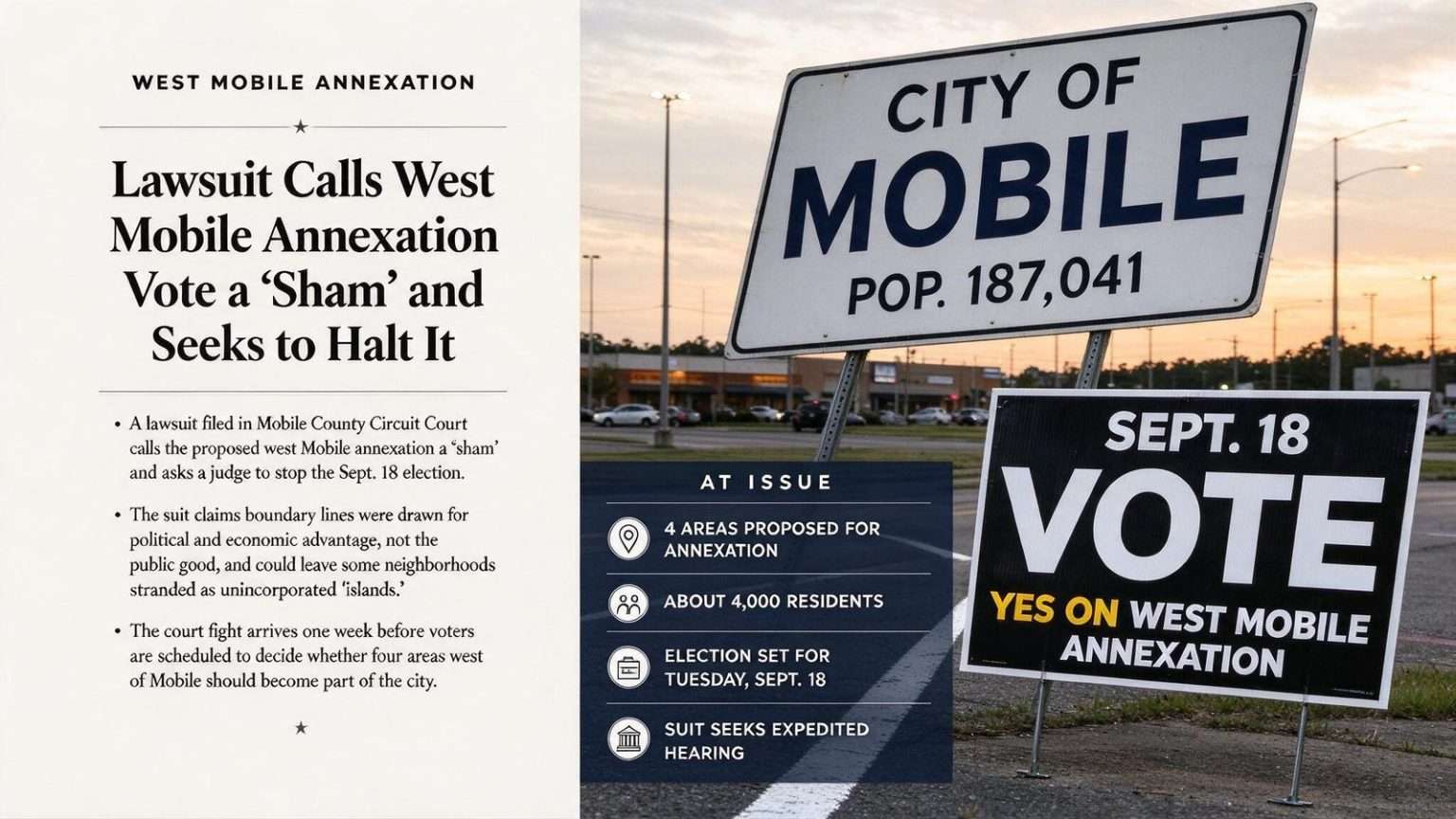
The city of Mobile’s proposal to annex four unincorporated areas just west of its limits was a “sham” drawn for political and economic advantage rather than the public good, according to a lawsuit filed in Mobile County Circuit Court seeking to stop the election scheduled for Tuesday, Sept. 18.
The suit was brought by three men who lived, respectively, in Areas A, B and C of the city’s four-part annexation plan: Jeffrey W. Harris, Furman Smith and Timothy L. Prine. Named as defendants were the city of Mobile and Mobile County Probate Judge Don Davis.
The fight landed in court in the final week before the vote, with both sides racing the calendar. Annexation elections in Alabama are governed by the state code’s procedures for referendums in unincorporated territory, and opponents of an annexation have historically found the courts to be their last, best venue once a council adopts resolutions and a probate judge sets an election date.
Timing is the pivot in such suits. Once an election is held and annexation is approved, unwinding it becomes dramatically harder — courts are reluctant to disturb a completed annexation on the same grounds that might justify stopping it beforehand. That asymmetry explains the rush to file and the request for an expedited hearing within days.
The core allegation
“The annexation lines were not drawn with the interest of ‘public good’ but, rather, strictly along economic and political lines and have no basis in the ‘public good,'” the suit stated, arguing that the boundaries bore “no rational basis to any legitimate ‘public good.'”
The Mobile City Council had adopted resolutions three weeks earlier calling the elections necessary for the “public good” — the statutory standard the plaintiffs set out to attack.
The four areas sat in a corridor between Cody Road, then the city limit, and a line just west of Schillinger Road, running from Hitt Road on the south to Ziegler Boulevard on the north. Together they held about 4,000 residents and nearly 1,900 registered voters.
Based on recent collections, annexing Area A alone would raise city sales tax revenue by more than $10 million a year.
That figure explains everything else about the fight. Western Mobile — the Schillinger Road corridor and the subdivisions around it — had been the fastest-growing part of the county for two decades, its retail strips and rooftops built on county services and county taxes. Every city boundary expansion to the west was, at bottom, an argument about who would collect the sales taxes those commercial strips generated.
The dispute was also part of a longer pattern. Over the previous two decades, Mobile had extended its boundaries in a series of piecemeal annexations, each one moving the city limit farther down the same westward corridor, and each one leaving the neighborhoods between the new lines and the next complaint feeling like the city would come for them eventually.
Residents of the corridor had organized around that feeling before. Civic associations in the western communities had periodically debated incorporating as a town, and the specter of that movement — a self-governing western Mobile County that captured its own tax base — has shadowed city annexation strategy for years.
The growth had followed the roads. Schillinger Road and the arterials feeding it carried the county’s population boom outward from the city, and with the residents came commerce — grocery stores, restaurants, banks and strip centers that generated sales tax at volumes no one foresaw when the corridor was still farmland. County roads and county sheriff’s deputies served the area; city taxes did not apply.
Islands and hostages
Central to the complaint was the shape of Area A, which the suit said was configured to combine the anticipated “yes” votes of the Mobile Terrace neighborhood with the tax revenue of the booming Schillinger Road commercial strip.
Mayor Sam Jones had openly conceded that the likelihood of success was a leading consideration in drawing the plan.
The admission was unusual. Boundary plans are typically defended in the language of service delivery and contiguity, and here the mayor was acknowledging, in effect, that the lines were political arithmetic — a candor the plaintiffs waved as evidence and the city defended as honesty about how referendums work.
“While Alabama law may allow for such a practice when it is not done as a subterfuge, the practical and actual affect is that Areas B and C are potentially left as ‘islands’ of unincorporated areas, surrounded on all sides by the city of Mobile,” the lawsuit noted.
Packaged that way, the plaintiffs argued, the plan effectively held Areas B and C hostage, leaving them no realistic path to forming their own town and no choice but to “eventually acquiesce and ultimately annex” into Mobile.
Stripped of any commercial tax base, the suit said, those neighborhoods would be left as “disjointed and unconnected” pockets with no prospect of self-determination.
The complaint’s framing turned the usual annexation narrative on its head. Where cities describe annexation as offering better services and fuller citizenship, the suit described a city consuming the commercial wealth of the county while stranding the residential areas — the tax base taken, the people left behind the line.
The island problem is a real one in Alabama local government. Unincorporated pockets surrounded by a city cannot incorporate on their own in any practical sense — the state’s incorporation standards make it difficult — and they watch their roads, drainage and policing fall increasingly to a county system while their neighbors inside the city line vote on the city’s future.
A vote the city expected to lose
The suit went further, contending that the city knew in advance how the areas would vote and included the ones it expected to lose only for appearances.
“The ‘opportunity to vote’ granted to the citizens of Areas B and C is a ‘sham’ since the city of Mobile has reason to know that Areas B and C will most likely vote against annexation,” the complaint read.
Their inclusion, the plaintiffs argued, was intended to “cloak” the election in a “robe of legitimacy.” By gerrymandering the lines with knowledge of where opposition lived, the suit charged, the city created “an almost certain outcome which serves only the city of Mobile’s desires while disenfranchising the very electors, property owners and residents affected by the proposed annexation election.”
The complaint also objected that the boundaries split neighborhoods and even streets, “potentially plac(ing) some neighbors on the one side of the street in the city of Mobile while their neighbors across the street would potentially remain in the unincorporated area of Mobile County.”
That objection had a practical edge beyond symbolism. A line down the middle of a street means different taxes, different garbage service, different police dispatch and — in the corridor’s new subdivisions — different rules on everything from alcohol sales to building permits, split between two households that bought into the same neighborhood at the same time.
Schools complicate the picture further. Mobile County’s city-county school arrangement means city and county residents draw on the same countywide system, but zoning, planning and code enforcement diverge sharply at the line, and development patterns follow whoever’s rules are friendlier — one more way a boundary down a street reshapes the ground around it.
A race against the calendar
With the election a week away, the plaintiffs asked for a speedy hearing, requesting that their bid for a preliminary injunction and a trial on the merits be consolidated and expedited “(d)ue to the impending vote, and the substantial public interest, and voting rights issues which are involved.”
Mobile attorney Stephen E. Clements represented the plaintiffs.
Clements was also lead counsel in a separate class action seeking tens of millions of dollars in refunds of taxes the city collected in its police jurisdiction — a case he described as a cousin to the annexation fight, since both turned on the city’s treatment of the unincorporated areas at its edge.
That companion case gave the annexation suit a wider context. Alabama cities collect certain taxes and police services fees in the one- and two-mile police jurisdictions that extend beyond their limits, and residents of those areas have long complained that they pay for city government without a vote in it. The refund suit and the annexation suit made, together, a single argument: the city’s relationship with its western edge had grown extractive.
City officials saw the same facts differently: the police jurisdiction argument cuts both ways, since cities bear responsibility for policing and code enforcement in those one- and two-mile bands whether or not they receive a commensurate share of the growth the corridor generates. From City Hall, the western expansion was the region’s natural course; from the corridor, it was a land grab with a ballot attached.
The case was assigned to Mobile County Circuit Judge Rick Stout.
Whatever Stout ruled, the suit succeeded in framing the question the election would be fought over: whether the city’s western expansion was growth management or gerrymandering. For the roughly 1,900 voters in the corridor, the argument arrived with barely a week to spare before they were scheduled to answer it at the polls.
However the court acted, the election on Sept. 18 would be decided under a shadow — either a court-ordered delay that acknowledged the plaintiffs’ arguments had traction, or a vote held over the objection of neighbors who said the lines themselves had been the outcome’s true author.