Mon Louis Island and a Servant’s Reward: The French Roots of a Mobile Family
The second installment of a Mobile family memoir traces a French line back to Bienville's settlers, to land between Bayou La Batre and Coden, and to how Mon Louis Island got its name.
MOBILE — The second installment of “The Rock Whence I Was Hewn,” the family memoir of Sister Marie Emilie, S.N.D. — born Elizabeth Zoe Walsh (1892-1979) — picked up where the first had left off: with her father, Joseph Walsh, having been fetched home from Admiral Farragut’s blockading fleet by a Union sailor bearing a note. What followed was a story of hard childhoods and long memories, and an origin tale for one of the most familiar place names on the Alabama coast. The memoir, serialized in the Mobile Press-Register during the 1950s and 1960s, offered readers a rare first-person account of Mobile’s transformation from a Confederate port under blockade to a Reconstruction-era Gulf Coast city, filtered through the lens of an Irish-Catholic family that straddled both worlds. The title itself, drawn from Isaiah 51:1, signaled the memoir’s project: to trace a family’s, and a city’s, identity back to its geological and genealogical bedrock.
The Walsh family’s Mobile story begins in the chaos of the Civil War. Admiral David Farragut’s fleet blockaded Mobile Bay from 1862 onward, tightening the noose around one of the Confederacy’s last major Gulf ports. The Battle of Mobile Bay in August 1864, with Farragut’s famous order “Damn the torpedoes, full speed ahead,” marked the beginning of the end for Confederate control of the Gulf. Joseph Walsh, the memoirist’s father, found himself caught in the conflict as a young man. The “note” borne by a Union sailor — a detail the memoir treats with the gravity of a turning point — signaled a moment of unexpected humanity amid the conflict. That a Union sailor would facilitate a Confederate’s return home speaks to the complex loyalties of Mobile’s Irish immigrant community, many of whom had no stake in the plantation economy but found themselves conscripted or pressed into service nonetheless.
The Irish presence in antebellum Mobile was substantial — by 1860, Irish-born residents constituted nearly 15% of the city’s free population, concentrated in the waterfront wards where they worked as draymen, dockworkers, and artisans. St. Vincent de Paul Parish, established in 1847, served as the spiritual and social anchor for this community, its school providing education to children who might otherwise have had none. The Walsh family’s connection to this parish positioned them within a subculture that maintained its distinctiveness while navigating the racial and class hierarchies of the Deep South.
Boarding School and a Broken Father
With her grandfather still a prisoner of war, the memoirist wrote, her grandmother concluded that the safest place for her son was away. Joseph was sent to the Christian Brothers school at Bay St. Louis, Mississippi — the institution known as St. Stanislaus — where he remained for several years. St. Stanislaus, founded in 1854 by the Brothers of the Sacred Heart, was one of the Gulf Coast’s premier Catholic boarding schools, drawing students from New Orleans, Mobile, and the Mississippi Coast. Its curriculum combined classical education with religious formation, producing generations of priests, businessmen, and civic leaders. For a boy from Mobile’s waterfront, the school represented both opportunity and exile.
His father eventually came home an invalid, blind in one eye and unable to work. At 16, Joseph left school and returned to Mobile to support the family. He worked for a time in a cigar shop and did well at it, then moved to the waterfront, where he spent the greater part of his life and, by his daughter’s account, made himself the success that he was. The Mobile waterfront of the 1870s and 1880s was a world of cotton factors, ship chandlers, stevedores, and the emerging banana trade that would later make Mobile a major port for United Fruit. Joseph Walsh’s rise from cigar clerk to waterfront figure mirrored the trajectory of countless Irish immigrants who leveraged hard work, Catholic parish networks, and Democratic political machines to establish themselves in post-war Southern cities.
Back to Bienville
In due course he met Mary Emily LeBlanc, a young Frenchwoman with dark eyes and dark hair, raised in the French tradition in a small place outside Mobile. They married between 1875 and 1877. Her family, she used to say, did not entirely approve of her marrying an Irishman. Her husband’s version was that she nearly broke her arm tripping over a tree root hurrying to see him, because he was the handsomest man in town. This tension — between the French Creole families who traced their roots to Mobile’s colonial founding and the Irish immigrants who arrived in the antebellum and post-war waves — runs through the memoir as a quiet undercurrent. The LeBlancs, like many French-descended families in the Mobile area, maintained cultural distinctiveness through language, cuisine, and Catholic practice well into the 20th century. The Creole community, centered in the Down the Bay and Church Street East neighborhoods, preserved a French-inflected dialect, celebrated Mardi Gras with a solemnity that contrasted with the rowdy parades of the American period, and kept alive culinary traditions — gumbo filé, courtbouillon, beignets — that have become signatures of Gulf Coast cuisine.
Her mother’s line, the memoirist wrote, was “interesting and romantic,” and it ran all the way back to the founding of the colony. The French had first sent expeditions to Canada, and among the young leaders were the brothers Iberville and Bienville. They explored, made settlements in the era of Marquette and Joliet, and hoped to descend the Mississippi — a plan frustrated by hostile tribes and imperial rivalries. Pierre Le Moyne d’Iberville and Jean-Baptiste Le Moyne de Bienville, sons of a minor Norman nobleman, founded Mobile in 1702 as the capital of French Louisiana, moving it to its present site in 1711. Bienville would go on to found New Orleans in 1718 and serve multiple terms as governor of Louisiana. The LeBlanc family’s claimed descent from this lineage places them among the “first families” of the Gulf Coast, a status that carried social weight in Mobile’s stratified society long after French rule ended in 1763. The transition from French to British to Spanish to American rule created a layered society where colonial ancestry was a form of cultural capital, and families like the LeBlancs navigated these shifts by emphasizing their French heritage while adapting to each new regime.
Mon Louis Island and a Servant’s Reward
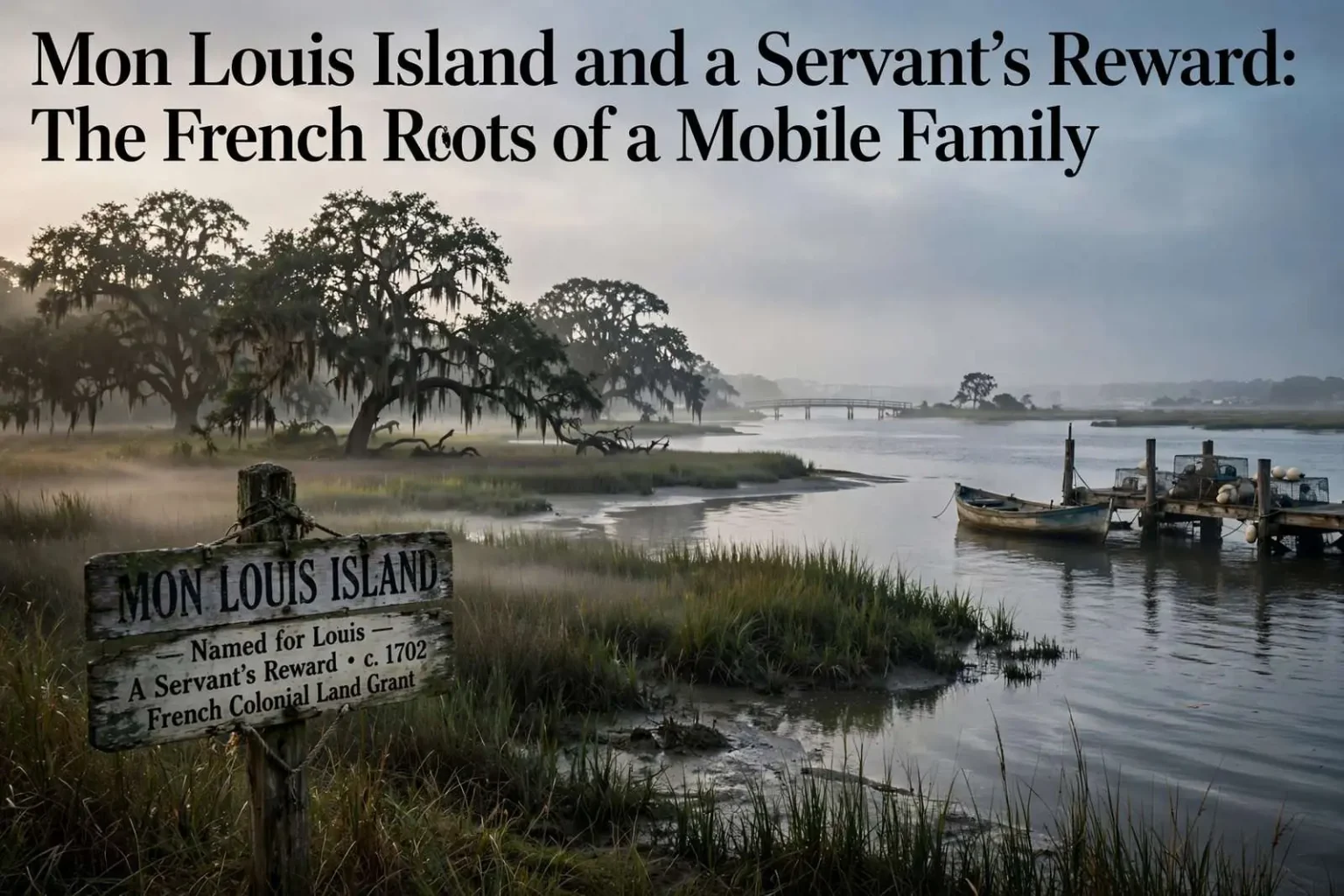
The memoir’s most enduring contribution to local lore is its account of how Mon Louis Island, the slender strip of land separating Mobile Bay from the Mississippi Sound, received its name. According to the family tradition, a French officer — variously identified as Bienville himself or a lieutenant in his command — granted the island to a loyal servant named Louis in recognition of years of faithful service. “Mon Louis” — my Louis — became the island’s designation, evolving over generations into the modern Mon Louis. The story, whether strictly factual or embellished by time, captures the personal nature of land grants in colonial Louisiana, where loyalty and service to the Crown’s representatives could elevate a servant to landowner in a single stroke. Land grants in the French colonial period were typically measured in arpents — roughly 0.85 acres — and were awarded to encourage settlement along the Gulf Coast’s waterways.
The island itself, roughly six miles long and less than a mile wide at its broadest point, has been shaped by the same forces that shaped the Walsh and LeBlanc families: hurricanes, economic shifts, and the slow mixing of cultures. In the 19th century, it supported small farms, a fishing community, and a brick kiln that supplied Mobile’s building boom. By the mid-20th century, when Sister Marie Emilie was writing her memoir, the island had become a quiet enclave of summer camps and year-round residents, connected to the mainland by a narrow bridge at the end of Dauphin Island Parkway. The Alabama State Docks’ expansion and the construction of the Theodore Industrial Canal in the 1950s altered the island’s ecology and economy, bringing industrial traffic to waters that had once been the domain of shrimp boats and oyster tongs.
The Memoirist’s Vocation
Elizabeth Zoe Walsh, the youngest of Joseph and Mary Emily’s children, entered the Sisters of Notre Dame de Namur in 1912, taking the name Sister Marie Emilie. Her religious vocation carried her far from Mon Louis Island — to teaching assignments in Cincinnati, Chicago, and Rome, where she earned a doctorate in theology. The Sisters of Notre Dame de Namur, founded in France in 1804 by St. Julie Billiart, were dedicated to education and service among the poor, a mission that resonated with the Walsh family’s own trajectory from immigrant labor to professional achievement. Yet the memoir reveals a mind that never fully left the Alabama coast. Her prose moves fluidly between the formal Latinate diction of her academic training and the colloquial rhythms of her childhood, preserving the voices of her parents and grandparents with a novelist’s ear for dialogue. The decision to serialize “The Rock Whence I Was Hewn” in the Mobile Press-Register, rather than publish it as a book, ensured that her family’s story reached a local audience that recognized the names, places, and events she described.
Sister Marie Emilie died in 1979, having witnessed Mobile’s transformation from a segregated port city to a Sun Belt metropolis grappling with integration, industrial decline, and urban renewal. The civil rights movement in Mobile, marked by the 1964 Bolden v. Mobile County School Board case and the 1969 Birdie Mae Davis desegregation order, reshaped the city’s institutions in ways that would have been unimaginable to the Joseph Walsh of the 1870s waterfront. Her memoir, read in installments over morning coffee by generations of Mobilians, became a kind of collective family album for the city’s older neighborhoods. The Walsh-LeBlanc union, with its Irish grit and French refinement, its waterfront labor and colonial pedigree, embodied the hybrid identity that has defined Mobile since its founding — a city that is Southern but not quite Deep South, Catholic but not quite Creole, American but haunted by the ghosts of French, Spanish, British, and Confederate flags that have flown over its harbor.
Mon Louis Island Today
Today, Mon Louis Island faces pressures that Sister Marie Emilie could scarcely have imagined. Rising sea levels, intensifying hurricanes, and the encroachment of industrial development threaten the island’s fragile ecology and the communities that have called it home for generations. Hurricane Frederic in 1979, Ivan in 2004, and Katrina in 2005 each reshaped the island’s coastline, while the BP Deepwater Horizon oil spill in 2010 devastated the seafood industry that sustained many island families. The Mon Louis Island Fire Department, a volunteer force housed in a modest station near the bridge, responds to emergencies across the island’s six-mile length. The island’s school, once a one-room building serving the children of farmers and fishermen, closed decades ago; children now bus to schools in Theodore and Tillman’s Corner. Yet the island retains a fierce sense of identity, celebrated each year in the Mon Louis Island Festival, where descendants of the Walsh, LeBlanc, and countless other families gather to share gumbo, stories, and the quiet pride of belonging to a place with a name that began as a servant’s reward and became a community’s inheritance.
The memoir’s final installment, published in the summer of 1968, concluded with Sister Marie Emilie’s reflection on the island’s name: “It is a small thing, perhaps, to have an island named for a servant’s fidelity. But in a world that forgets so quickly, it is not nothing.” That observation — modest, grounded, and deeply rooted in the Gulf Coast’s particular alchemy of memory and place — remains the truest measure of the memoir’s achievement. It reminds us that history on the Alabama coast is not only made by governors and generals, admirals and industrialists, but also by the sailor who carried a note, the grandmother who sent her son away, the Frenchwoman who tripped over a tree root, and the servant named Louis whose loyalty outlasted empires.