Money Talks: Filings Reveal the Shape of the 2004 Mobile County Commission Races
Pre-election campaign finance filings in May 2004 showed Mobile County Commission candidates raising tens of thousands of dollars from PACs, contractors, doctors and developers ahead of the June 1 primary.
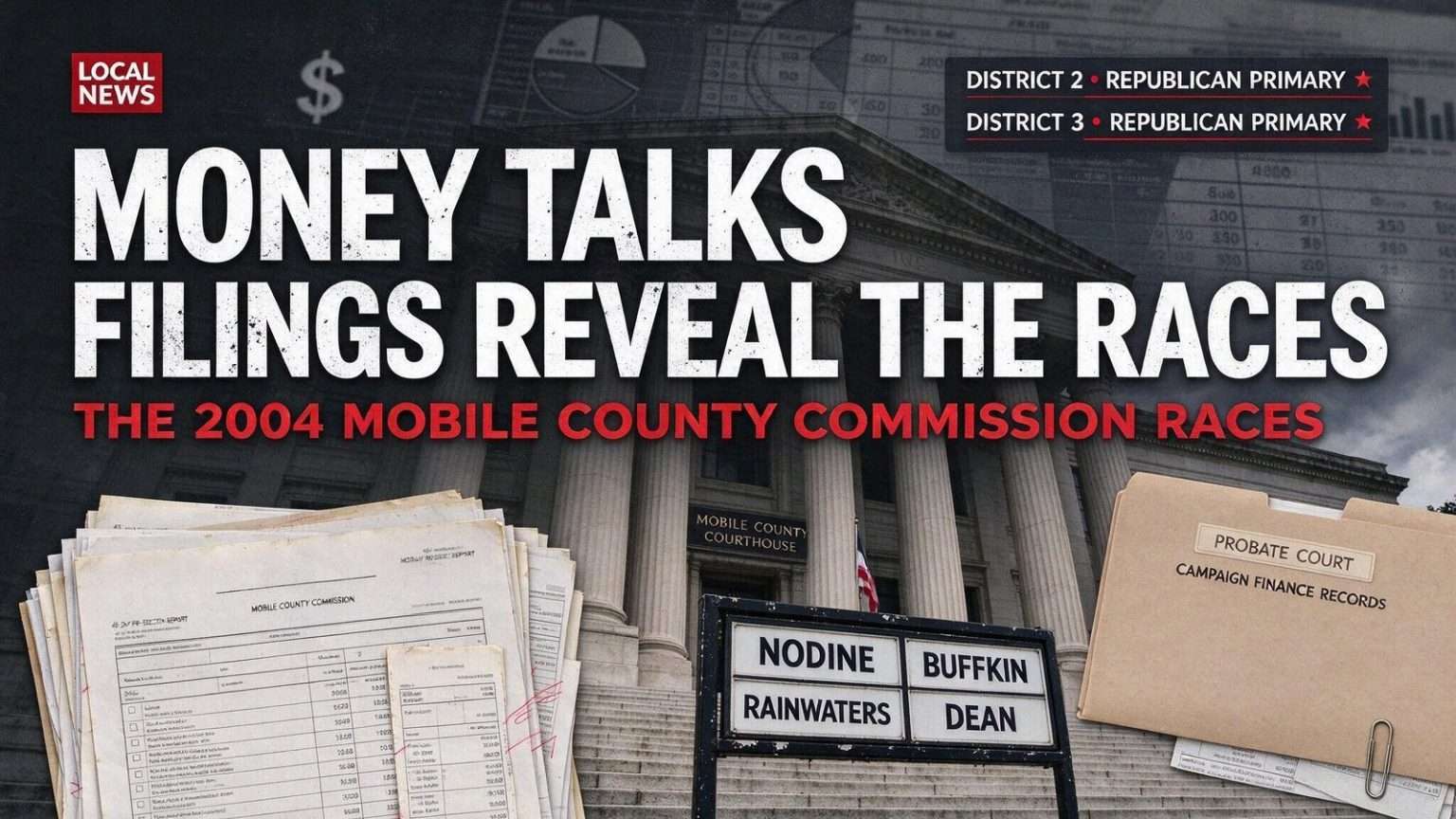
Money Talks: Filings Reveal the Shape of the 2004 Mobile County Commission Races
With the June 1 primary bearing down, candidates for the Mobile County Commission filed their 45-day pre-election campaign finance reports in late May 2004 — and the documents told a story that stump speeches rarely do. The reports, filed in probate court and open to public inspection, laid out where the money came from and how fast it was going out the door. Taken together, they showed a District 2 Republican primary that had become an expensive three-way scramble, and a District 3 race in which the incumbent held a commanding financial edge.
District 2, Republican primary
Stephen R. Nodine — The Mobile city councilman opened the period with $31,166.09 on hand and raised $31,940 in cash, plus $311.28 in in-kind support. After spending $30,283.31, his campaign closed with $32,822.78. His larger contributors ranged from Montgomery political action committees to local businesses: Gulf Coast Asphalt gave $10,000 and RSVP PAC gave $5,500, with $1,000 checks from Dan Elcan, Palmer Hamilton, S.C. Middlebrooks and James E. Mattei of Charlotte, N.C. Mobile Warehouse Co. and Rebecca Co. each gave $1,500. Waste Management, Bizpac, Telpac and a long string of physicians and contractors filled out the list.
The pattern in Nodine’s filing — road-building money, waste-hauling money, and a steady stream of medical and construction contributors — reflected the realities of a county commission seat, where the winner has a vote on road contracts, landfill matters and the county’s development decisions. A sitting city councilman with name recognition across the district, Nodine entered the final stretch with the largest bankroll of the three active campaigns.
Ralph Buffkin — A first-time candidate, Buffkin started from zero and reported $22,400 in cash contributions. He put in $3,500 of his own money; Russell C. Buffkin gave $2,000 and John P. Case gave $2,000. A cluster of physicians and attorneys — Dr. Fredrick Cushing Jr., Dr. H. Wade Faulkner, Dr. J.M. Harrison and the firm of Frazer, Greene, Upchurch & Baker — anchored his early list, along with Royal Street PAC. His filing read like the resume of a well-connected first campaign: friends, professional colleagues and a handful of established Mobile names supplying the seed money a newcomer needs to be taken seriously.
Austin L. Rainwaters — Also starting from zero, Rainwaters reported $40,390.38 in cash contributions, the largest haul of the three, and he and his wife loaned the campaign another $23,000. He spent $33,564.20 and closed with $29,826.18. Frankie Y. Rainwaters gave $9,000; Citizens for Better Roads gave $5,750; AEM LLP gave $3,000; E.L. Rainwaters gave $2,000. The Mobile Area Realtors PAC, several members of the Stimpson family, home builders and roadbuilding interests appeared throughout his filing.
Rainwaters’ donor profile was the most growth-oriented of the three — realtors, home builders and road interests backing a candidate whose campaign was already spending at a pace matching its record fundraising. The $23,000 in family loans meant the operation was running partly on borrowed money, a common practice in Alabama local races but one that puts a candidate’s personal finances behind his political fortunes.
Freeman Jockisch — The incumbent’s report reflected a campaign already collapsing. He opened with $3,224.21, took in $6,433 in cash and $837.33 in in-kind contributions, and the Jockisch family loaned the campaign $22,830.91. After $5,793.94 in spending, the report showed $26,695.91 on hand. Jockisch had by then been convicted in federal court over the handling of his campaign money and had suspended his re-election bid. His name remained on the ballot with the primary weeks away, and the filings showed a campaign kept on life support by family loans rather than by donor support.
District 3, Republican primary
Mike Dean — The incumbent commissioner opened the period $4,762.50 in debt but raised $31,495 in cash and $1,825 in in-kind support. After $13,602.76 in expenditures, he closed with $14,954.74. His donor list read like a directory of Mobile’s business establishment: Sonny Callahan & Associates and the Callahan for Congress Committee, Southern Earth Sciences, Midway Materials, Abraham and Mayer Mitchell, the law firm of Lyons and Crane, Logan U. Gewin at $1,250 and Ronald L. Gaines at $1,000, among dozens of others in the $250 to $750 range.
Dean’s filing captured what incumbency in a county commission district usually looks like: broad, moderate-sized support from the businesses, engineering firms and institutions that deal with county government regularly, plus the imprimatur of a congressman’s political operation. The $4,762.50 of opening debt was the one blemish on an otherwise commanding position, and his relatively modest spending left him holding a five-figure reserve entering the final weeks.
Michael Burdine — The veteran Mobile police officer began with nothing and raised $3,312.50 in cash, loaning his own campaign $14,500. After $6,298.72 in spending, he had $11,513.78 on hand. His itemized backers included Bayou La Batre Mayor Stan Wright, who gave $300 — a contribution that matched the mayor’s public endorsement of Burdine over Dean.
The Wright endorsement tied the challenger to the seafood-town leadership of southern Mobile County and signaled that Burdine’s appeal ran through the district’s smaller communities rather than its institutional donors. A candidate funding four-fifths of his operation out of his own pocket was running a campaign of persistence rather than money.
Howard E. Waters — The sheriff’s deputy ran the leanest operation in the field. He opened with $583.40 and reported $2,855 in contributions; he and his wife loaned the campaign $2,500. After $4,608.84 in expenditures, he was left with $1,329.56. Among his listed receipts: Rodriguez Boat Builders, S&S Materials and $500 raised at a fish fry fundraiser at the Purple Lounge.
A fish fry at a neighborhood lounge raising $500 may be the smallest number in any of the filings, but it is also the most telling: it represents a campaign funded by the community it hoped to represent, one plate and one ticket at a time. Waters’ report stood in contrast to the institutional money flowing to Dean and described a candidacy built around personal networks rather than political infrastructure.
Reading the numbers
Alabama’s campaign finance law at the time required candidates to file periodic reports itemizing contributions above a set threshold, and those filings remain among the most revealing documents in local politics. They show not only how much a candidate has, but who is betting on him — and in a county commission race, where the winner votes on road contracts, zoning and the distribution of federal grant money, the identity of the bettors matters.
The 2004 District 2 reports showed a contest in which none of the three Republicans could claim a decisive money advantage. All were spending nearly as fast as they raised, and two of the three were leaning on family loans to stay competitive. Rainwaters led in total cash raised; Nodine led in what he had accumulated from his council tenure; Buffkin trailed in raw dollars but posted the cleanest file of wholly fresh contributions. None of the three had a bankroll that would scare off the others, and with Jockisch’s suspended candidacy still on the ballot, the district’s voters faced a crowded, expensive and unsettled field.
The District 3 filings showed the opposite picture entirely — an incumbent backed by the county’s institutional business community facing two challengers financing themselves largely out of their own pockets and, in one case, out of a fish fry. Dean’s cash advantage was not enormous in absolute terms, but next to Burdine’s borrowed $14,500 and Waters’ $1,329.56 on hand, it was decisive. In local races, where television advertising is rare and campaigns are won through signage, direct mail, church visits and word of mouth, a five-figure reserve buys a saturation the challengers could not match.
Whether money would decide either contest was another question. County commission primaries in Mobile had a history of incumbents falling despite financial advantages — the same dynamics that had produced the District 2 situation, in which an incumbent’s legal troubles rather than his bankroll defined his race. The filings measured resources, not voter sentiment, and low-turnout primaries in particular can reward organization and name recognition over raw spending.
On June 1, in a rain-dampened primary with historically low turnout, the answer would prove complicated.
Why the Filings Matter
Pre-election reports of this kind serve several audiences at once. Opponents’ researchers use them to catalog an adversary’s donors; reporters use them to trace the flow of money that official campaign messages never mention; and voters — the few who ever pull the documents from probate court — use them to see whether a candidate’s promised independence is funded by the very interests he would regulate. In a jurisdiction where the commission controls hundreds of millions of dollars in annual spending, the gap between public positions and private contributors is where the real story usually sits.
The 2004 filings also preserved a portrait of Mobile County’s political economy at a particular moment: a business establishment — road builders, engineers, realtors, the medical community, the remnants of a congressional political machine — supplying nearly all of the money in both districts, while working-class and small-town candidacies scraped by on personal loans and fish fries. That asymmetry, visible in the ledgers, is the background against which every commission decision gets read.