Byrne’s Exit Set Off a Republican Scramble in Baldwin County
Bradley Byrne's move to the two-year college chancellor's office opened Senate District 32 in the most Republican county in Alabama. Party insiders handicapped a field that had not yet formed.
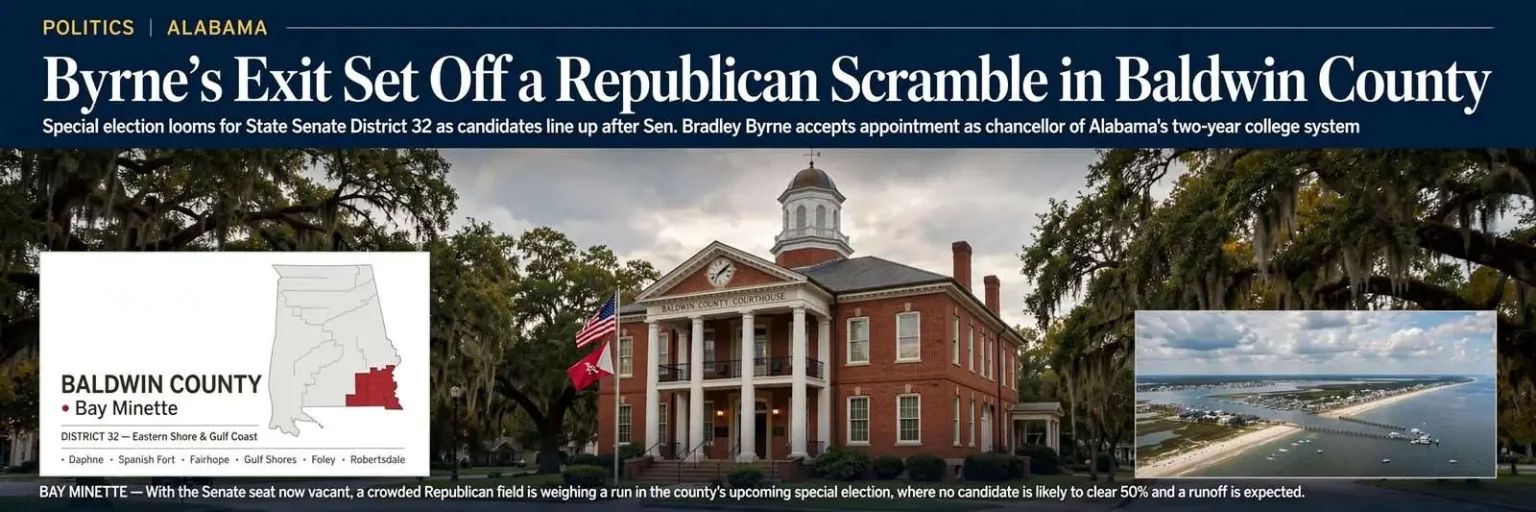
BAY MINETTE — Baldwin County was, by common consent, the reddest county in a very red state, and so the special election called to fill its state Senate seat promised to be a Republican family affair. The vacancy opened when Sen. Bradley Byrne accepted an appointment as chancellor of Alabama’s two-year college system, a post handed to him by Gov. Bob Riley at a moment when the system was engulfed in scandal. Byrne’s departure left Senate District 32 — a district anchored on the Eastern Shore and the Gulf beaches — without a senator, and the telephone lines across the county were busy over the weekend as prospective candidates counted their friends and measured their odds.
Special elections in Alabama follow rules that shape any scramble like this one. A candidate must win a majority of the vote to take the seat outright; if no one clears 50 percent, the top two finishers advance to a runoff. In a sprawling, fast-growing district where no single figure dominates, that arithmetic alone makes a runoff a reasonable starting assumption, and party veterans in Baldwin County treated it as such from the first weekend. The winner would serve the remainder of the term and face the ordinary election cycle again soon, which raised the stakes for anyone hoping to build a durable political operation in the county.
Byrne’s move to Montgomery’s executive branch was itself a story. The two-year college system, which trains thousands of students across Alabama and runs a sprawling network of campuses, had spent recent years battered by scandal — investigations into nepotism, double-dipping and questionable contracts had forced out its leadership and left the whole apparatus under scrutiny. Riley reached for a chancellor he hoped could restore credibility, and Byrne, who had built his reputation in Baldwin County public affairs, took the job. That meant the Senate district — anchored on the Eastern Shore communities of Daphne, Spanish Fort and Fairhope and stretching out to the Gulf beaches — would need a new senator.
Asked to size up a field that had not yet formally taken shape, Republican officials, officeholders and Baldwin County business figures offered a remarkably consistent set of names — and a remarkably inconsistent set of predictions.
The names in circulation
Nearly everyone began with State School Board member Randy McKinney of Gulf Shores, who had run a close race against Byrne for the same seat several years earlier. “My guess would be Randy McKinney will run and be elected,” one longtime observer said, adding that a McKinney victory would in turn open his school board seat and set off a domino effect of its own. McKinney’s service on the State Board of Education gave him a level of recognition across the district that few potential rivals could match, and his earlier Senate run meant he already had a list of donors, volunteers and precinct-level supporters ready to be reactivated.
State Rep. Randy Davis was widely thought to have the inside track on money and on the affections of Montgomery. “If he gets the endorsement from ALFA and/or the Business Council, he’ll be hard to beat,” one source said. Davis represented a coastal House district and had cultivated relationships with the interest groups that finance campaigns in Alabama — the Alabama Farmers Federation, better known as ALFA, and the Business Council of Alabama among them. Both organizations wield early endorsements and independent spending power that can swamp a rival’s fundraising in a short special election, which is precisely why handicappers watched Davis’s phone so closely.
Others mentioned Baldwin County Commissioner David Ed Bishop of Fairhope, county GOP chairman Don McGriff, former state Sen. Albert Lipscomb, former Foley Mayor Tim Russell, former District Attorney David Whetstone, state Rep. Steve McMillan and a handful of others. Each carried a distinct base: Bishop had a commission record and Fairhope roots; McGriff commanded the county party’s network; Lipscomb retained loyalists from his Senate years; Russell carried name identification across the county’s southern towns; Whetstone brought a law-and-order profile; and McMillan had ties in the beach communities. None, however, could be described as an automatic front-runner.
One name kept climbing. Trip Pittman, a Montrose businessman who ran Pittman Tractor Company and had served on the Baldwin County Planning Commission and the Alabama Commission on Higher Education, was new to elective politics but had personal financial strength the others lacked. Asked directly, Pittman removed all doubt. “I am running so I would have to pick myself in a runoff,” he said. “I am definitely running. Please let everyone know and I would appreciate whatever help and support they can give me.”
Money, name identification and a very small electorate
The consensus was that no candidate would win outright and that a runoff was close to inevitable. Beyond that, the handicappers diverged. Some believed McKinney’s recognition from statewide school board service made him the man to beat. Others thought the electorate was in a mood to punish incumbency of any kind. “I think we need a new face. Great time for a new face,” one Republican said. “Electorate is disgusted with the incumbents and the same old thing going on, i.e. giving themselves huge pay raise.”
That legislative pay raise — and the related controversy over lawmakers drawing second public paychecks, known in Alabama as double-dipping — hovered over every calculation. Lawmakers had approved the raise in 2007, lifting base legislative pay by more than 60 percent and tying it to median household income in the state, a formula critics said let sitting senators and representatives collect automatic increases without ever having to vote on one again. Combined with documented cases of legislators holding state jobs, university posts or consulting contracts while serving in office, the issue had become a lightning rod in conservative circles, and Baldwin County’s activist class had been among the loudest in protest.
One veteran put the point sharply. The special election, he said, “may be the first opportunity we will have to find out how big a factor the pay raise and double-dipping issues will be with voters. My sense is that voters may be close to the tipping point in regard to accountability and independence from the big special interests that dominate Montgomery.”
For the candidates, the practical lesson was that a message would matter as much as machinery. Special elections reward whichever campaign can best marshal its committed voters, because the casual majority stays home. In a low-turnout summer contest the electorate skews older, better informed and far more likely to have followed the pay-raise fight in Montgomery. A candidate whose record read as incumbency would have to run against it; a newcomer could run against everyone else’s.
A county of many countries
Baldwin’s geography complicated every forecast. The Eastern Shore towns of Daphne, Fairhope and Montrose, the beach communities of Gulf Shores and Orange Beach, the agricultural center around Robertsdale and Loxley, and the north end around Bay Minette all pull in different directions. “Baldwin County is strange with so many different ‘ethnic territories,'” one longtime figure observed. Another agreed that Bay Minette, Summerdale, Robertsdale, Loxley and Spanish Fort were genuinely up for grabs and might well decide the race.
The observation was more than color. Baldwin County has been Alabama’s fastest-growing county for years, drawing new residents from Mobile across the bay and from elsewhere in the country, but the growth has not been uniform. The Eastern Shore’s subdivisions and the beach corridor’s tourism economy have produced affluent, service-oriented constituencies; the central and northern farm belt remains more traditional and more locally rooted. A candidate strong in Fairhope could be anonymous in Bay Minette, and a campaign built in Gulf Shores might never reach Spanish Fort. Winning would require stitching together coalition politics across communities that barely share a local newspaper, and no one in the weekend conversation pretended the task was simple.
Several sources warned that Lipscomb, whatever his fundraising limits, retained a devoted conservative base that could matter enormously in a low-turnout summer contest. “Late summer low turnout, Lipscomb makes the runoff,” one predicted. “Can the other candidates turn out their supporters and overcome his hard right support?” Lipscomb had served in the Senate during an earlier era of Baldwin County politics and had been a reliable vote for conservative causes; his backers, the reasoning went, would show up in a special election precisely when most of the county ignored it.
As for the Democrats, expectations were modest. “Even money that they won’t run anyone,” one source said, “and, if they do, it will be token opposition for the sole purpose of not leaving the seat uncontested.” Baldwin County’s registration has tilted heavily Republican for a generation, and no Democrat had seriously contested the district in years. A token candidate would serve mainly to keep the party’s name on the ballot and to deny the winner the claim of an unopposed mandate.
Whoever emerged, the same figure noted, would inherit a district growing faster than its roads, its schools and its insurance market could comfortably absorb. Baldwin’s population boom had already strained Highway 59, the Eastern Shore’s arterial roads and the county’s school construction budgets, and coastal homeowners were still wrestling with rising premiums and shrinking availability of property insurance in the years after the Gulf’s recent hurricanes. A new senator would step into those fights immediately, and every candidate weighing the race understood that the district’s problems would define the campaign as much as the candidates themselves.
“Baldwin County is blessed,” one Republican concluded. “We have several candidates who would do a good job in the Senate.” With Pittman formally in and the rest of the field still counting friends and measuring odds, the scramble that began over the weekend telephones was only going to widen. What the handicappers could agree on was that the runoff math would hold: too many credible names, too small and too scattered an electorate, and a seat that had just become the county’s most watched prize.